Viking Funerals have long been a tradition at Railway and this week we’re shipping out to sea one of our earliest and most important innovations — the database plugin.
Let’s have a moment of silence for plugins, please, for they served us well.
.
..
…
..
.
Thank you.
It’s now time to usher in the post-plugin era.
All aboard and please mind the gap. 🫡
Plugins Have Been Deleted

The day is finally here that we can bid farewell to the age of plugins and welcome in the age of Database Services.
This has been a long time coming.
We first announced this structural change during Launch Week 01 and in total we’ve dedicated space in more than half a dozen changelogs and many rounds of email blasts to let you know all about this upcoming change.
What you need to know:
- Legacy plugins have been deleted across all of Railway
- We’ve archived active database plugins and will make the data available on request for six months, until August 23, 2024
- To request a copy of your archived plugin, please reach out using the Database Migration thread in the Help Station — we will be happy to help you retrieve your archive
On a practical note, we’re so excited for what this means — among other things, Database Services provide data persistence, flexible configuration and management, and connectivity over the public internet or private networking.
On a strategic note, this completed migration greatly accelerates our effort to ween off of Google Cloud and into a future where we’re racking and stacking servers around the world and passing on the savings and performance gains to you.
Needless to say, we’re excited for this journey.
Onward!
Service Groups Beta
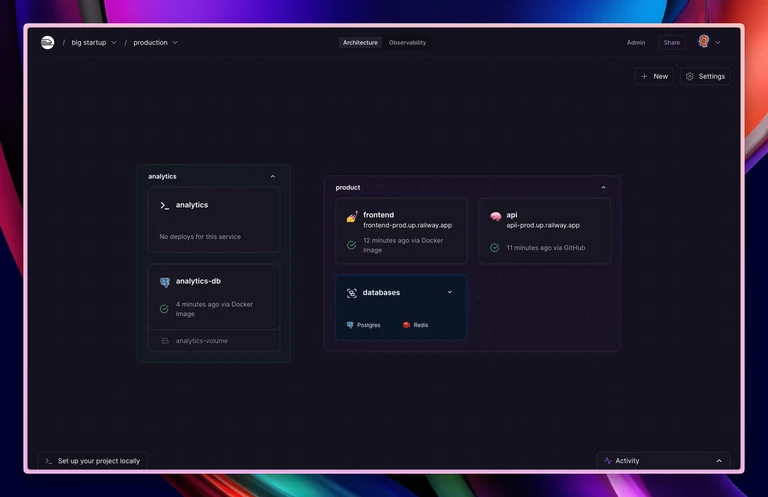
As Railway is growing, we’re experiencing a precambrian explosion of complexity in user projects. The median number of services per project is going up, up, up and in response we’ve been designing better ways to organize ever-more-complex application stacks.
Following the Service Groups Preview from late last year, today we’re introducing the next implementation of Service Groups, which we’re labeling Service Groups Beta.
Here’s what’s new:
- We’ve introduced the first bit of multiplayer functionality. Groups and node positions on the canvas are the same for everyone on your team. (In the future this will be realtime!)
- We now show what’s inside collapsed groups
- We now allow groups to be nested inside other groups (see
Databasesabove!) - We fixed a number of issues when moving services between groups
- We designed better group and node context menus
To get started with Service Groups Beta, head over to your Feature Flags settings page and enable the Canvas Service Groups toggle.
Enjoy!
Improved Template Deploy Flow
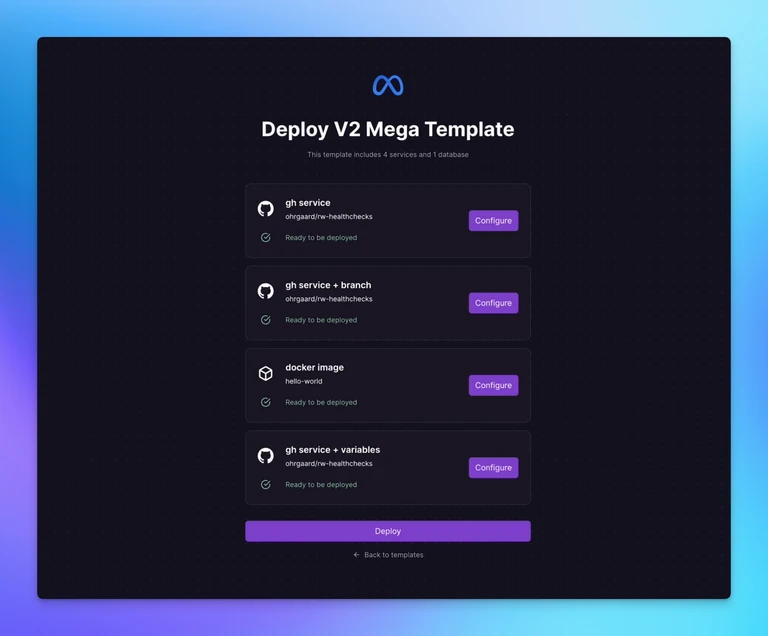
The past few weeks have been an exciting time for Templates:
- We started teasing the new Template Composer
- We introduced Template Metrics and Template Health Indicators
- We crossed $10K in kickback payouts
- We nearly crossed 500 templates in the Template Library
So what’s next?
Well this week we shipped a small but important improvement to the template deploy flow to make the experience easierfastercleanerbetter.
The tl;dr is that unlike before, when you deploy a template with one or more GitHub repos as dependencies, we will no longer need to clone/fork those into your GitHub account.
Instead, we can now use the repo itself as the source (rather than a copy of it) making the entire thing much cleaner and easier to work with.
Does that sound good? We think so too.
To get started, head over to your Feature Flag settings page and enable the Template Deploy V2 toggle.
Billing Thresholds Arrive Next Week
We wanted to let you know that in an effort to increase the quality of Railway’s service offerings, we’re going to start selectively introducing billing thresholds next week.
What this means is that while billing amounts won’t change at all, a small subset of users will be charged a partial amount of their bill earlier in the billing cycle.
We’re doing this because like any cloud company we deal with fraud and this is an effort to identify risky accounts earlier in the billing cycle so they don’t clog up our books with unpaid invoices.
This change will afford us a healthier “meantime to fraud identification” and let us focus on what we do best, which is build infrastructure for you to deploy your applications and run your business.
We hope that makes sense. As mentioned, the vast majority of our users will experience no change whatsoever.
Thanks for your continued support.
Fixes and Improvements
- We’re starting to think about writing some new Monitoring and Alerting features → tell us what you’d like to see!
- We made a number of improvements to the invite system
- We added support for deploying from branches of a public GitHub repo when deploying the repo directly via the URL
- We added the ability to delete an unpublished template from a team account