This week we got people merging PRs from the driver’s seat (on Railway, no less), and a database company’s stock rocketed so high, its CEO is now the richest person alive.
Speaking of data storage solutions, we’re cooking up something big ourselves: object storage on Railway.
This has been a highly requested feature, and we’re finally exploring it. But before we build, we’d love your input:
- What would you use object storage for on Railway?
- How are you handling it today, and what’s painful (or delightful) about that workflow?
- Which features matter most? (S3 API compatibility, versioning, TTL/lifecycle, public vs. private buckets, CDN integration, etc.)
Drop by this Central Station post and let us know. Your input will shape how this ships, don’t miss your chance to influence it.
Now, onto the new stuff that shipped this week, which includes first-class support for Monorepos, verified templates and replica metrics 🚄
Let’s go!
First-Class Support for Monorepos
Import JS monorepos when creating a new projectDeploying monorepos on Railway has technically been possible for a while, but the experience... wasn’t the greatest. You had to manually deploy each service, deploys would fail the first time because the root directory wasn’t set up right, and overall it felt clunky.
Not anymore. Railway now has first-class support for monorepos!
Starting with the JavaScript ecosystem (npm, pnpm, yarn, and Bun workspaces), you can import your monorepo straight from GitHub and we’ll:
- Auto-detect packages and stage a service for each one
- Configure watch paths and try to infer your start/build commands (so you don’t have to)
We'll be expanding support for more languages and tooling soon.
Give it a spin by going to dev.new/github, and let us know in Central Station if you hit any issues or have feedback.
Verified Templates
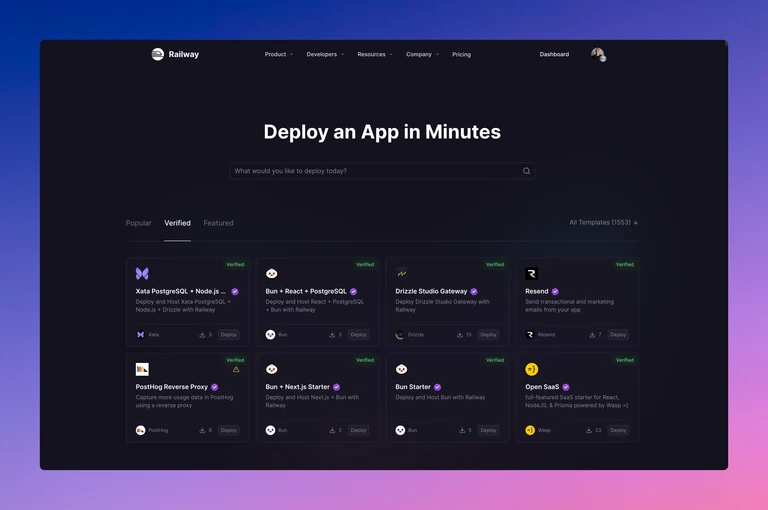
The Railway Templates Marketplace now has over 1,500 templates ready to one-click deploy — from full-stack apps and databases to AI automations and full-blown SaaS projects.
Anyone can submit a template, and template creators earn every time someone deploys theirs. But with so many options, we’re adding an easy way to spot templates that are actively maintained.
Enter Verified Templates:
- Always kept up-to-date
- Backed by our new Partner Program
- Easy to find under the shiny new Verified tab
We have verified templates from Redis, Bun, Prisma, PostHog, Drizzle, Cal, Wasp, ParadeDB, Resend, Xata and more coming soon.
Our marketplace is already powering nearly $3M in GMV today — and we see the path to $1B. Check out the full announcement post to learn about the vision behind Railway’s partner program. If you think your company would be a good fit for Verified Templates, apply to become a partner— we’d love to work with you.
Replica Metrics to Priority Boarding
View replica metricsNow available in Priority Boarding: Replica metrics.
When running multiple replicas for a service, it wasn’t obvious which replica was doing the heavy lifting and which was just chilling in the background. Now you can view metrics for all replicas where you can:
- View performance data for every replica
- Spot when one replica is handling more load than the others
- Decide if scaling or rebalancing is needed
Try it out and if anything feels off, drop us a note in Central Station.
Fixes and Improvements
- We fixed noisy deploy behavior for monorepos: changes outside watch patterns no longer trigger skipped builds or create unnecessary “temporarily deployed” updates in the dashboard (e.g. a README update in your monorepo’s root directory shouldn’t trigger a service deployment). The Railway GitHub bot also respects this change, so PRs won’t get extra deploy events
- We improved the experience of integrating the Railway MCP server with other MCP clients by adding it to the official MCP registry. It is listed at this URL
- We shipped mirrored versions of the most highly used Bitnami images into our own DockerHub registry. This is to maintain template deployment continuity by their planned deprecation date of September 29th, 2025. You can read more info about the planned deprecation from VMWare/Broadcom here.