
Deploy Automatisch
No-code visual workflow builder that connects your apps and automates tasks

Just deployed
/var/lib/postgresql/data
automatisch-worker
Just deployed
automatisch
Just deployed

mailpit
Just deployed
/data
Redis
Just deployed
/data
Deploy and Host Automatisch on Railway
Automatisch is an open-source business automation tool — a self-hosted Zapier alternative that connects services like Slack, GitHub, Google Sheets, Telegram and Stripe into workflows you build visually, with no code. Pick a trigger, chain actions onto it, map data between steps, and publish. Teams self-host Automatisch when the data in those workflows cannot leave their own infrastructure — customer records, invoices, support tickets — which is why it turns up in healthcare, finance and GDPR-bound European companies. It is AGPL-licensed, so there is no per-task pricing and no lock-in.
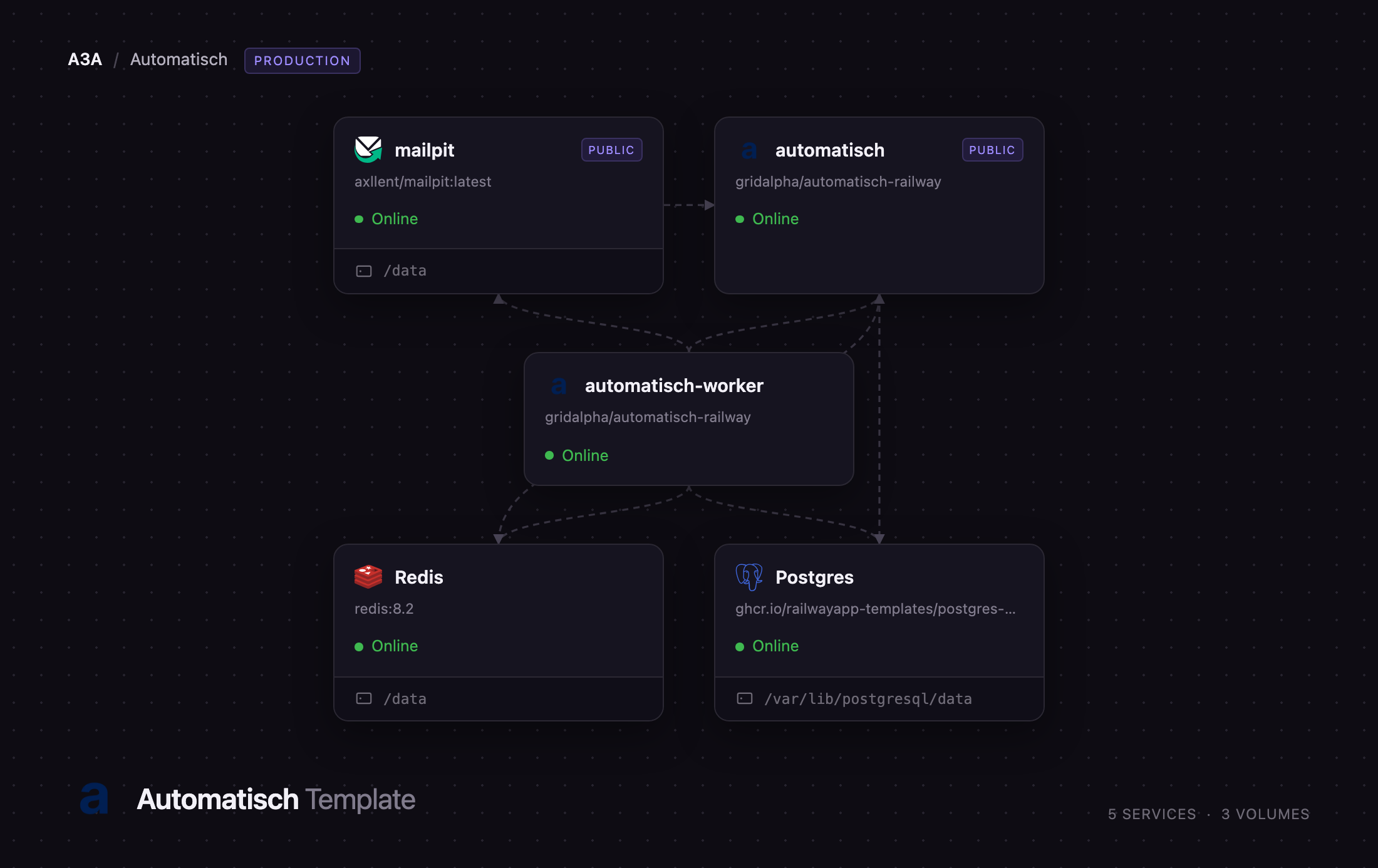
This template runs Automatisch in the shape its own production docs describe, not one all-in-one container. automatisch serves the web UI, the REST API and the public webhook endpoint. automatisch-worker is a separate BullMQ worker that executes flows, polls triggers and sends mail, so a slow third-party API never blocks a page load. Postgres stores flows, encrypted credentials, execution history and the built-in datastore; Redis carries the job queues; mailpit captures password-reset and invitation mail so those flows work on the first deploy with no SMTP account. Only the app and the inbox get public URLs.
Getting Started with Automatisch on Railway
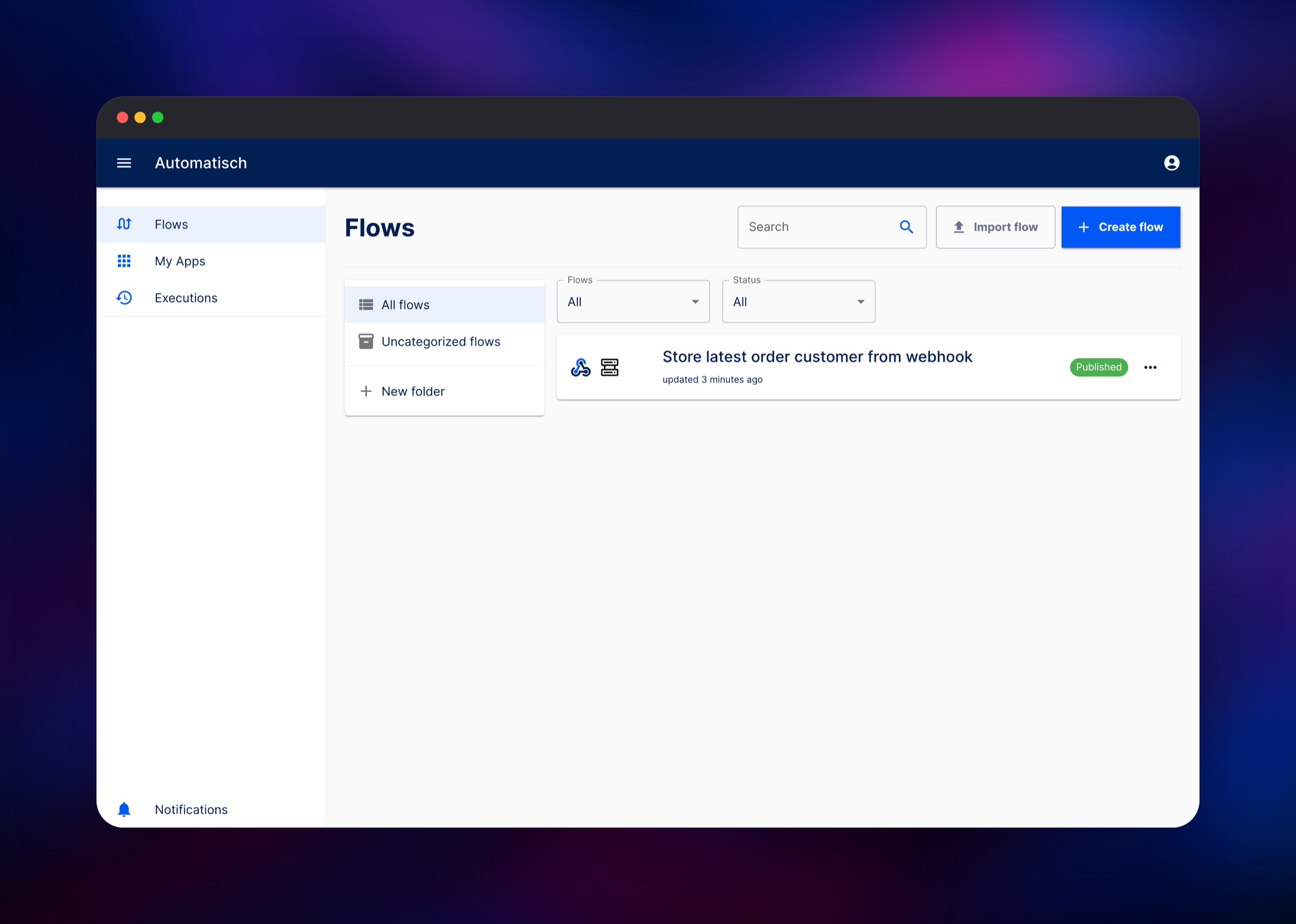
Set ADMIN_EMAIL and ADMIN_PASSWORD before deploying — they become your first administrator, created inside the container before the app accepts a request. The stock image instead seeds the well-known user@automatisch.io / sample login from Automatisch's README, so your instance never serves default credentials. Open the deployed URL, sign in, and you land on the Flows screen.
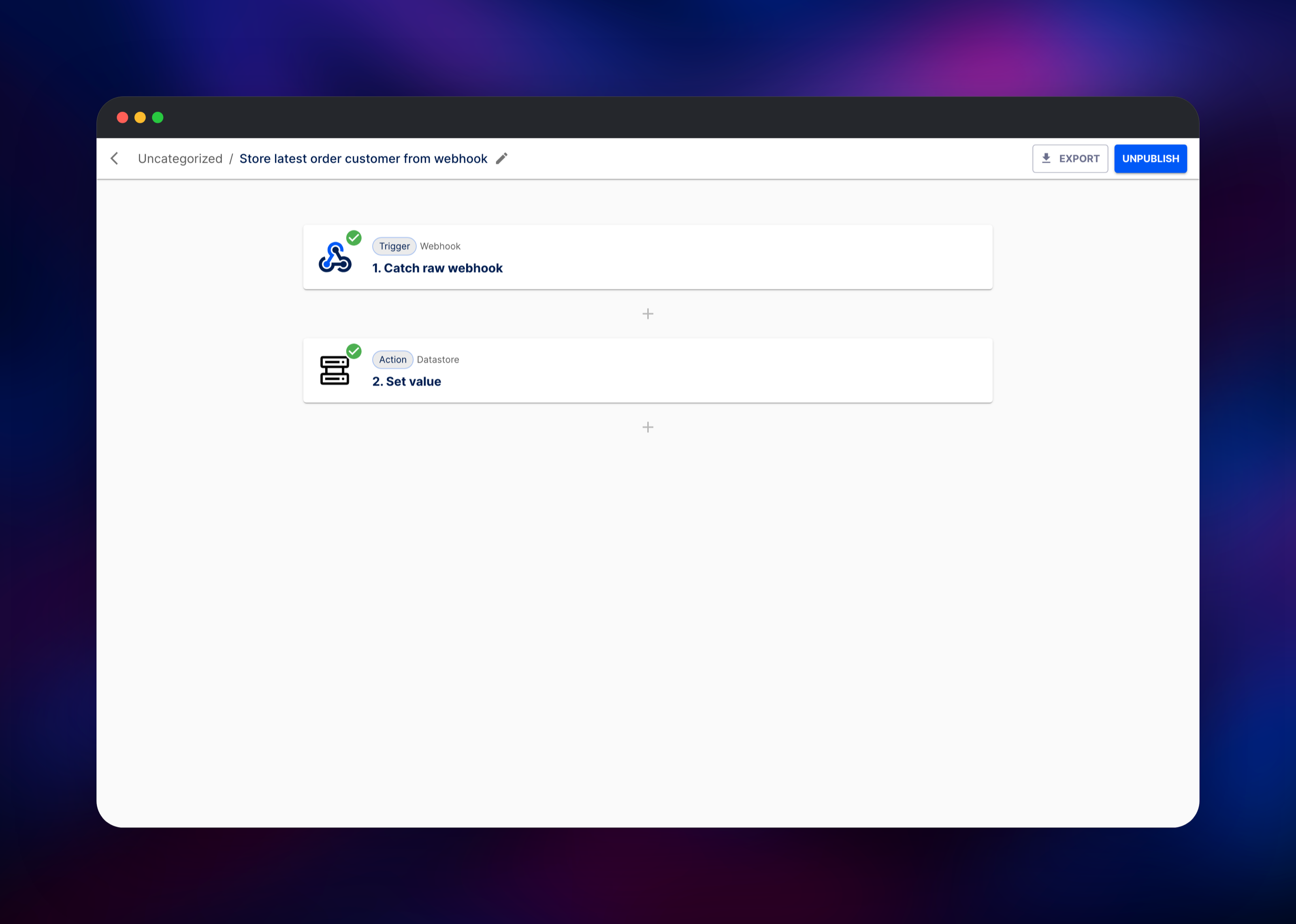
Click Create flow, choose an app for the trigger, then an event. Webhook → Catch raw webhook proves the deployment end to end with no third-party account: Automatisch gives you a webhook URL, you send it a JSON payload, and Test & Continue captures it as sample data. Add a second step — Datastore → Set value pairs well — and map a trigger field into it. Publish, send the webhook again, and open Executions: a successful run means the endpoint, the queue and the worker are all working.
To connect real services, open My Apps and add a connection with that provider's OAuth or API credentials; Automatisch encrypts them with your ENCRYPTION_KEY. Queue health lives at /admin/queues.
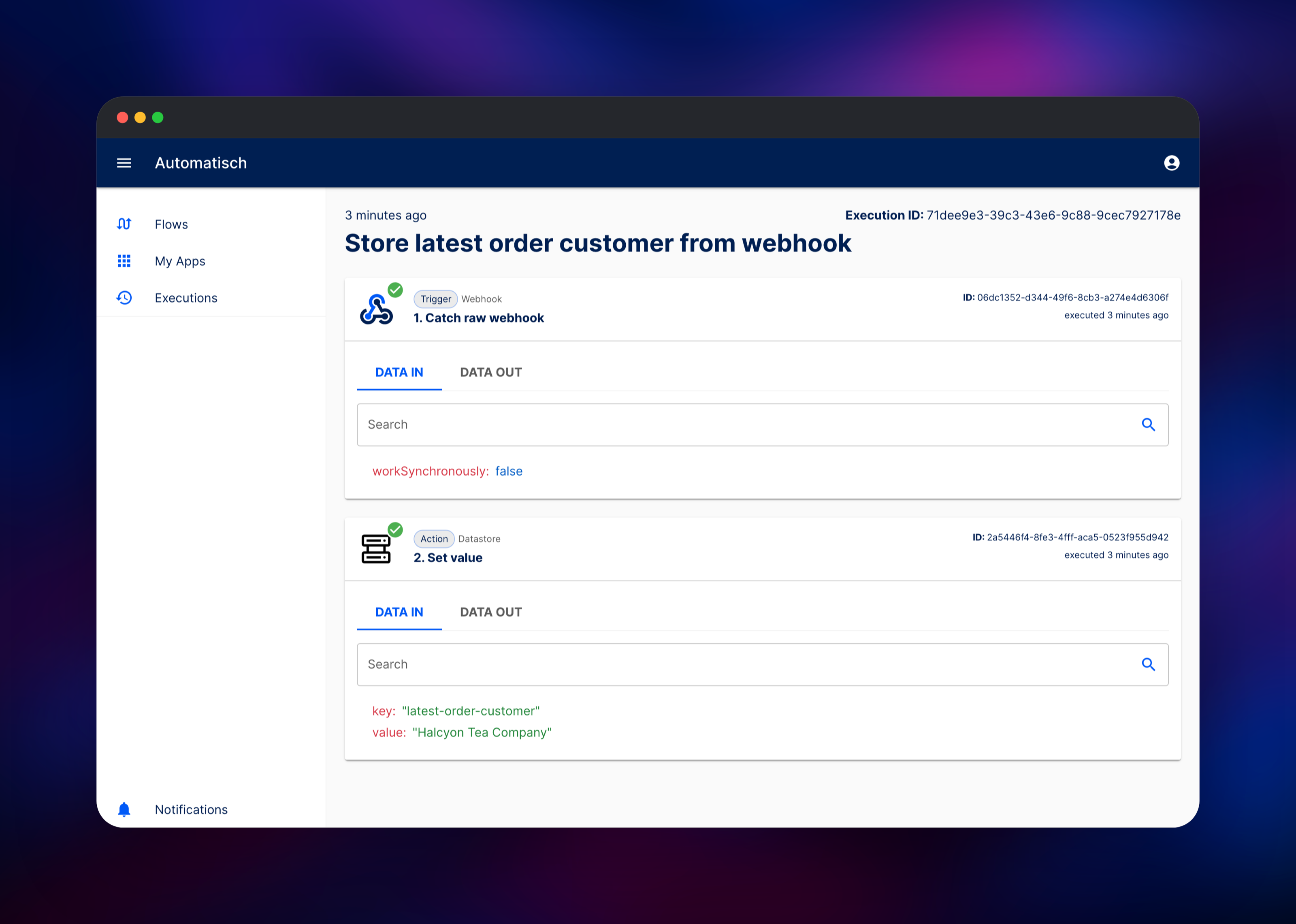
About Hosting Automatisch
Automatisch is narrower than a general-purpose workflow engine: it connects service A to service B when something happens, with a UI a non-developer can drive. Self-host it when the workflows carry data you would rather not hand to a vendor, or when per-task pricing has become the dominant cost.
- Visual flow editor with a variable picker that maps data between steps
- Around 80 integrations, plus helpers: Formatter, Filter, Delay, HTTP Request, Datastore
- Incoming webhooks with a per-flow URL; instant or polled triggers
- Encrypted storage of every connected account's credentials
- Execution history with per-step input and output, so a failed run is debuggable
- Multi-user support with an admin role
The split matters before you scale. automatisch handles HTTP, enqueues work and runs migrations on boot; automatisch-worker consumes the queues and runs the flow steps. Both build from the same image and must stay on the same version, since they share one schema and queue format.
Why Deploy Automatisch on Railway
Railway removes the compose file and the server:
- App, worker, Postgres, Redis and mail inbox provisioned together, already wired
- Private networking, with public URLs only where they are needed
- TLS and a domain on the app service out of the box
- Secrets generated at deploy time, not copied from a sample file
- Vertical scaling and worker replicas without touching a host
Common Use Cases
- Ops notifications: post to Slack when a Stripe payment succeeds or a GitHub issue opens
- Lightweight ETL: catch an internal webhook, reshape it with Formatter, append a Google Sheets row
- CRM and billing glue: create a Pipedrive deal or an Invoice Ninja invoice from a form submission
- Scheduled housekeeping: a daily Scheduler flow that queries an API and files the result
Dependencies for Automatisch
automatischandautomatisch-worker— built from gridalpha/automatisch-railway, a thin layer overautomatischio/automatisch:0.15.0Postgres—ghcr.io/railwayapp-templates/postgres-ssl:18, the durable store for flows, credentials and executionsRedis—redis:8.2, the BullMQ queue backendmailpit—axllent/mailpit:latest, an SMTP sink with a web inbox
Environment Variables Reference
| Variable | Purpose |
|---|---|
ADMIN_EMAIL, ADMIN_PASSWORD | The first administrator, created before the app serves |
ENCRYPTION_KEY | Encrypts credentials for connected apps — changing it orphans existing connections |
API_URL, WEB_APP_URL, WEBHOOK_URL | The public base URL every generated webhook URL is built from |
POSTGRES_*, REDIS_* | Database and queue host, port and credentials |
WORKER | Set to true on the worker service only |
SMTP_*, FROM_EMAIL | Outbound mail; point these at a real relay to send outside the template |
ENABLE_BULLMQ_DASHBOARD | Serves the queue dashboard at /admin/queues behind basic auth |
TELEMETRY_ENABLED | Set to false here; upstream defaults it to true |
Deployment Dependencies
- Source: github.com/automatisch/automatisch
- Image: automatischio/automatisch
- Docs: automatisch.io/docs
- Runtime: Node.js 22 on Alpine, PostgreSQL 18, Redis 8
Hardware Requirements for Self-Hosting Automatisch
| Resource | Minimum | Recommended |
|---|---|---|
| CPU | 1 vCPU | 2 vCPU |
| RAM | 1 GB across app and worker | 2 GB or more |
| Storage | 1 GB Postgres | 5 GB, growing with history |
| Runtime | Node.js 22, PostgreSQL 14+, Redis 6+ | PostgreSQL 18, Redis 8 |
Execution history is what grows, so watch the database volume rather than the app containers.
Self-Hosting Automatisch with Docker
The project's quick start clones the repository and uses its Compose file:
git clone https://github.com/automatisch/automatisch.git
cd automatisch
docker compose up
That gives you the default login user@automatisch.io / sample, which you must change immediately. To run the image directly, supply the database, queue and key variables yourself. This starts the web role:
docker run -d --name automatisch -p 3000:3000 \
  -e APP_ENV=production \
  -e POSTGRES_HOST=postgres -e POSTGRES_DATABASE=automatisch \
  -e POSTGRES_USERNAME=automatisch -e POSTGRES_PASSWORD=changeme \
  -e REDIS_HOST=redis \
  -e ENCRYPTION_KEY=$(openssl rand -base64 36) \
  -e WEBHOOK_SECRET_KEY=$(openssl rand -base64 36) \
  automatischio/automatisch:0.15.0
Add a second container with -e WORKER=true and no published port for the worker. Keep the keys identical across both and stable across restarts — regenerating ENCRYPTION_KEY orphans every stored connection.
How Much Does Automatisch Cost to Self-Host?
Automatisch Community Edition is free and open source under AGPL-3.0, with no task limits and no seat count. Files named .ee. fall under a separate Enterprise licence and unlock extras such as SAML single sign-on behind a LICENSE_KEY; nothing here needs one. On Railway you pay for compute and storage only.
FAQ
What is Automatisch?
An open-source workflow automation tool that connects services such as Slack, GitHub, Stripe and Google Sheets, letting you build automations visually instead of writing integration code. A self-hosted Zapier alternative.
What does this Railway template deploy?
Five services: the Automatisch web app, a separate queue worker, PostgreSQL, Redis and a Mailpit inbox. Only the app and the inbox get public URLs.
Why does the template include Redis and a separate worker service?
Every flow runs through BullMQ job queues held in Redis, and the worker process consumes them. Without both, published flows would never execute — triggers would fire and nothing would happen.
Do I need an SMTP server to run self-hosted Automatisch?
No. Mailpit captures outgoing mail, so password resets and invitations are visible in its web inbox immediately. To deliver mail for real, point the SMTP_* variables at your own relay.
Can I scale Automatisch to handle more executions?
Yes. The worker is stateless and coordinates through Redis, so adding replicas increases throughput. Keep app and worker on the same image version, since they share one schema.
Is Automatisch still maintained?
The current release is 0.15.0 and upstream commit activity slowed noticeably in early 2026. The community edition is stable and self-contained, so it stays a reasonable choice for straightforward integrations; if you need a large catalogue under active development, compare it with n8n.
Template Content
automatisch-worker
gridalpha/automatisch-railwayautomatisch
gridalpha/automatisch-railwaymailpit
axllent/mailpit:latestRedis
redis:8.2