
Deploy Baserow | No-Code Database on Railway
Self-host Baserow. The open-source Airtable alternative on Railway
DB

Redis
Just deployed
/data

Just deployed
/var/lib/postgresql/data
Baserow
Just deployed
/baserow/data

Deploy and Host Baserow on Railway
Deploy Baserow on Railway to get a fully self-hosted no-code database platform in minutes. Baserow is an open-source Airtable alternative that lets teams build databases, automations, apps, and AI agents without writing code. Self-host Baserow on Railway to keep full control of your data while getting the simplicity of a managed spreadsheet-database hybrid.
This Railway template deploys Baserow with PostgreSQL for persistent storage and Redis for caching and real-time features, all pre-configured and ready to use.
Getting Started with Baserow on Railway
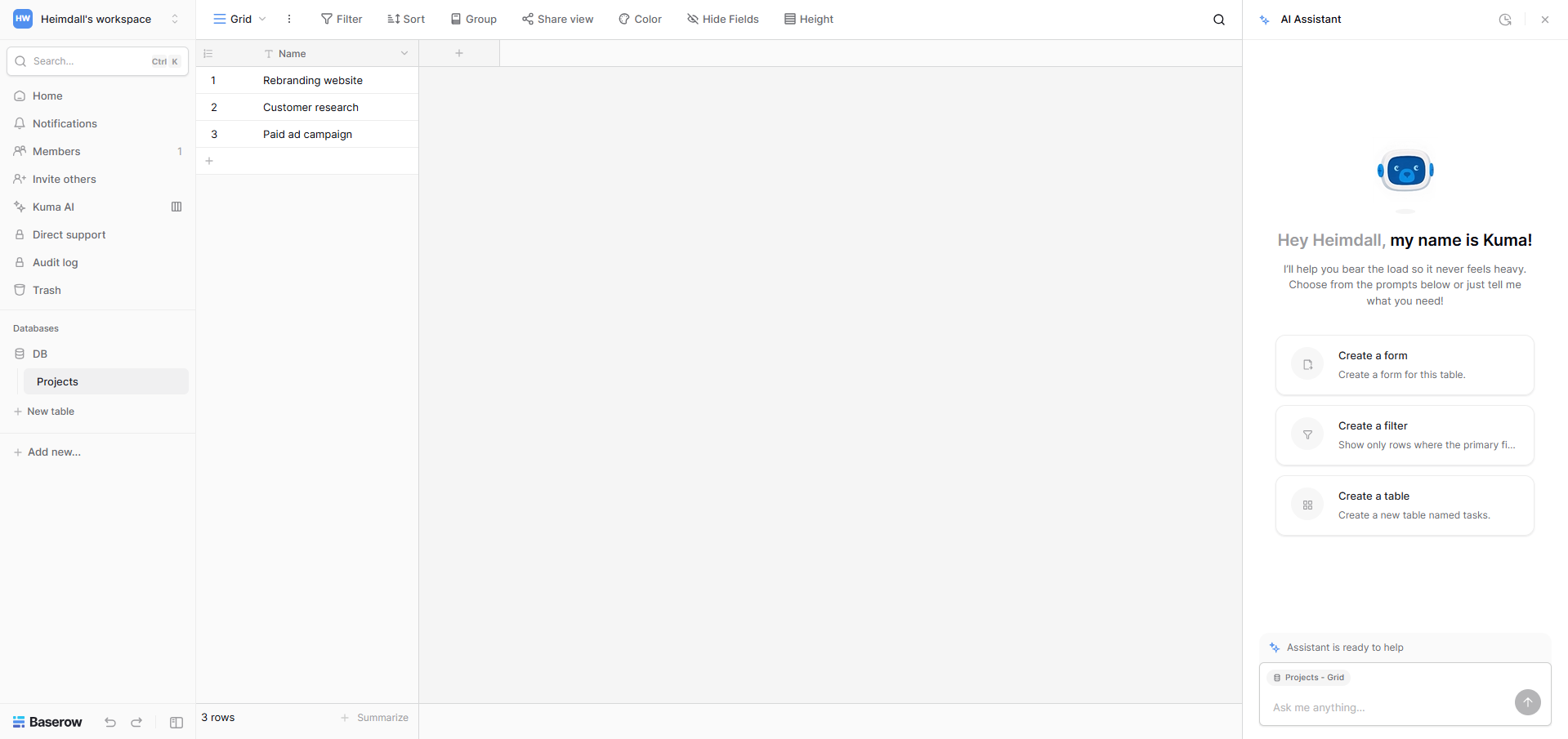
Once deployed, open the generated Railway URL. You'll see the Baserow signup page. Create your first admin account by entering your email and a password. After registration, you land in the dashboard where you can create your first workspace and database.
Click Create new to add a database. Baserow gives you a spreadsheet-like grid view by default. Add fields (text, number, date, link, file, formula) to define your schema, then start adding rows. Switch between Grid, Kanban, Gallery, Calendar, Form, and Survey views using the view selector at the top.
To invite team members, go to Members in the sidebar and share your workspace. All changes sync in real-time across all users.
About Hosting Baserow
Baserow is a privacy-first, open-source no-code platform trusted by over 150,000 users. It provides the power of a relational database with the simplicity of a spreadsheet. Key features include:
- Multiple views — Grid, Kanban, Calendar, Gallery, Form, and Survey views on the same data
- Linked records — Relate tables together with foreign-key lookups and rollups
- Built-in automations — Trigger actions on row create/update/delete (send email, call webhook, update row)
- Application builder — Build custom interfaces and dashboards on top of your data
- Real-time collaboration — Multiple users can edit simultaneously with live updates
- REST API — Full CRUD API for every table with token-based authentication
- GDPR, HIPAA, SOC 2 compliant — Enterprise-grade data governance when self-hosted
The template runs Baserow's all-in-one Docker image with an external PostgreSQL database and Redis cache for production reliability.
Why Deploy Baserow on Railway
- One-click deploy with PostgreSQL and Redis pre-configured
- No Docker, Kubernetes, or server management needed
- Automatic TLS certificates and public URL
- Persistent volume for file uploads and media
- Scale resources up or down from the Railway dashboard
- Full data ownership — no vendor lock-in
Common Use Cases for Self-Hosted Baserow
- Internal CRM and project tracker — Replace spreadsheets with linked records, filters, and Kanban boards for managing leads, tasks, or inventory
- Data collection and surveys — Create form and survey views to collect structured data from customers or team members directly into your database
- Workflow automation — Use built-in automations or connect to n8n/Zapier to trigger actions when rows change (send notifications, sync to other systems)
- Custom internal tools — Use the application builder to create dashboards, portals, and admin panels without writing frontend code
Dependencies for Baserow on Railway
- Baserow —
baserow/baserow:2.0.0— all-in-one image with backend (Django/Gunicorn), frontend (Nuxt.js), Caddy reverse proxy, and Celery workers - PostgreSQL — Railway-managed Postgres for relational data storage
- Redis — Railway-managed Redis for caching, real-time updates, and Celery task queue
Environment Variables Reference for Baserow
| Variable | Example Value | Description |
|---|---|---|
SECRET_KEY | (64-char hex string) | Django signing key for sessions and tokens |
DATABASE_URL | ${{Postgres.DATABASE_URL}} | PostgreSQL connection string |
REDIS_URL | ${{Redis.REDIS_URL}} | Redis connection string |
BASEROW_PUBLIC_URL | https://${{RAILWAY_PUBLIC_DOMAIN}} | Public-facing URL with https prefix |
BASEROW_AMOUNT_OF_WORKERS | 1 | Number of Celery background workers |
BASEROW_AMOUNT_OF_GUNICORN_WORKERS | 2 | Number of REST API workers |
BASEROW_TRIGGER_SYNC_TEMPLATES_AFTER_MIGRATION | false | Disable template sync on first boot |
Deployment Dependencies
- Runtime: Python 3.x (backend), Node.js (frontend), Redis, PostgreSQL 12+
- Docker Hub: baserow/baserow
- GitHub: baserow/baserow
- Docs: baserow.io/docs/installation/install-with-docker
Hardware Requirements for Self-Hosting Baserow
| Resource | Minimum | Recommended |
|---|---|---|
| CPU | 1 vCPU | 2 vCPU |
| RAM | 2 GB (app) + 1 GB (Postgres) + 1 GB (Redis) | 4 GB (app) + 2 GB (Postgres) + 1 GB (Redis) |
| Storage | 10 GB | 20 GB+ (scales with uploads) |
| Runtime | Docker 20.10+ | Docker 24+ |
Self-Hosting Baserow with Docker
The fastest way to self-host Baserow is with the all-in-one Docker image:
docker run -d \
  --name baserow \
  -p 8080:80 \
  -v baserow-data:/baserow/data \
  -e BASEROW_PUBLIC_URL=http://localhost:8080 \
  baserow/baserow:2.0.0
For production with an external PostgreSQL and Redis:
docker run -d \
  --name baserow \
  -p 8080:80 \
  -v baserow-data:/baserow/data \
  -e BASEROW_PUBLIC_URL=https://baserow.example.com \
  -e DATABASE_URL=postgresql://user:pass@db-host:5432/baserow \
  -e REDIS_URL=redis://:password@redis-host:6379 \
  -e SECRET_KEY=$(openssl rand -hex 32) \
  -e BASEROW_AMOUNT_OF_WORKERS=1 \
  -e BASEROW_AMOUNT_OF_GUNICORN_WORKERS=2 \
  baserow/baserow:2.0.0
Is Baserow Free to Self-Host?
Baserow's core is fully open source under the MIT license. Self-hosting is free with unlimited rows, storage, and users. There's no time limit or feature gate on the open-source edition. Railway costs are infrastructure only (compute, database, storage). Optional paid add-ons (premium views, RBAC, SSO) are available through Baserow's self-hosted premium license starting at ~$12/user/month.
Baserow vs Airtable: Why Self-Host on Railway?
| Feature | Baserow (Self-Hosted) | Airtable |
|---|---|---|
| Pricing | Free (open source) + infra costs | $20/user/month (Team plan) |
| Row limits | Unlimited | 50,000 per base (Team) |
| Data ownership | Full — your servers | Airtable's cloud |
| Self-hosting | Yes (Docker) | No |
| API | Full REST API | REST + limited GraphQL |
| Automations | Built-in + webhooks | Built-in + Zapier |
| Application builder | Yes (no-code) | Interfaces (limited) |
For teams that need data sovereignty, unlimited scale, or want to avoid per-seat pricing, self-hosted Baserow on Railway is a compelling alternative.
FAQ
What is Baserow and why should I self-host it? Baserow is an open-source no-code database platform and Airtable alternative. Self-hosting gives you full data ownership, no row limits, no per-seat pricing, and compliance with data residency requirements (GDPR, HIPAA).
What does this Railway template deploy for Baserow? The template deploys three services: Baserow (the all-in-one Docker image with backend, frontend, and workers), PostgreSQL (for data storage), and Redis (for caching and task queues). All services are pre-configured to communicate via Railway's private network.
Why does Baserow need PostgreSQL and Redis? PostgreSQL stores all your databases, tables, rows, user accounts, and configuration. Redis handles caching, real-time collaboration events, and serves as the message broker for Celery background workers (automations, exports, imports).
How do I connect Baserow to n8n or Zapier for workflow automation? Baserow has official integrations for both n8n (built-in Baserow node) and Zapier (triggers and actions). You can also use Baserow's built-in webhook system to send events to any HTTP endpoint when rows are created, updated, or deleted. Enable webhooks from the database settings menu.
Can I migrate my Airtable data to self-hosted Baserow? Yes. Baserow has a built-in Airtable import feature. Go to your workspace, click the dropdown arrow next to a database, select Import, and choose Airtable. You'll need your Airtable API key and base ID. The importer transfers tables, fields, and rows.
How do I back up my Baserow data on Railway?
Your PostgreSQL data is on a Railway-managed volume with automatic persistence. For explicit backups, use pg_dump via railway connect to the Postgres service. File uploads are stored on the Baserow volume at /baserow/data.
Template Content