
Deploy Bigcapital
Double-entry accounting and invoicing software for small businesses

gateway
Just deployed
Just deployed

gotenberg
Just deployed
Just deployed

mariadb
Just deployed
/var/lib/mysql

clickhouse
Just deployed
/var/lib/clickhouse
redis
Just deployed
/data
bigcapital-storage
Bucket
Just deployed
Deploy and Host Bigcapital on Railway
Bigcapital is open-source double-entry accounting software for small businesses, bookkeepers and finance teams who want QuickBooks-style invoicing, bills and financial statements without a per-seat subscription. It covers the full cycle: a chart of accounts, customers and vendors, items, sales invoices, purchase bills, expenses, manual journals, inventory, and reports from the balance sheet to receivable aging. Multi-currency and multi-organization support are built in, and every figure traces to a journal entry.
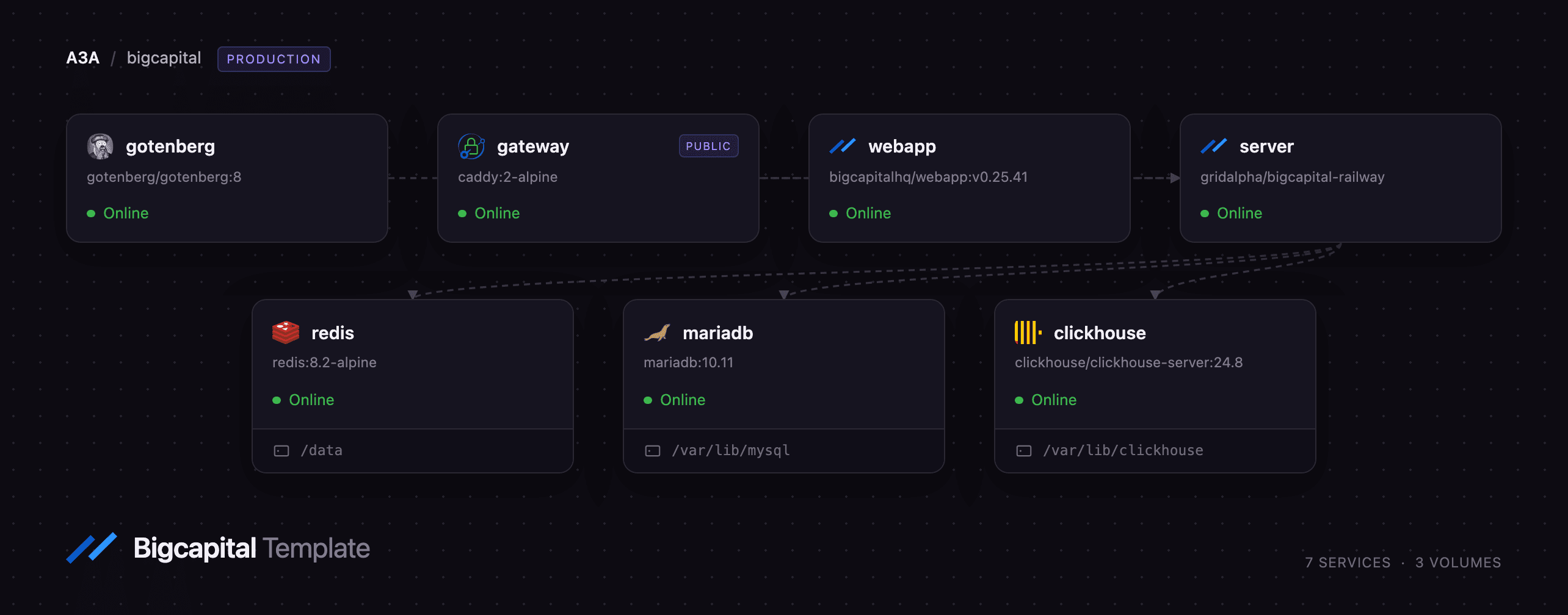
Deploy Bigcapital on Railway and you get the whole production topology, not a single
container. The gateway service is the one public origin: it serves the webapp React
front end and forwards /api to the server NestJS backend, which keeps the session
cookie and the API on the same host. mariadb holds the ledger, redis backs the job
queue, gotenberg renders invoice PDFs, clickhouse stores analytics roll-ups, and a
Railway object-storage bucket keeps document attachments. Self-hosting Bigcapital
elsewhere means wiring those seven pieces together yourself; here they arrive connected,
with volumes, health checks and private networking set.
Getting Started with Bigcapital on Railway
Set SIGNUP_ALLOWED_EMAILS on the server service to your own email address before you
deploy — that address becomes the only one allowed to create an account, which keeps a
public URL from being claimed by whoever finds it first. Everything else has a default.
There is no shipped admin password. Open the deployed URL at /auth/register, sign up with
that allow-listed address, and you become the owner of a new organization. The sign-up link
is hidden on the login page by design; the route still works. A short wizard then asks for
legal name, business location, base currency, fiscal year and time zone. Saving it
provisions a dedicated database for your organization and seeds a full chart of accounts.
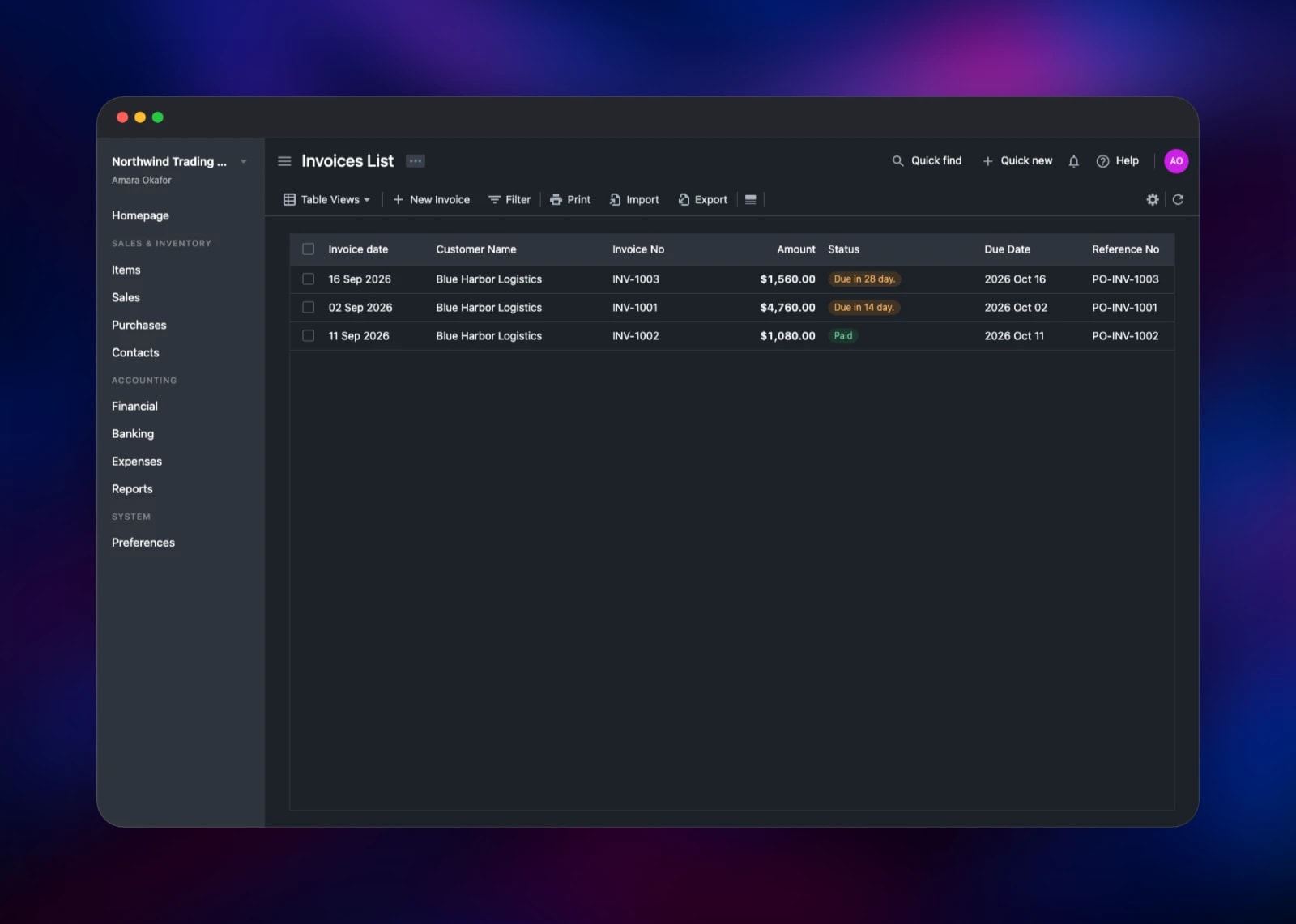
To prove the deployment works end to end, add a customer under Contacts, add an item
under Items, then create a sales invoice under Sales and mark it delivered. Open
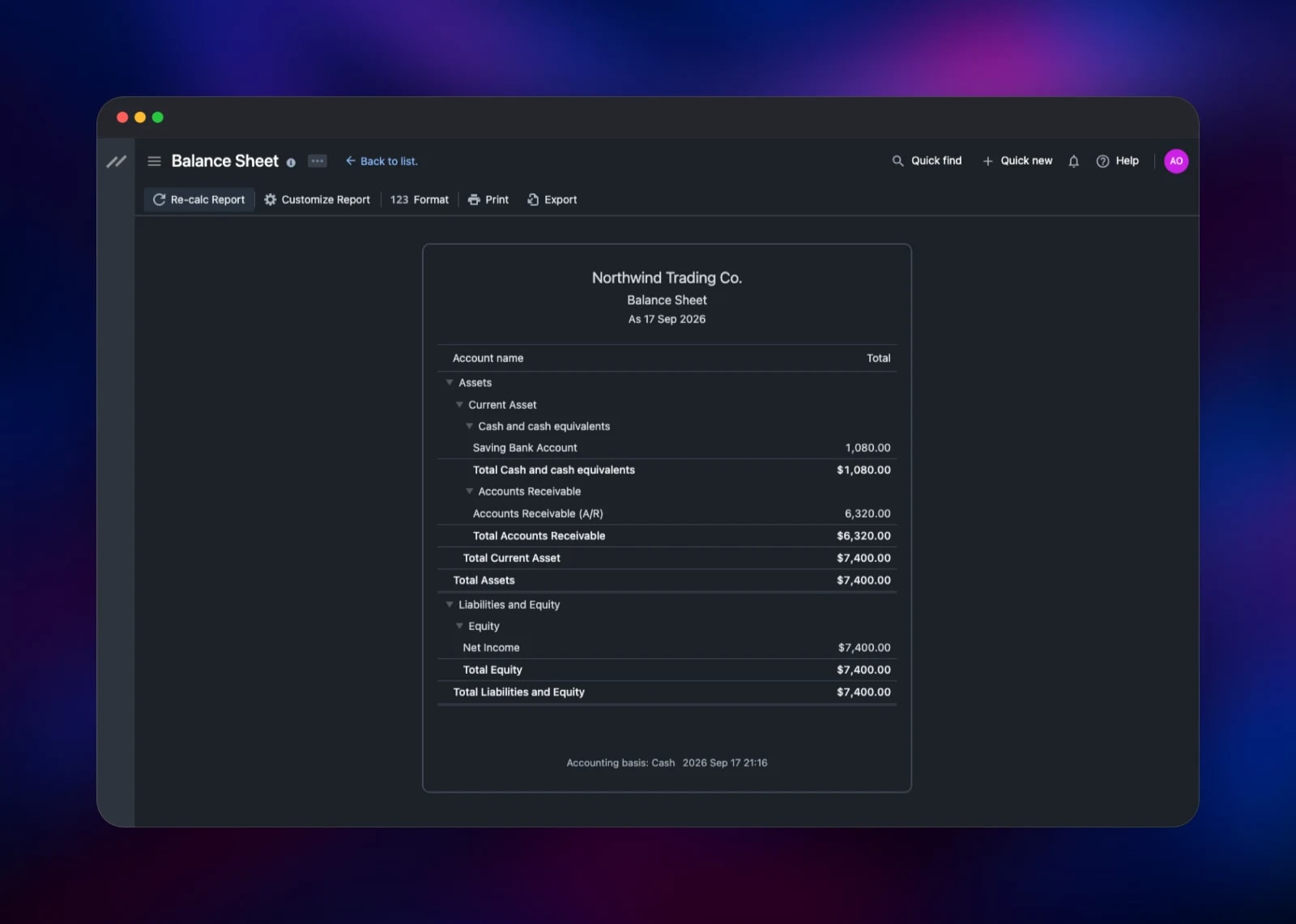
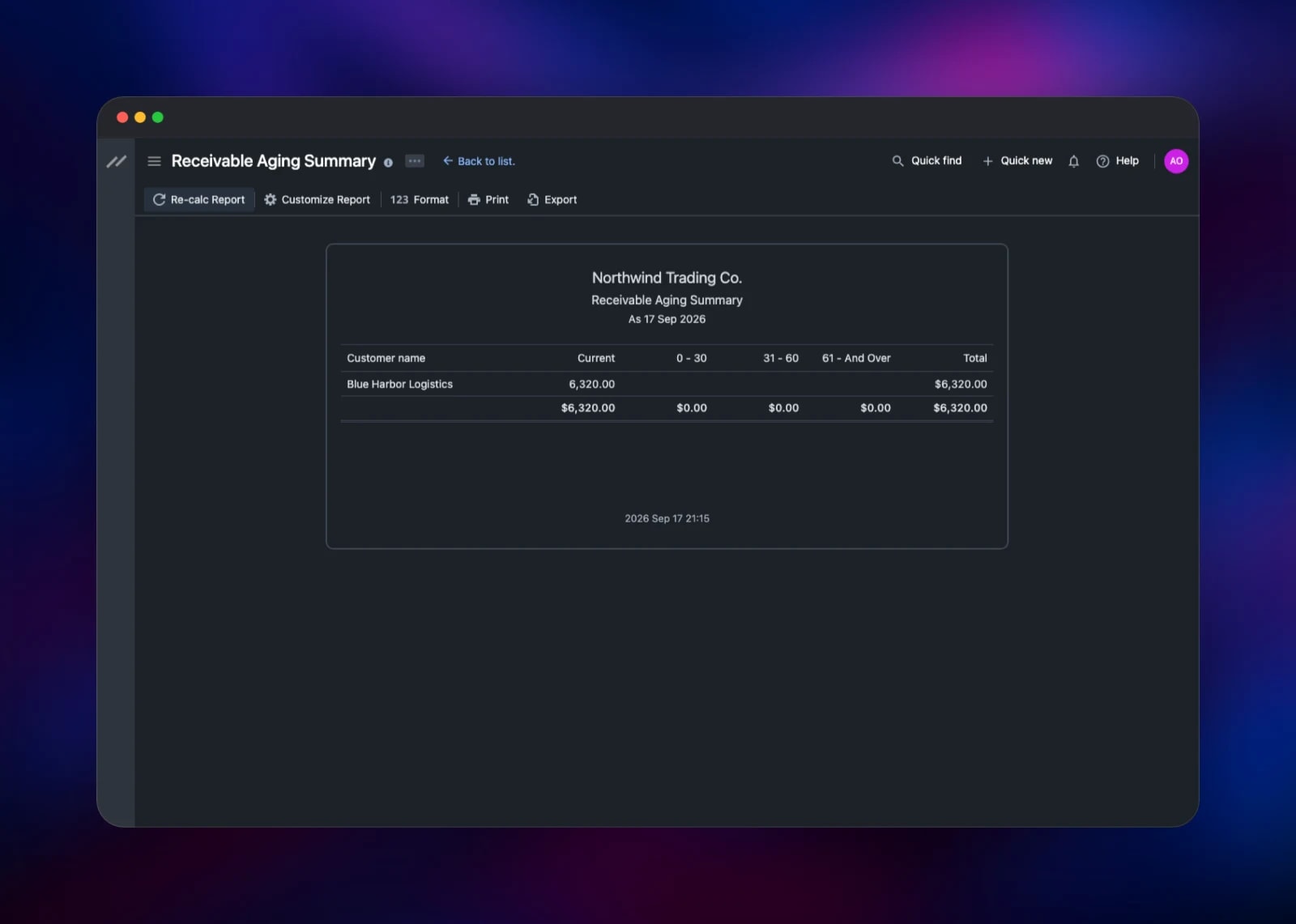
Reports → Balance Sheet and the total appears under Accounts Receivable; record a
payment and it moves into your bank account row. Set the MAIL_* variables before inviting
colleagues, since invitations and password resets are emailed.
About Hosting Bigcapital
Hosted bookkeeping platforms price per user, per company or per transaction. Self-hosting Bigcapital gives an accountant with several client companies, or a business that wants its ledger inside its own infrastructure, the same feature surface at infrastructure cost.
Key capabilities:
- Double-entry general ledger with a seeded, editable chart of accounts
- Sales invoices, estimates, receipts and credit notes, plus purchase bills
- Customer and vendor records with running receivable and payable balances
- Expense tracking, manual journals, and banking with account reconciliation
- Inventory items with cost and sell prices, and landed-cost allocation
- Balance sheet, profit and loss, cash flow, general ledger, trial balance and aging reports
- Multi-currency with exchange rates, and multiple organizations under one login
Each service has one job. server is the NestJS API that owns the ledger logic and the
background job processors. webapp is the compiled React front end on nginx. gateway is a
Caddy reverse proxy putting both behind one hostname, so the browser never makes a
cross-site request. mariadb stores a system database plus one database per organization,
created on demand. redis carries the BullMQ queues behind notifications, exports and
analytics syncs. gotenberg turns invoice HTML into PDFs. clickhouse holds ledger deltas
for fast workspace totals.
Why Deploy Bigcapital on Railway
Railway removes the assembly work this stack normally needs:
- Seven services, three volumes and an object-storage bucket in one click
- Private networking between the app, database, cache and PDF renderer
- Persistent volumes for MariaDB, Redis and ClickHouse
- Health checks and automatic restarts on every service
- Free HTTPS on a generated domain, or bring your own
Common Use Cases
- A small business running its own books instead of paying per-seat for QuickBooks or Xero
- An accountant keeping several client organizations in one installation
- A startup that wants invoicing, expenses and statements it can query directly
- A company with data-residency rules covering its ledger
Dependencies for Bigcapital
gridalpha/bigcapital-railway— the API server image, built onbigcapitalhq/serverbigcapitalhq/webapp— the React front end on nginxcaddy:2-alpine— single-origin reverse proxymariadb:10.11— the ledger; Bigcapital creates one database per organizationredis:8.2-alpine— BullMQ job queues and rate-limit countersgotenberg/gotenberg:8— PDF rendering for invoices and reportsclickhouse/clickhouse-server:24.8— analytics roll-ups for workspace totals- A Railway object-storage bucket for document attachments
Environment Variables Reference
| Variable | Service | Purpose |
|---|---|---|
SIGNUP_ALLOWED_EMAILS | server | Comma-separated addresses allowed to register |
SIGNUP_DISABLED | server | Keep true; the allow-list is what re-opens sign-up |
APP_JWT_SECRET | server | Signs authentication tokens; changing it logs everyone out |
BASE_URL | server | Public URL used in emailed links |
MAIL_* | server | SMTP host, port, credentials and sender identity |
CLICKHOUSE_ENABLED | server | Set false to skip analytics roll-ups |
THROTTLE_AUTH_LIMIT | server | Login attempts allowed per minute per client |
STRIPE_PAYMENT_SECRET_KEY | server | Optional; enables customer payment links |
Deployment Dependencies
- Source:
- Images: and
- Documentation:
- Runtime: Node.js 18, MariaDB 10.11, Redis 8
Hardware Requirements for Self-Hosting Bigcapital
| Resource | Minimum | Recommended |
|---|---|---|
| CPU | 2 vCPU total | 4 vCPU |
| RAM | 3 GB total | 6 GB or more |
| Storage | 5 GB volumes | 10 GB plus bucket growth |
| Runtime | Node.js 18, MariaDB 10.11, Redis 8 | Same |
The API server and MariaDB are the two that matter. ClickHouse is optional; CLICKHOUSE_ENABLED=false frees roughly a gigabyte.
Self-Hosting Bigcapital with Docker
Upstream ships a production Compose file. Clone the repository:
git clone https://github.com/bigcapitalhq/bigcapital.git
cd bigcapital
cp .env.example .env
Generate the two secrets the stack refuses to start without, then bring it up:
echo "APP_JWT_SECRET=$(openssl rand -base64 48)" >> .env
echo "CLICKHOUSE_PASSWORD=$(openssl rand -base64 32)" >> .env
docker compose -f docker-compose.prod.yml up -d
You are then responsible for the reverse proxy, TLS certificates, volume backups and the S3-compatible storage attachments expect. The Railway template covers that part.
Is Bigcapital Free to Self-Host?
Bigcapital is open source under AGPL-3.0, so the software costs nothing and there are no per-user or per-company fees. The company sells a hosted cloud plan; self-hosting has no licence key and no feature gate. On Railway you pay only for the compute, memory and storage the seven services consume.
FAQ
What is Bigcapital?
Bigcapital is open-source accounting software with double-entry ledgers, invoicing, expenses, inventory and financial statements — a self-hostable alternative to QuickBooks, Xero and Wave.
What does this Railway template deploy?
Seven services: the API server, the React front end, a Caddy gateway giving both one public origin, MariaDB, Redis, Gotenberg for PDF rendering and ClickHouse for analytics, plus a managed object-storage bucket for attachments.
Why does Bigcapital need MariaDB and Redis?
MariaDB holds the ledger, and Bigcapital creates a separate database per organization, so it needs an account that can create databases. Redis backs the queues that send notifications, build exports and sync analytics in the background.
How do I create the first admin user in self-hosted Bigcapital?
There is no default password. Visit /auth/register on the deployed URL and sign up with
an address listed in SIGNUP_ALLOWED_EMAILS; the first account becomes the organization
owner. Leave SIGNUP_DISABLED=true so nobody else can register.
Can I use my own SMTP server for invoices and invitations?
Yes. Set MAIL_HOST, MAIL_PORT, MAIL_USERNAME, MAIL_PASSWORD, MAIL_SECURE,
MAIL_FROM_NAME and MAIL_FROM_ADDRESS on server. Without them the app runs fine, but
invitations, password resets and emailed invoices will not send.
Does self-hosted Bigcapital support multiple companies?
Yes. One login can own several organizations, each with its own database and chart of accounts. Switch between them from the organization menu in the top-left corner.
Template Content
gateway
caddy:2-alpinegotenberg
gotenberg/gotenberg:8SIGNUP_ALLOWED_EMAILS
Your email address; the only account allowed to register
mariadb
mariadb:10.11clickhouse
clickhouse/clickhouse-server:24.8redis
redis:8.2-alpinebigcapital-storage
Bucket