
Deploy Budibase | Open Source Retool Alternative
Self Host Budibase. Build internal tools with low-code platform on Railway
Budibase
Just deployed
/data

Deploy and Host Budibase on Railway

Budibase is an open-source low-code platform that lets teams build internal tools, admin panels, CRUD apps, forms, and workflow automations in minutes — without writing frontend code. Self-host Budibase on Railway to keep your business data inside your own infrastructure while skipping the pain of managing CouchDB, MinIO, Redis, and the Node.js app stack yourself.
This Railway template deploys the official budibase/budibase:latest all-in-one image, which bundles the Budibase builder, worker, CouchDB, MinIO, and Redis into a single container behind an Nginx proxy. A persistent volume at /data keeps your CouchDB metadata and MinIO-backed file uploads between restarts, and all cluster secrets are generated for you at deploy time.
Getting Started with Budibase on Railway
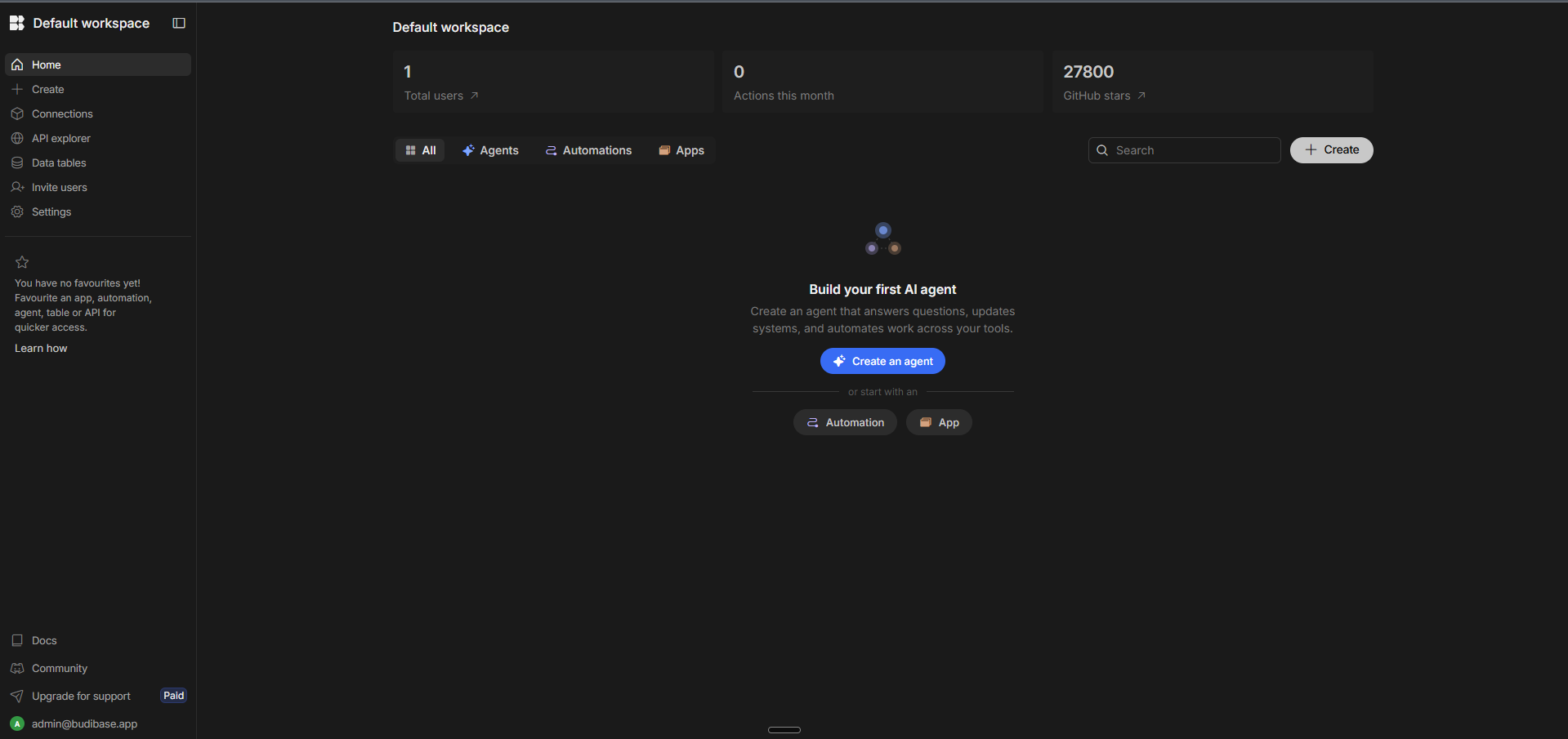
Once the deployment is live, open the Railway-generated URL in your browser. You'll land on the Budibase login page at /builder. Sign in with the admin credentials set via the BB_ADMIN_USER_EMAIL and BB_ADMIN_USER_PASSWORD environment variables — you can rotate both from the Budibase admin panel after first login. From the builder, create a new app, connect a data source (CouchDB comes pre-wired; you can also point to external Postgres, MySQL, MongoDB, Airtable, Google Sheets, or REST/GraphQL APIs), and drag-and-drop UI components onto a screen. Publish your app when you're ready — end users reach it at /app/.
About Hosting Budibase
Budibase is an open-source low-code platform (GPL-v3 licensed) used by over 50,000 companies to build internal tools 50× faster than traditional development. A single Budibase instance handles multiple apps, user roles (RBAC), SSO, automations, and AI agents — all from one builder UI.
Key features:
- Visual drag-and-drop app builder with 40+ pre-built components
- Built-in CouchDB (Budibase DB) for rapid prototyping, plus external DB connectors
- Workflow automations triggered by cron, webhooks, or user actions
- Role-based access control, SSO (OIDC/OAuth2/SAML), and multi-tenant apps
- REST and GraphQL API connectors for any third-party service
- AI agents and LLM integrations (OpenAI, Anthropic, and any OpenAI-compatible endpoint)
The all-in-one image used here is the same one Budibase ships for single-box self-hosting — PM2 supervises CouchDB, MinIO, Redis, the apps service, and the worker service inside one container.
Why Deploy Budibase on Railway
Railway removes the DevOps busywork around a four-service stack:
- Single click to deploy the bundled CouchDB + MinIO + Redis + Budibase image
- Persistent
/datavolume provisioned and attached automatically - Secrets (
JWT_SECRET,API_ENCRYPTION_KEY,COUCH_DB_PASSWORD, etc.) generated for you - Free HTTPS on a
*.up.railway.appdomain, plus custom-domain support - Horizontal redeploys without losing CouchDB documents or uploaded files
Common Use Cases
- Internal CRMs, admin panels, and operations dashboards backed by your existing databases
- Approval flows for expenses, vacation requests, or procurement orders
- Customer support ticketing, inventory trackers, and applicant tracking systems
- Forms and data-entry tools that write to Postgres, Airtable, Google Sheets, or Budibase DB
- AI-powered internal assistants that chain LLM calls with business data via automations
Dependencies for Budibase
budibase/budibase:latest— all-in-one image containing the builder, worker, CouchDB, MinIO, Redis, and Nginx proxy
Environment Variables Reference
| Variable | Purpose |
|---|---|
PORT | Internal Nginx proxy port (must be 80) |
BB_ADMIN_USER_EMAIL | Initial admin account email (bootstrap-only) |
BB_ADMIN_USER_PASSWORD | Initial admin account password (bootstrap-only — never use ${{secret()}}) |
JWT_SECRET | Signs user session tokens |
API_ENCRYPTION_KEY | Encrypts stored datasource credentials |
INTERNAL_API_KEY | Authenticates internal service-to-service calls |
COUCH_DB_USER / COUCH_DB_PASSWORD | CouchDB credentials used by app and worker |
MINIO_ACCESS_KEY / MINIO_SECRET_KEY | MinIO object-store credentials |
REDIS_PASSWORD | Redis authentication password |
RAILWAY_RUN_UID | Set to 0 so bundled services can own /data |
Deployment Dependencies
- Runtime: Node.js 20 + CouchDB 3 + MinIO + Redis (all bundled)
- GitHub: https://github.com/Budibase/budibase
- Docker Hub: https://hub.docker.com/r/budibase/budibase
- Docs: https://docs.budibase.com/docs/docker
Hardware Requirements for Self-Hosting Budibase
| Resource | Minimum | Recommended |
|---|---|---|
| CPU | 1 vCPU | 2 vCPU |
| RAM | 2 GB | 4 GB |
| Storage | 5 GB | 20 GB+ (grows with app uploads) |
| Runtime | Docker | Railway (managed) |
Self-Hosting Budibase on Railway
The Railway template provisions everything via the official single-container image. For reference, the equivalent local Docker run looks like this:
docker run -d \
  --name budibase \
  -p 10000:80 \
  -v budibase_data:/data \
  -e BB_ADMIN_USER_EMAIL=admin@yourdomain.com \
  -e BB_ADMIN_USER_PASSWORD=ChangeMeNow \
  -e JWT_SECRET=$(openssl rand -hex 32) \
  -e API_ENCRYPTION_KEY=$(openssl rand -hex 32) \
  --restart unless-stopped \
  budibase/budibase:latest
If you prefer docker-compose with separate services (CouchDB, MinIO, Redis, apps, worker, proxy), pull the reference stack from the official repo:
git clone https://github.com/Budibase/budibase.git
cd budibase/hosting
cp hosting.properties.example hosting.properties
docker-compose --env-file hosting.properties up -d
How Much Does Budibase Cost to Self-Host?
Budibase's core is open-source under GPL-v3 and free forever when self-hosted — up to 20 users with SSO, RBAC, multiplayer editing, and embeds included at no cost. The Premium tier (Business Source License) adds features like audit logs, custom SSO policies, and priority support at $50/creator + $5/app-user per month. On Railway, you only pay for the underlying compute, egress, and storage — typically $5–$15/month for a single-tenant Budibase instance.
FAQ
What is Budibase and why self-host it? Budibase is an open-source low-code platform for building internal tools and business apps. Self-hosting keeps customer data and datasource credentials on infrastructure you control — a common requirement for regulated industries and privacy-conscious teams.
What does this Railway template deploy?
A single Railway service running the budibase/budibase:latest all-in-one image, with a persistent /data volume, a public HTTPS domain on port 80, and generated secrets for JWT, API encryption, CouchDB, MinIO, and Redis.
Why are CouchDB, MinIO, and Redis bundled inside the Budibase image? Budibase uses CouchDB for metadata (apps, screens, automations), MinIO for file uploads and app exports, and Redis for session storage and worker queues. The all-in-one image lets you run the full stack as one service — ideal for Railway's 1-volume-per-service model.
How do I change the admin password in self-hosted Budibase on Railway?
Log in to /builder with the initial BB_ADMIN_USER_EMAIL/BB_ADMIN_USER_PASSWORD credentials, then open Account Settings. Changing BB_ADMIN_USER_PASSWORD in Railway afterwards has no effect — it's a bootstrap-only variable consumed at first startup.
Can I connect Budibase on Railway to an external Postgres or MongoDB? Yes — add the external DB as a datasource inside the Budibase builder. The template's bundled CouchDB only stores Budibase metadata; your app data can live anywhere you point a datasource at.
Does the template persist data across redeploys?
Yes. CouchDB documents (your apps and automations) and MinIO uploads both live on the attached Railway volume at /data. Redeploys rebuild the container but preserve the volume.
Template Content
Budibase
budibase/budibase:latestBB_ADMIN_USER_EMAIL
Create admin email
BB_ADMIN_USER_PASSWORD
Create admin password