
Deploy Clickhouse
Columnar database for fast analytics queries over very large tables
clickhouse-2
Just deployed
/var/lib/clickhouse
keeper-2
Just deployed
/var/lib/clickhouse
clickhouse-1
Just deployed
/var/lib/clickhouse
keeper-1
Just deployed
/var/lib/clickhouse
Just deployed
keeper-3
Just deployed
/var/lib/clickhouse

Deploy and Host ClickHouse on Railway
ClickHouse is an open-source columnar database built for analytical queries over very large tables. It stores each column separately, compresses it hard, and scans billions of rows per second on ordinary hardware — which is why it sits underneath Plausible, PostHog, Langfuse and most self-hosted event pipelines. Teams reach for it when Postgres starts timing out on a GROUP BY over a year of events.
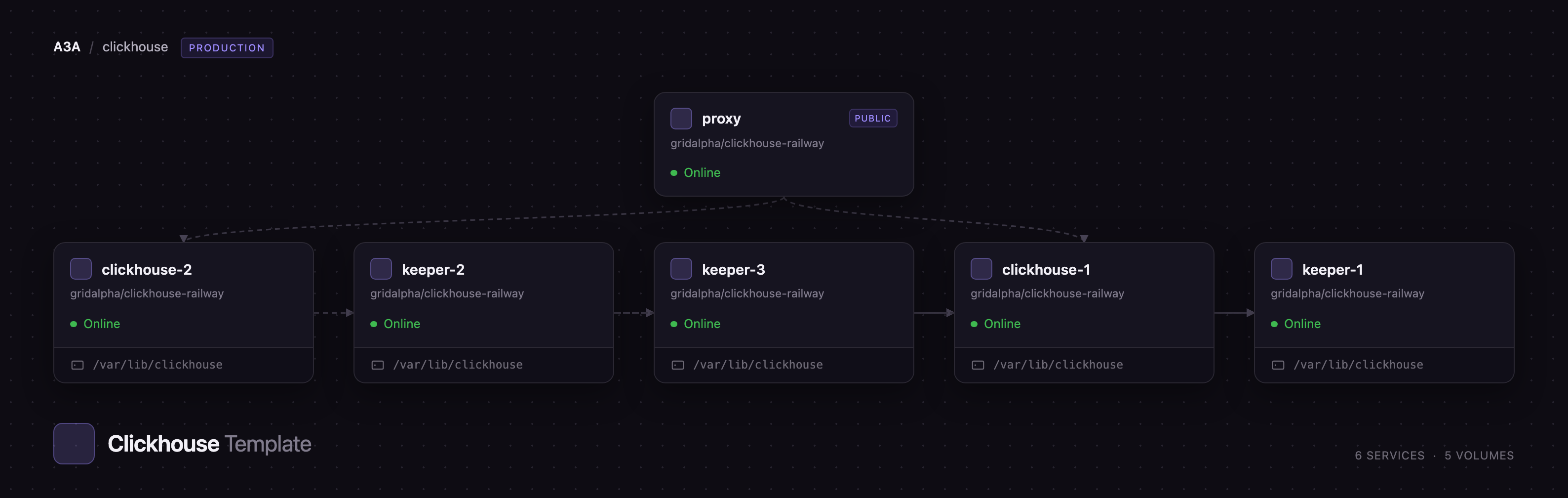
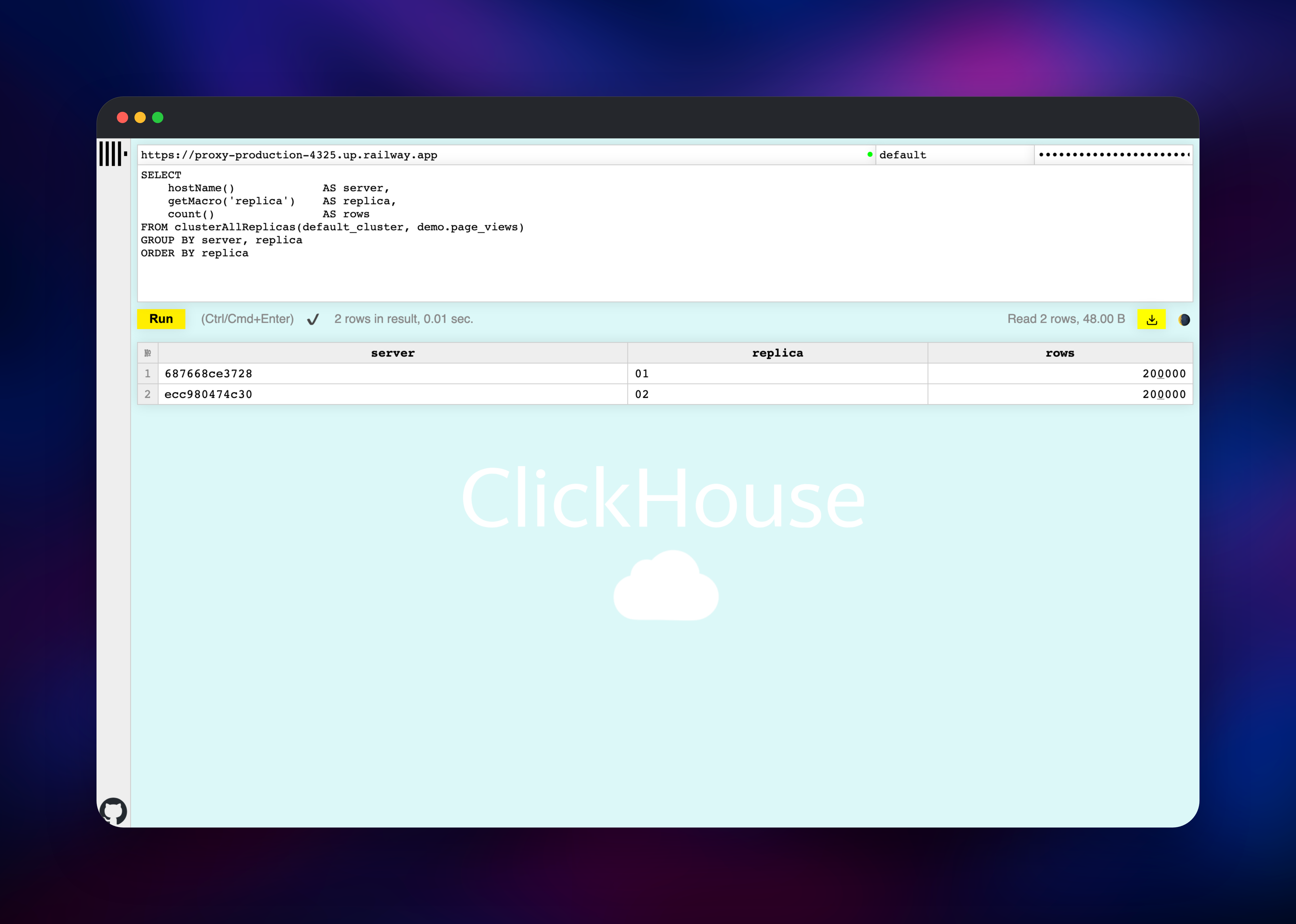
Deploy ClickHouse on Railway as a replicated cluster rather than a single container. This template runs upstream's replication for fault tolerance topology: one shard held by two servers, clickhouse-1 and clickhouse-2; a three-node ClickHouse Keeper ensemble, keeper-1 to keeper-3, coordinating them; and a Caddy proxy owning the only public domain. Rows written to either replica appear on both, and the proxy routes to the first healthy one, failing over when it stops answering. Self-host ClickHouse on Railway and all five stateful nodes keep a volume at /var/lib/clickhouse.
Getting Started with ClickHouse on Railway
Set a password for the default user at deploy time — the server refuses to start without one and stores it as a SHA-256 hash, never plaintext. Wait for all six services to go green: the Keeper nodes elect a leader within seconds, and the servers register once a quorum exists.
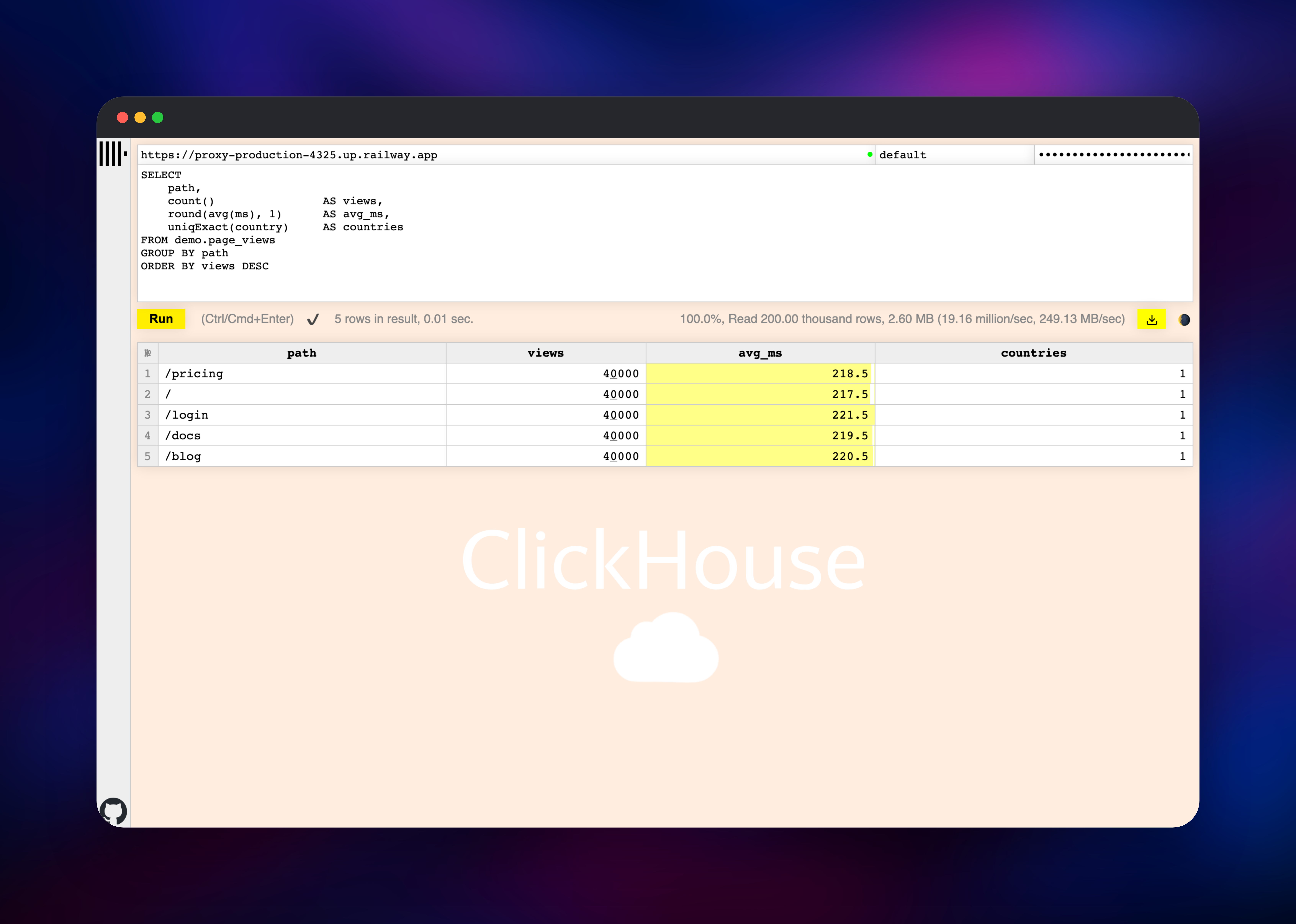
Open the public URL and you land on ClickHouse Play, the built-in SQL console. Sign in as default with your password, run SELECT 1, then create your first replicated table. ON CLUSTER default_cluster is the part that matters — it applies the DDL to both replicas instead of one:
CREATE TABLE page_views ON CLUSTER default_cluster
(ts DateTime, path String, country String)
ENGINE = ReplicatedMergeTree ORDER BY (ts, path);
Insert a few rows, then check SELECT active_replicas, absolute_delay FROM system.replicas — 2, 0 means replication is healthy. Applications use the same URL over the HTTP interface, so any ClickHouse client, curl or the JDBC/ODBC drivers work. Note /dashboard is broken in current upstream builds and renders no charts; /play is the usable interface.
About Hosting ClickHouse
ClickHouse answers analytical questions — counts, sums, percentiles, funnels — over tables too big for a row store to scan interactively. It does not replace a transactional database; it goes beside one when reporting queries start hurting. Self-host it when per-query cloud pricing turns unpredictable, or when the data cannot leave your infrastructure.
Key features:
- Columnar storage with aggressive compression — often 10x or better on event data
- Vectorised execution scanning hundreds of millions of rows per second per core
ReplicatedMergeTree— multi-master replication, either replica taking writes- Materialised views that roll data up as it is inserted, not on a schedule
- Table engines reading Kafka, S3, Postgres and MySQL directly
Each service has one job. clickhouse-1 and clickhouse-2 are full copies of the same shard, each with its own volume, serving HTTP on 8123 and the native protocol on 9000, and exchanging data parts on 9009. keeper-1 to keeper-3 hold the replication log and decide which replica merges which part. proxy is Caddy, holding the public HTTPS endpoint and health-checking both replicas on /ping.
Why Deploy ClickHouse on Railway
Railway removes the setup work that makes a replicated cluster a project of its own.
- Six services, five volumes and the cluster topology in one deploy
- Keeper ensemble and replica registration configured at boot
- Private networking between nodes; only the proxy is public
- Automatic failover to the second replica if the first goes unhealthy
- Vertical scaling per service, so Keeper stays small while servers grow
Common Use Cases
- Product and web analytics — the storage layer behind self-hosted Plausible, PostHog or a homegrown event pipeline
- Observability data — logs, traces and metrics at volumes that make per-GB ingest pricing painful
- Customer-facing dashboards where each page load aggregates over millions of rows
- AI and LLM telemetry — token usage, latency and cost per request, as Langfuse stores it
Dependencies for ClickHouse
clickhouse/clickhouse-server:26.3— the database, run twice as two replicas of one shardclickhouse/clickhouse-keeper:26.3— coordination, run three times as a raft ensemblecaddy:2-alpine— the public HTTPS front door and health-checking load balancer- Five Railway volumes at
/var/lib/clickhouse, one per stateful service
Both images are pinned to 26.3, the current long-term-support line, supported until March 2027. Server and Keeper must run the same version, and the tag keeps moving within 26.3.x, so patch releases still arrive on redeploy while the on-disk format stays put.
Environment Variables Reference
| Variable | Service | Purpose |
|---|---|---|
CLICKHOUSE_PASSWORD | servers | Password for the default user; required |
CLICKHOUSE_DB | servers | Optional database created on first boot |
CLICKHOUSE_REPLICA_ID | servers | The {replica} macro; must differ per replica |
CLICKHOUSE_CLUSTER | servers | Cluster name used by ON CLUSTER |
KEEPER_HOSTS | servers, Keeper | Ensemble members, in raft id order |
KEEPER_SERVER_ID | Keeper | Raft id; matches the node's place in KEEPER_HOSTS |
CLICKHOUSE_UPSTREAMS | proxy | Replica addresses the proxy balances across |
CLICKHOUSE_LOG_LEVEL | servers, Keeper | information; trace exceeds Railway's log cap |
Deployment Dependencies
- Source: ClickHouse/ClickHouse (Apache-2.0)
- Docker Hub:
clickhouse/clickhouse-server,clickhouse/clickhouse-keeper,caddy - Docs: clickhouse.com/docs — SQL reference, table engines, replication
Hardware Requirements for Self-Hosting ClickHouse
Sized per ClickHouse server; Keeper nodes are far lighter.
| Resource | Minimum | Recommended |
|---|---|---|
| CPU | 2 vCPU | 4–8 vCPU per replica |
| RAM | 2 GB (low ingest only) | 8–32 GB, more for interactive queries |
| Storage | 10 GB volume | 50 GB+, sized by retention after compression |
| Runtime | x86-64 with SSE 4.2, or ARM64 | SSD-backed storage |
ClickHouse reads its cgroup limits on Railway, sizing thread pools and memory to the plan you pick. Keeper nodes run in 512 MB — they hold coordination metadata, not table data.
Self-Hosting ClickHouse
A single node is one container, with a password set and the HTTP interface published:
docker run -d --name clickhouse \
  -e CLICKHOUSE_PASSWORD=your-password \
  -p 8123:8123 -p 9000:9000 \
  -v clickhouse-data:/var/lib/clickhouse \
  clickhouse/clickhouse-server:26.3
Replication needs Keeper too, plus remote_servers and zookeeper config blocks on each server — that XML is what this template renders at boot. Once running, the HTTP interface takes SQL as a plain POST body, which is how most ingestion works:
curl -u default:your-password --data-binary \
  "INSERT INTO page_views FORMAT JSONEachRow {\"path\":\"/pricing\"}" \
  https://your-clickhouse-host/
Is ClickHouse Free to Self-Host?
ClickHouse is open source under Apache-2.0, with no paid tiers, seat limits or feature gates — replication, materialised views and every table engine ship in the same build. ClickHouse Cloud is the managed offering, billed on compute and storage. Self-hosting replaces that bill with infrastructure: on Railway you pay for the compute and the five volumes.
FAQ
What is ClickHouse? An open-source columnar OLAP database. It stores data by column and runs queries in a vectorised engine, so aggregations over hundreds of millions of rows return in well under a second.
What does this Railway template deploy? A replicated ClickHouse cluster: two servers holding one shard, a three-node Keeper ensemble coordinating them, and a Caddy proxy as the only public service, plus five volumes.
Why does the template include ClickHouse Keeper? Replicated tables need a consensus store for the replication log and for deciding which replica performs each merge. Keeper is ClickHouse's ZooKeeper-compatible implementation, and three nodes form a quorum that survives losing one.
How do I connect to self-hosted ClickHouse on Railway from my application?
Point your client at the public HTTPS URL with the default user and your password — the HTTP interface is what most drivers use. Services in the same project can skip the proxy and reach a replica privately on 9000 (native) or 8123 (HTTP).
Do I have to create tables with ON CLUSTER?
For anything replicated, yes. A plain MergeTree created without it exists only on the replica that received the statement — that is ClickHouse's design. Pair ON CLUSTER default_cluster with ReplicatedMergeTree and both replicas stay in step. To add a third replica later, copy the server service with the next CLICKHOUSE_REPLICA_ID and add it to CLICKHOUSE_REPLICAS.
Template Content
clickhouse-2
gridalpha/clickhouse-railwaykeeper-2
gridalpha/clickhouse-railwayclickhouse-1
gridalpha/clickhouse-railwaykeeper-1
gridalpha/clickhouse-railwaykeeper-3
gridalpha/clickhouse-railway