
Deploy Dawarich
Map your own location history — an open-source Google Timeline

dawarich-sidekiq
Just deployed
Redis
Just deployed
/data

Just deployed
/var/lib/postgresql/data
dawarich
Just deployed
dawarich-storage
Bucket
Just deployed
Deploy and Host Dawarich on Railway
Dawarich is an open-source alternative to Google Timeline. It takes the location history your phone already records, stores it in your own database, and turns it into an interactive map, a list of trips and places, and year-by-year statistics on where you went. People self-host it for one reason above all: location history is among the most sensitive data a person generates, and running it yourself means nobody else holds a copy of everywhere you have been.
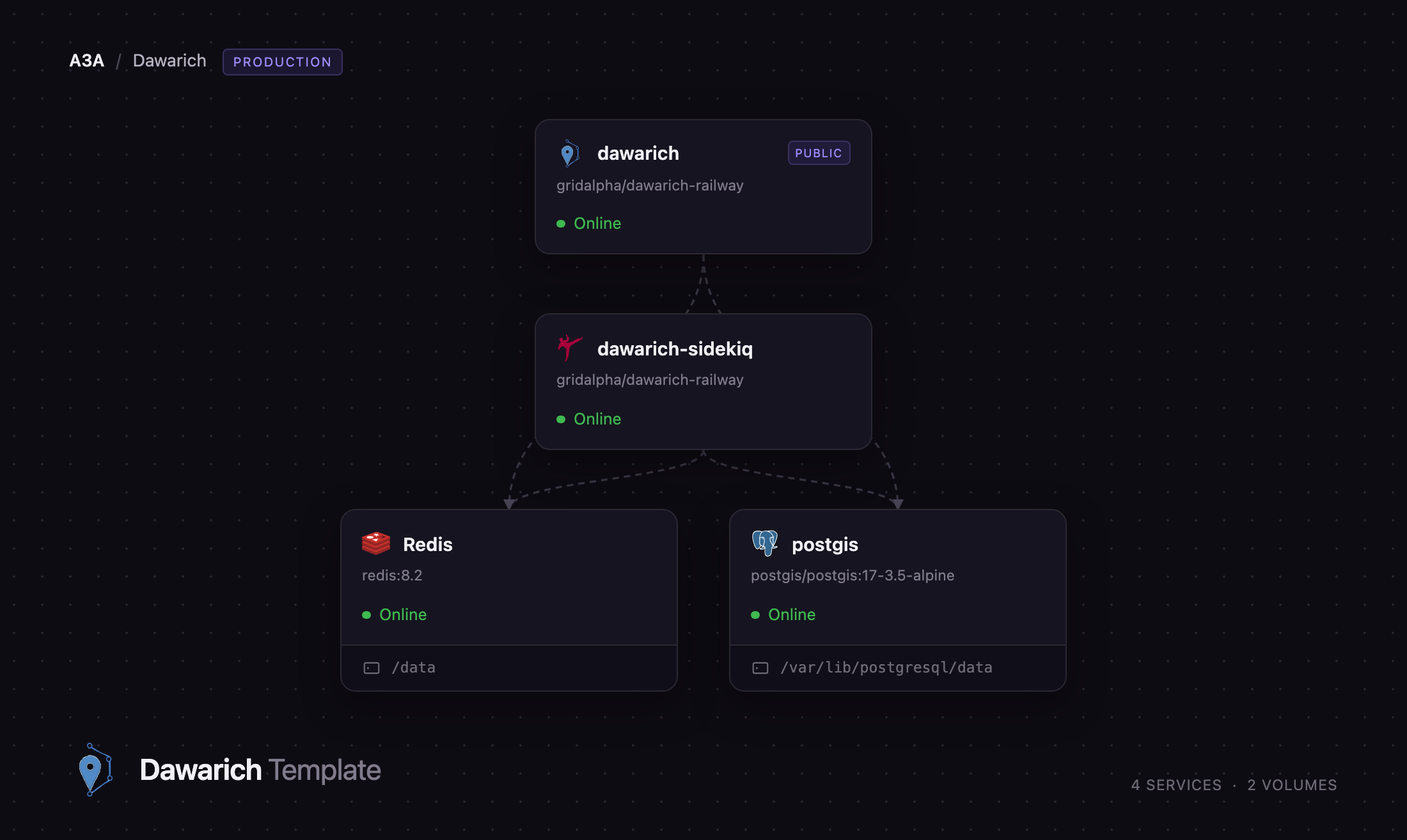
Deploy Dawarich on Railway and you get the full production shape, not a single
container. Four services are pre-wired: dawarich, the Rails web app serving the map and
API and holding the only public URL; dawarich-sidekiq, a worker that parses imports,
reverse-geocodes points and rebuilds statistics without blocking a request; postgis,
PostgreSQL with the PostGIS extension storing every point as a geographic coordinate; and
Redis, backing the job queue, cache and live map updates. An object storage bucket holds
uploaded imports and rendered videos, so the web and worker containers share files
without sharing a disk.
Getting Started with Dawarich on Railway
Set DAWARICH_ADMIN_EMAIL and DAWARICH_ADMIN_PASSWORD when you deploy — that pair
becomes your account, created the first time the app boots against an empty database.
There are no default credentials to change afterwards and public registration is off.
Open the public URL, sign in, and you land on the map.
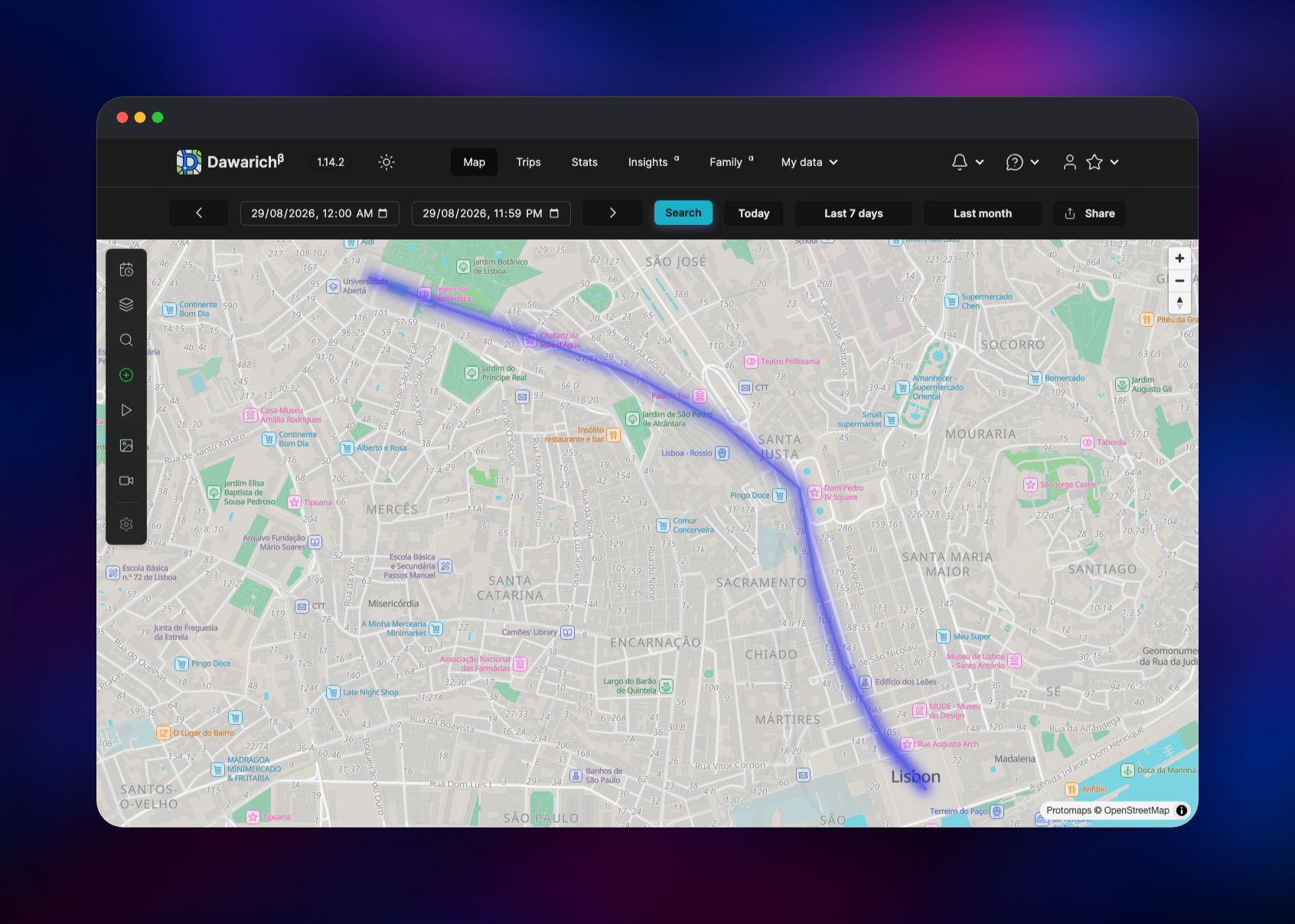
A new instance has no data, so the map opens on today's date and shows nothing. The
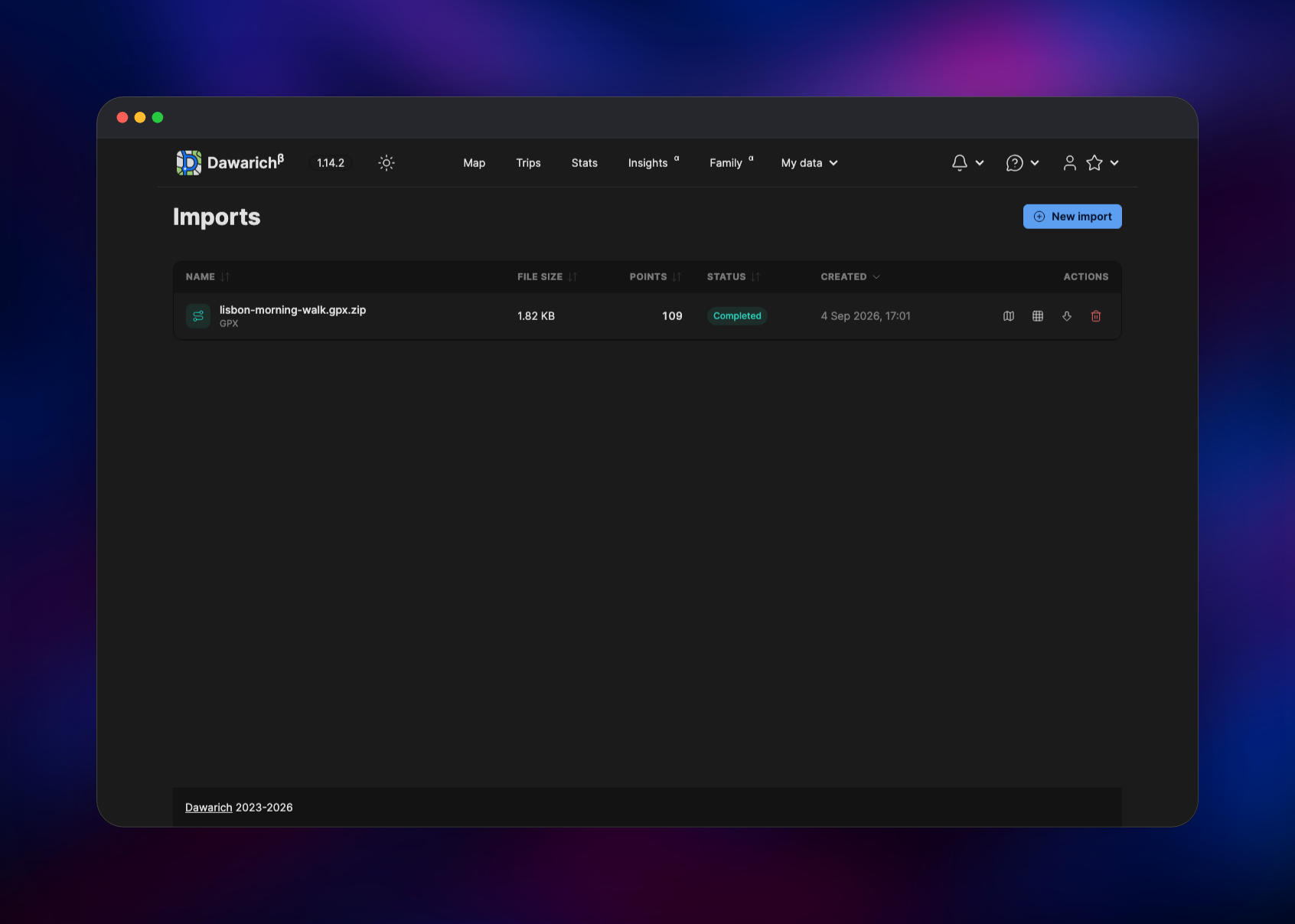
quickest way to confirm everything works is My data → Imports → New import: upload a
.gpx, .geojson, Google Takeout .json, OwnTracks .rec or .fit file and the format
is detected automatically. It uploads straight to object storage, the worker picks it up,
and the row moves to Completed with a point count. Set the map's date range to the dates
the file covers and your track is drawn on it. Then connect a phone — the Dawarich apps,
OwnTracks, Overland or GPSLogger post to the API with a key from your account settings.
Reverse geocoding stays off until you pick a provider under Settings → Geocoding.
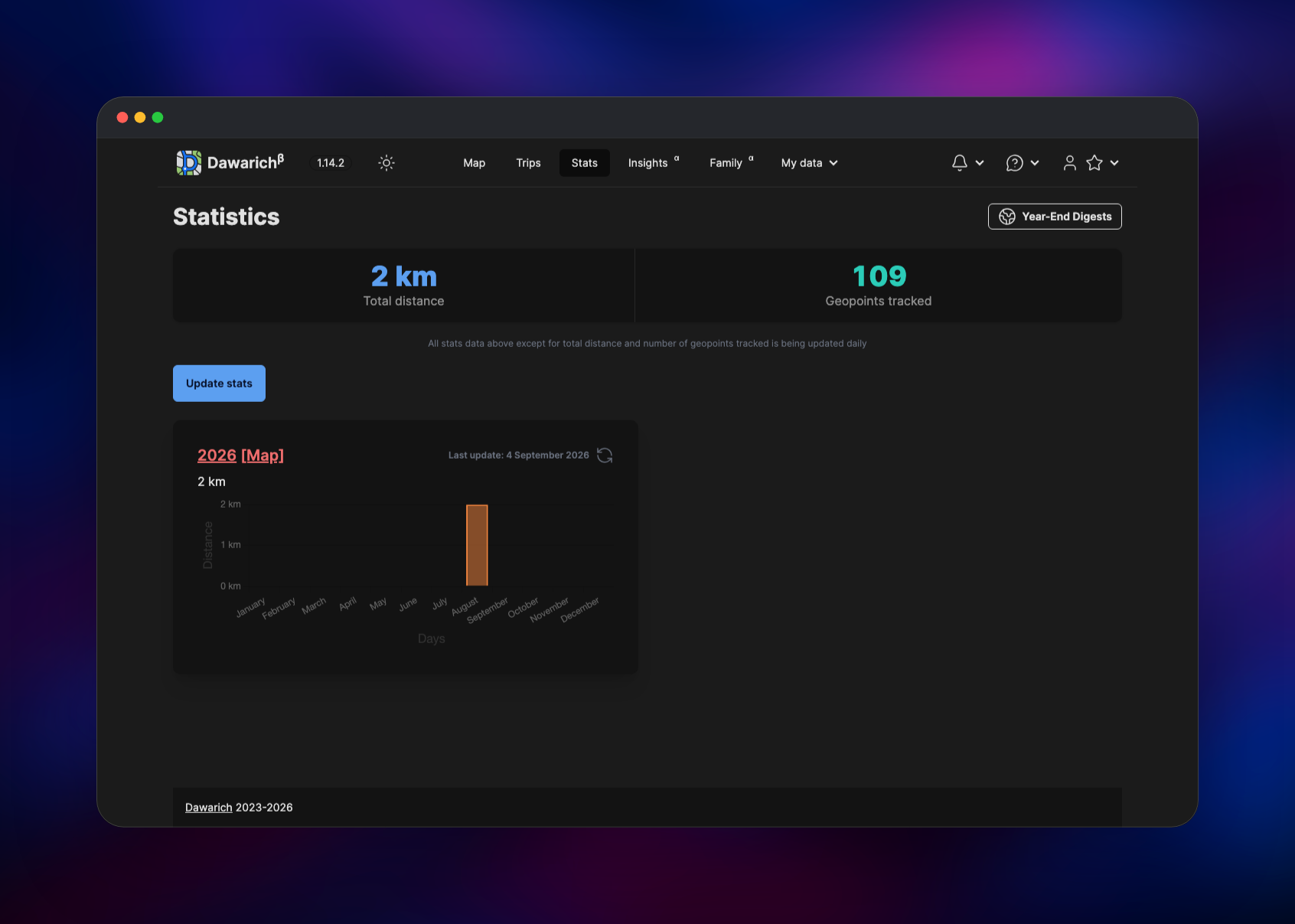
About Hosting Dawarich
Dawarich is a Ruby on Rails application that ingests location points from phones and file exports, stores them as geographic data, and derives everything else from that one stream. It suits anyone who wants Google Timeline without Google, or who has years of Takeout archives on a disk and wants them queryable again.
- Interactive map with heatmaps, fog-of-war and per-day tracks
- Imports Google Takeout, GPX, GeoJSON, KML, OwnTracks, FIT, TCX and CSV
- Live tracking from the Dawarich apps, OwnTracks, Overland or GPSLogger
- Trips, visited places and cities, with optional reverse geocoding
- Yearly and monthly statistics: distance, countries and cities visited
- REST API, two-factor auth and shareable read-only links
The service split matters at import time: a Takeout archive can hold years of points and
parsing it is slow, so that work goes to dawarich-sidekiq while dawarich keeps
serving the map. postgis is not interchangeable with plain PostgreSQL — the schema
stores points as geography columns.
Why Deploy Dawarich on Railway
Railway removes the setup work self-hosting Dawarich normally involves:
- Web app, worker, PostGIS, Redis and object storage deploy together, already wired
- Persistent volumes attached, so your location history survives redeploys
- HTTPS and a public domain provisioned automatically
- Vertical scaling for large Takeout imports, no server to touch
- Deploys from a public GitHub repository you can fork
Common Use Cases
- Replacing Google Timeline with a private map of your movement history
- Reviving years of Google Takeout archives as a searchable, mappable dataset
- Keeping an automatic travel log of countries, cities and distance a year
- Sharing a read-only map of a trip instead of posting a route publicly
Dependencies for Dawarich
dawarich— the Rails web app, built fromgridalpha/dawarich-railwayonfreikin/dawarich:1.14.2. Serves the map, API and admin, and migrates on boot.dawarich-sidekiq— the same image as a Sidekiq worker: parses imports, reverse-geocodes points, rebuilds statistics and renders videos.postgis—postgis/postgis:17-3.5-alpine, storing every point asgeography(Point,4326).Redis— managed Redis: Sidekiq's queue, the Rails cache, live map updates and rate-limit counters, each on its own database.- Object storage bucket — uploaded import files and generated route videos.
Environment Variables Reference
| Variable | Purpose |
|---|---|
DAWARICH_ADMIN_EMAIL | Email for the account created on first boot |
DAWARICH_ADMIN_PASSWORD | Password for that account |
SECRET_KEY_BASE | Rails signing key; also derives encryption keys |
APPLICATION_HOSTS | Hostnames the app answers on; add custom domains here |
APPLICATION_PROTOCOL | https enables HSTS and secure cookies |
ALLOW_EMAIL_PASSWORD_REGISTRATION | false keeps public signup closed |
WEB_CONCURRENCY / RAILS_MAX_THREADS | Puma workers and threads per worker |
BACKGROUND_PROCESSING_CONCURRENCY | Sidekiq threads; raise for large imports |
PHOTON_API_HOST / NOMINATIM_API_HOST | Reverse-geocoding provider, if used |
Deployment Dependencies
- Source repository:
- Upstream project:
- Images:
freikin/dawarich,postgis/postgis - Docs:
Hardware Requirements for Self-Hosting Dawarich
| Resource | Minimum | Recommended |
|---|---|---|
| CPU | 1 vCPU | 2+ vCPU |
| RAM | 2 GB | 4 GB (web + worker + PostGIS) |
| Storage | 5 GB volume | 10 GB+ for multi-year histories |
| Runtime | Ruby 3.4, PostgreSQL 17 + PostGIS 3.5, Redis 7+ | — |
Points are compact — hundreds of thousands fit in a few gigabytes — but a large Takeout import is memory-hungry while parsing, so give the worker room.
Self-Hosting Dawarich
Dawarich publishes a Docker image and a Compose file covering all four containers. The shortest local path is to clone the repository and start it:
git clone https://github.com/Freika/dawarich.git
cd dawarich
docker compose -f docker/docker-compose.yml up -d
The database must be PostgreSQL with PostGIS — a plain postgres image fails on the first
migration. A minimal database container:
docker run -d --name dawarich_db \
  -e POSTGRES_USER=dawarich \
  -e POSTGRES_PASSWORD=changeme \
  -e POSTGRES_DB=dawarich \
  -v dawarich_db_data:/var/lib/postgresql/data \
  postgis/postgis:17-3.5-alpine
Point the app at it with the DATABASE_HOST, DATABASE_PORT, DATABASE_NAME,
DATABASE_USERNAME and DATABASE_PASSWORD variables, set REDIS_URL, and give both
containers the same SECRET_KEY_BASE.
Is Dawarich Free?
Dawarich is open source under AGPL-3.0 and free to self-host, with no paid tier, seat limits or feature gates. The maintainer offers a hosted version too, but nothing here depends on it. On Railway you pay only for the compute, memory and storage the four services use. Reverse geocoding is the one place an external cost can appear, and only if you pick a paid provider.
FAQ
What is Dawarich? Dawarich is a self-hosted location history tracker — an open-source alternative to Google Timeline that maps where you have been, from your phone or from exports such as Google Takeout.
What does this Railway template deploy? Four services — the Dawarich web app, a Sidekiq worker, PostgreSQL with PostGIS, and Redis — plus an object storage bucket for uploads and rendered videos, wired together with a public HTTPS URL on the web app.
Why does this template include PostGIS instead of plain PostgreSQL?
Dawarich stores every point as a geographic coordinate and uses PostGIS functions to
calculate distances, detect visits and match points to countries. Its migrations enable
the postgis extension explicitly, so a plain database will not start.
Why are there separate app and worker services? Imports, reverse geocoding and statistics are slow; running them in the worker keeps the map responsive while a multi-year archive is processed.
How do I import my Google Takeout location history into self-hosted Dawarich?
Request a Takeout archive containing Location History, then upload it or its
Records.json under My data → Imports → New import. The format is detected and the
worker processes it in the background.
How do I track my phone with self-hosted Dawarich? Generate an API key in your account settings and point the Dawarich mobile app, OwnTracks, Overland or GPSLogger at your instance URL. Points then appear live.
Can other people sign up on my instance?
No. Public registration is disabled by default, so only the account created on first boot
exists. Enable it later with ALLOW_EMAIL_PASSWORD_REGISTRATION, or invite family from
the Family screen.
Template Content
dawarich-sidekiq
gridalpha/dawarich-railwayRedis
redis:8.2dawarich
gridalpha/dawarich-railwaydawarich-storage
Bucket