
Deploy Forgejo
Self-host Forgejo, a lightweight Git forge, with CI, Postgres and Redis
forgejo
Just deployed
/data

Just deployed
/var/lib/postgresql/data
forgejo-runner
Just deployed

Redis
Just deployed
/data
forgejo-storage
Bucket
Just deployed
Deploy and Host Forgejo on Railway
Forgejo is a lightweight, community-governed Git forge: repositories, pull requests, issues, releases, a package registry and built-in CI, all from a single Go binary. It began in 2022 as a fork of Gitea led by the people behind Codeberg, is published under the GPL-3.0-or-later licence with no paid edition, and has become the default choice for teams who want GitHub's workflow without GitHub's ownership of their code. Small teams, universities and open-source projects self-host Forgejo for private repositories, auditable access control and CI they control.
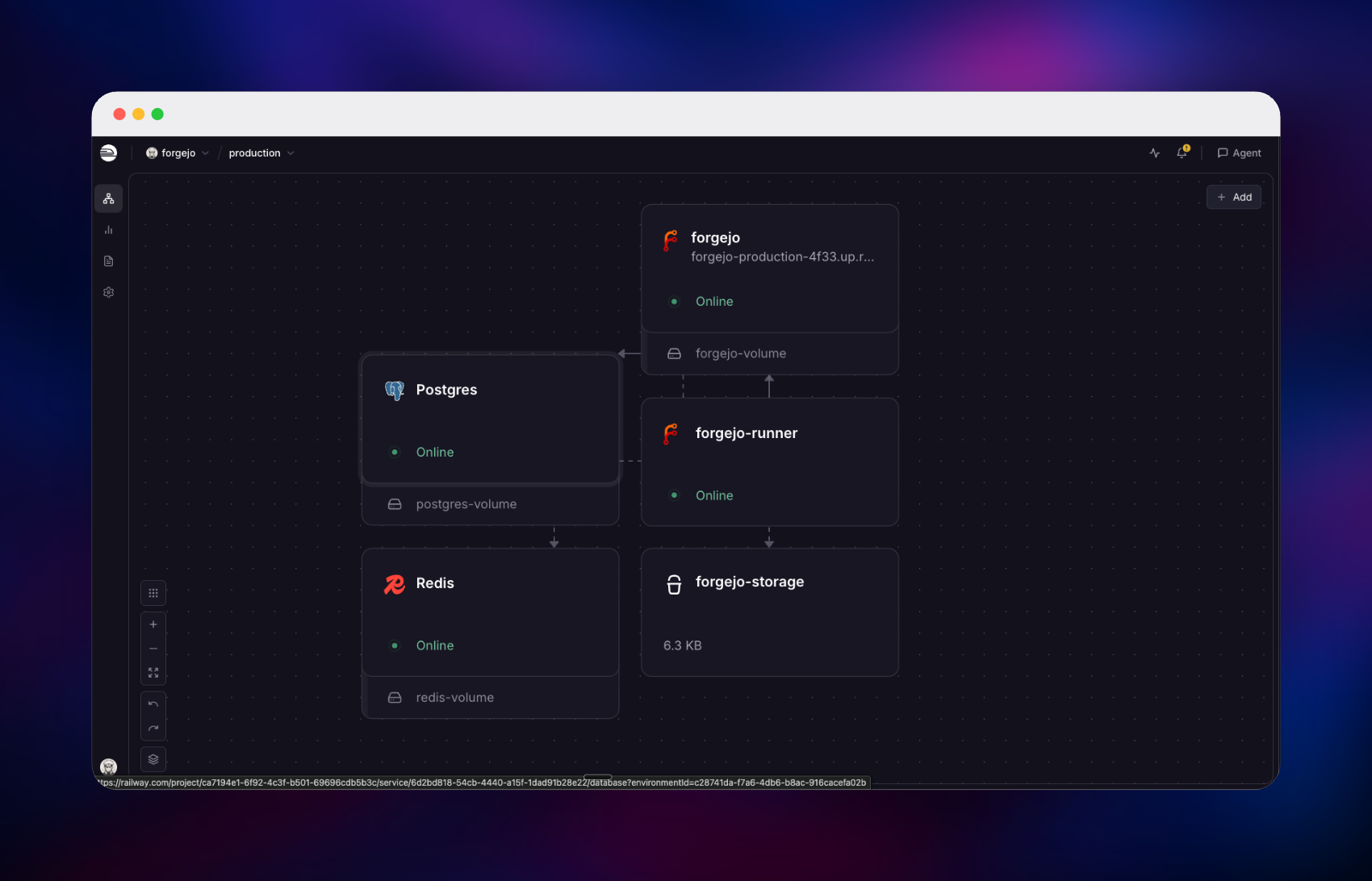
This template lets you deploy Forgejo on Railway with the parts a real forge needs already wired together: the Forgejo web and SSH service, a Forgejo Actions runner so CI actually executes, PostgreSQL for metadata, Redis for cache, sessions and queues, a storage bucket for attachments, LFS objects, packages and CI logs, and a volume for the Git repositories. Browser traffic arrives over HTTPS on the public domain, git push over HTTPS or over SSH through a TCP proxy, and the runner reaches Forgejo over Railway's private network. The first administrator account is created before the web server accepts its first request, so the instance is never reachable without an owner.
Getting Started with Forgejo on Railway
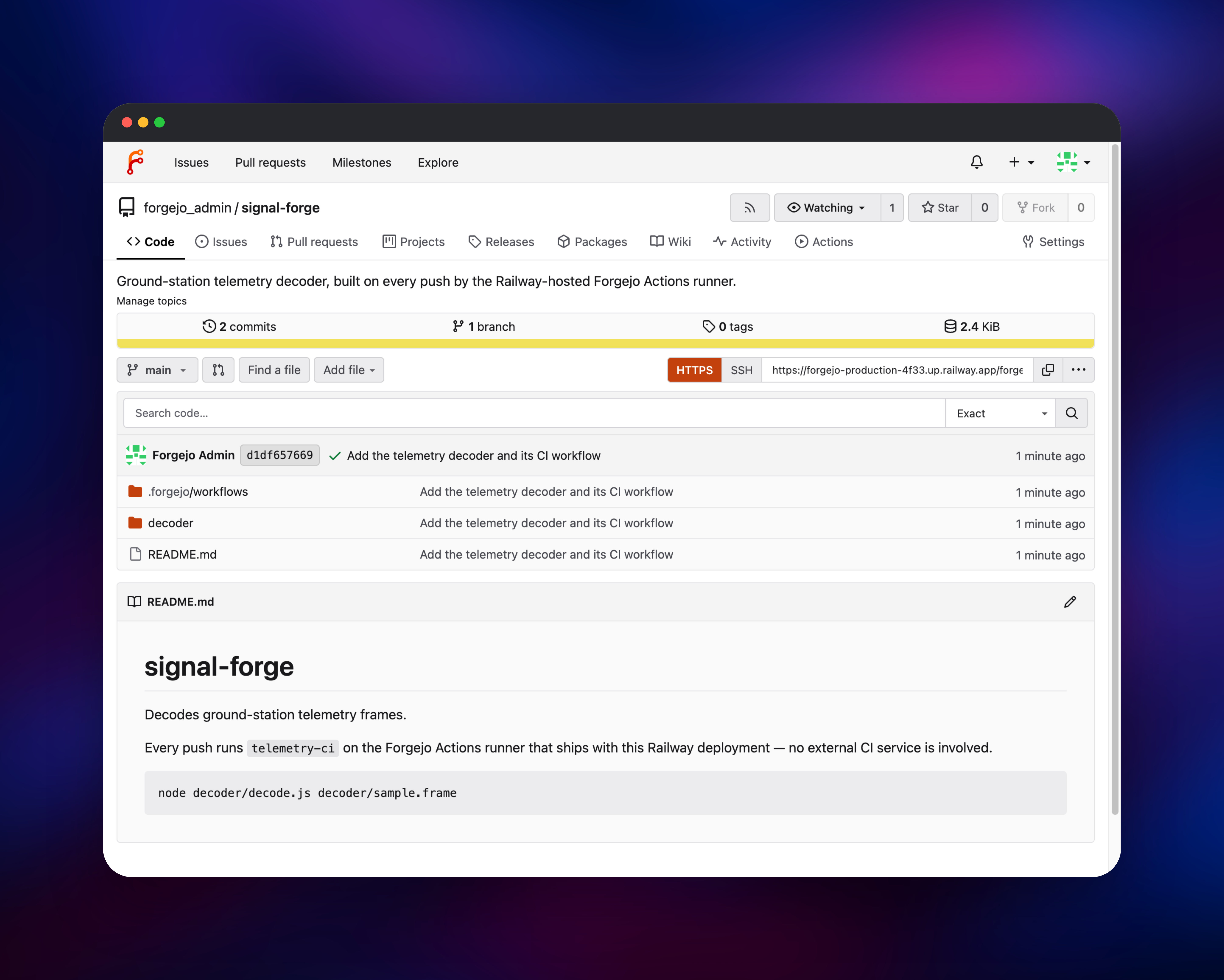
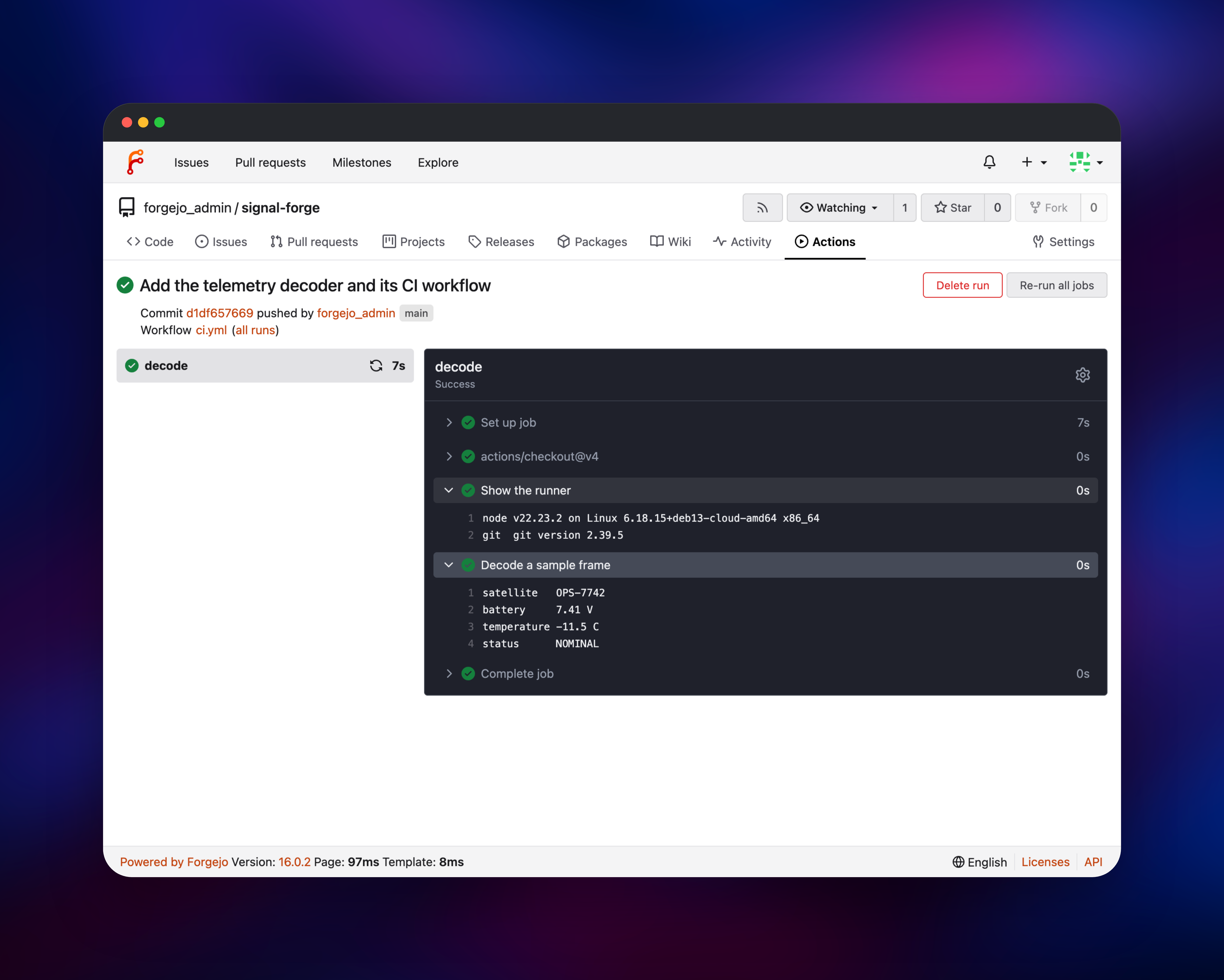
Open the public URL once the deployment is green and you will land on a working forge with registration already closed. Sign in with the administrator username and password you set at deploy time — there is no setup wizard and no default password to change, because the account is created during the first boot. Create your first repository from the + menu, tick Initialize repository, and clone it over HTTPS using the URL on the repository page. For SSH, add a public key under Settings → SSH / GPG keys and clone from the address on the SSH tab, which already carries the proxy host and port. To confirm CI is alive, commit a workflow at .forgejo/workflows/ci.yml with runs-on: host and push: the run appears under the repository's Actions tab within seconds. The bundled runner shows as idle under Site Administration → Actions → Runners, and you can invite your team from Site Administration → User Accounts.
About Hosting Forgejo
Forgejo does what a Git host has to do and stops there: it serves repositories, reviews code and runs CI, without the sprawl that makes larger platforms expensive to operate. Self-host it when code must stay on infrastructure you control, or when per-seat pricing stops making sense.
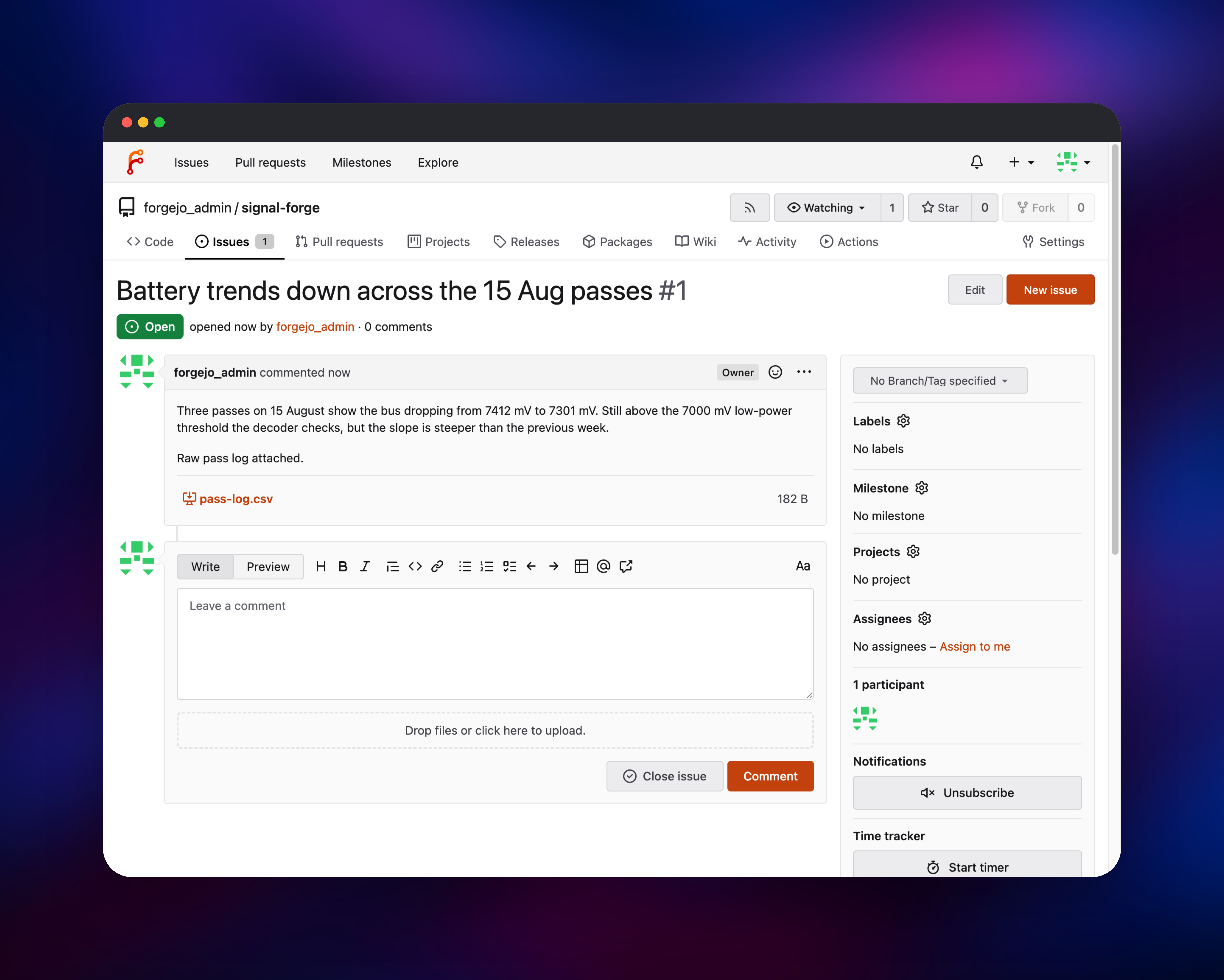
- Repositories with pull requests, code review, protected branches and required checks
- Issues, labels, milestones, projects and a per-repository wiki
- Forgejo Actions, a CI system whose workflow syntax is compatible with GitHub Actions
- A package registry covering container images, npm, Maven, PyPI, Cargo, NuGet and more
- Git LFS, mirroring, releases, a REST API, organisations, teams and two-factor authentication
The forge runs as one service because Git repositories live on a filesystem, and the volume at /data makes them durable across restarts. PostgreSQL holds every row that is not a Git object: users, issues, pull requests, CI runs. Redis carries the cache, sessions and queues, so a redeploy does not sign everyone out.
Why Deploy Forgejo on Railway
Railway removes the operational work that usually comes with running a forge.
- PostgreSQL, Redis and object storage are provisioned and connected for you
- The public HTTPS domain and its certificate are issued automatically
- A TCP proxy exposes Git over SSH without running your own server
- The Actions runner is registered at deploy time, so CI works immediately
- Volumes, health checks and restart policies are configured already
Common Use Cases
- A private forge for a team that wants GitHub's workflow on its own infrastructure
- Client or contract work whose source cannot sit on a third-party platform
- Mirroring public repositories to keep a durable, self-owned copy with its own CI
- Publishing internal container images, npm packages or Python wheels
Dependencies for Forgejo
- Forgejo —
codeberg.org/forgejo/forgejo:16: web UI, Git HTTP, SSH and API - Forgejo Actions runner —
code.forgejo.org/forgejo/runner:13, runs CI workflows - PostgreSQL 18 — repository metadata, issues, pull requests, CI history
- Redis — cache, session store and background queues
- Storage bucket — attachments, avatars, LFS, packages, release assets, job logs
- Volume at
/data— Git repositories and SSH host keys
Environment Variables Reference
| Variable | Purpose |
|---|---|
FORGEJO_ADMIN_USERNAME / _PASSWORD / _EMAIL | The first administrator account |
FORGEJO_RUNNER_SECRET | Shared secret linking the runner to the forge |
FORGEJO_RUNNER_LABELS | Labels a workflow's runs-on must match |
FORGEJO_RUNNER_CAPACITY | Concurrent CI jobs per runner |
FORGEJO__service__DISABLE_REGISTRATION | Set false to allow public signup |
FORGEJO__mailer__ENABLED | Set true and add SMTP settings to send notifications |
Any setting in Forgejo's app.ini can be supplied as FORGEJO__<section>__; a dot inside a section name is escaped as _0X2E_.
Deployment Dependencies
- Source: codeberg.org/forgejo/forgejo and code.forgejo.org/forgejo/runner
- Documentation: forgejo.org/docs
Hardware Requirements for Self-Hosting Forgejo
| Resource | Minimum | Recommended |
|---|---|---|
| CPU | 1 vCPU | 2 vCPU, plus 2 for the runner |
| RAM | 512 MB | 2 GB, plus 2 GB for the runner |
| Storage | 5 GB volume | 20 GB+, sized to your repositories |
| Runtime | Go binary, Linux container | PostgreSQL 18, Redis, S3-compatible storage |
Forgejo is frugal — the binary idles in a few hundred megabytes. CI consumes the resources, so give the runner headroom matching the builds you expect.
Self-Hosting Forgejo with Docker
The template needs none of this, but it is what running Forgejo yourself looks like. Start the forge with SQLite and a local volume:
docker run -d --name forgejo \
  -p 3000:3000 -p 222:22 \
  -v forgejo-data:/data \
  codeberg.org/forgejo/forgejo:16
Point it at PostgreSQL with environment variables instead of editing app.ini by hand:
docker run -d --name forgejo \
  -e FORGEJO__database__DB_TYPE=postgres \
  -e FORGEJO__database__HOST=postgres:5432 \
  -e FORGEJO__database__NAME=forgejo \
  -e FORGEJO__database__USER=forgejo \
  -e FORGEJO__database__PASSWD=changeme \
  -v forgejo-data:/data codeberg.org/forgejo/forgejo:16
How Much Does Forgejo Cost to Self-Host?
Forgejo is free software under the GPL-3.0-or-later licence: no paid tier, no enterprise edition, no per-seat pricing, every feature including CI and the package registry available to everyone. Self-hosting costs only infrastructure, so on Railway you pay for the compute, storage and bandwidth the forge and its runner use. CI usually moves the bill.
Forgejo vs Gitea vs GitLab CE
| Forgejo | Gitea | GitLab CE | |
|---|---|---|---|
| Governance | Non-profit, elected | For-profit company | Public company |
| Licence | GPL-3.0-or-later | MIT, open-core add-ons | MIT, paid tiers |
| Footprint | Go binary, ~512 MB | Go binary, ~512 MB | 4 GB+, several services |
| CI | Forgejo Actions | Gitea Actions | GitLab CI |
Forgejo and Gitea feel almost identical to use; the difference is who decides where the project goes. GitLab CE is heavier, worth it for a whole DevOps suite rather than a Git forge.
FAQ
What is Forgejo?
A self-hosted Git forge for hosting repositories, reviewing pull requests, tracking issues and running CI, maintained by a non-profit under the GPL-3.0-or-later licence.
What does this Railway template deploy?
Forgejo, a Forgejo Actions runner, PostgreSQL, Redis and a storage bucket, plus a volume for Git repositories, a public HTTPS domain and a TCP proxy for Git over SSH.
Why does the template include PostgreSQL, Redis and a storage bucket?
Forgejo can run on SQLite and local disk, but that does not survive a container being replaced. PostgreSQL holds the metadata, Redis keeps sessions and queues out of process memory, and the bucket stores attachments, LFS objects and packages without filling the volume.
How do I run CI on self-hosted Forgejo?
The runner ships registered and idle. Commit a workflow to .forgejo/workflows/ with runs-on: host and push. Syntax is largely GitHub Actions compatible, so many workflows run with only the runs-on line changed.
How do I add users if registration is disabled?
Create them from Site Administration → User Accounts, or set FORGEJO__service__DISABLE_REGISTRATION to false to reopen signup.
Is CI isolated from the forge?
The runner executes jobs in its own container, separate from Forgejo, but workflow steps are not sandboxed from that container. Give push access only to people you trust with it.
Template Content
forgejo
gridalpha/forgejo-railwayforgejo-runner
gridalpha/forgejo-railwayRedis
redis:8.2forgejo-storage
Bucket


