
Deploy Huginn
Self-hosted IFTTT alternative: agents watch the web and act
huginn-worker
Just deployed
huginn
Just deployed
postgres
Just deployed
/var/lib/postgresql/data

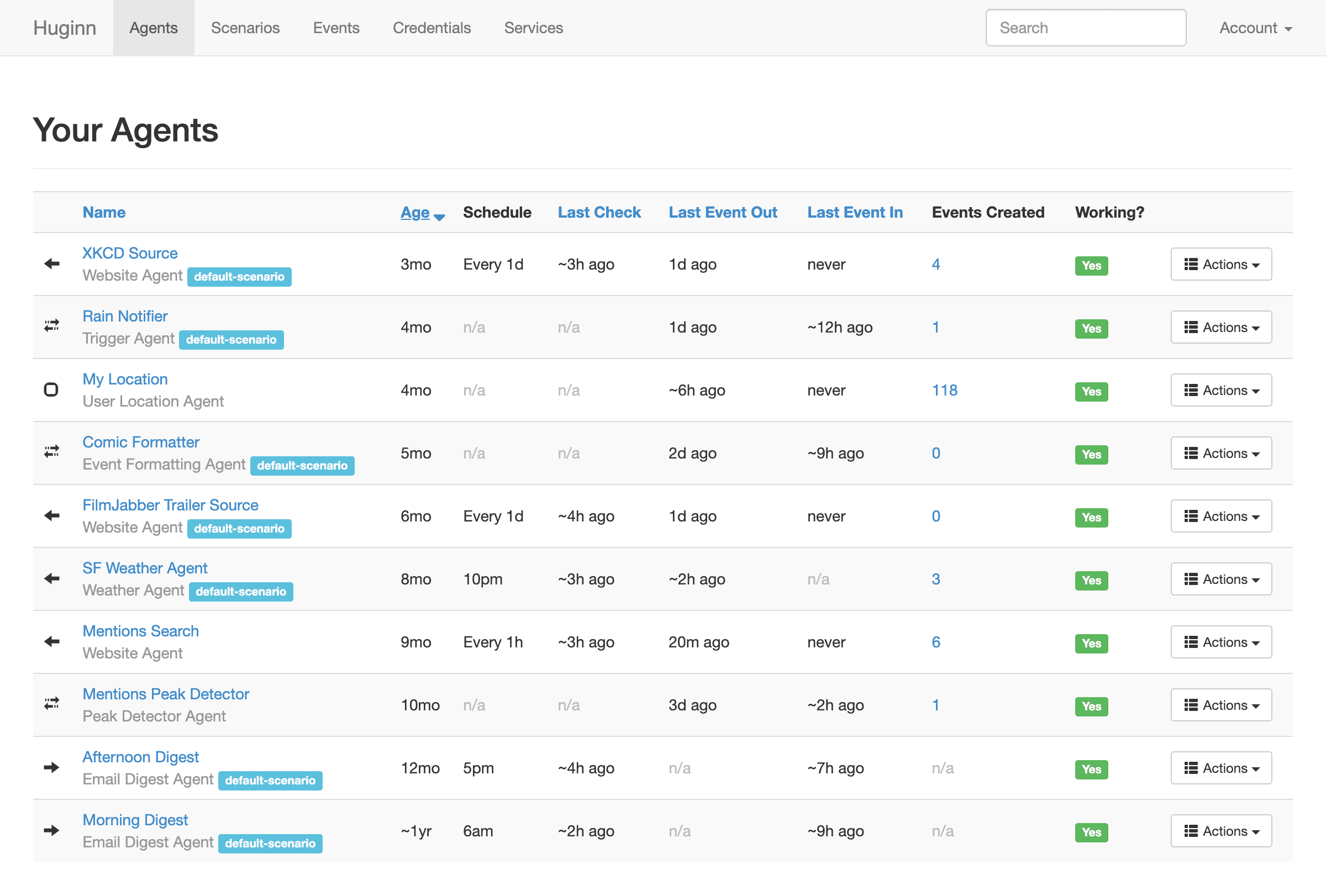
Screenshot: upstream's own agent-list screenshot (huginn/huginn README, MIT), showing the agents dashboard with event flows.
Deploy and Host
Huginn is a self-hosted IFTTT / Zapier: agents watch the web and act on your behalf. With 50,000+ stars, it covers RSS feeds, page scraping, price and weather tracking, webhooks and MQTT, and notifications by email, Slack, Telegram, or webhook — and agents can chain into each other or publish your own feeds and JSON endpoints.
What gets deployed:
- huginn — web UI (Puma); runs database migrations and seeds the admin account on first boot
- huginn-worker — threaded background worker that actually runs your agents
- postgres — PostgreSQL 16 companion, data on a Railway volume
The deploy form has two generated fields — a Rails secret and an admin password — and nothing else to fill in. On first boot the admin account (admin + your generated password) is created automatically, with 6 default example agents ready to try.
About Hosting
Three services from the official image (ghcr.io/huginn/huginn-single-process v2026.11.19, MIT). Railway's injected PORT is honored natively — Puma binds 0.0.0.0:$PORT on every boot. The mailer domain is derived from the live public domain, and the healthcheck is / (unauthenticated, 200). All persistent state lives in Postgres; the app services are stateless, so agents, events, and users survive redeploys.
Why Deploy
- Zero-fuss start: no setup wizard, no email step — admin account seeded on first boot, 6 example agents already there.
- Real automation: a decade of agent types — scrape a page and get emailed when it changes, watch RSS/IMAP/webhooks/MQTT, track flights and deals, post to Slack/Telegram, summarize with an OpenAI-compatible API.
- Always-on by design: the worker runs continuously, so scheduled agents fire without a second deploy.
- Private by default: your agents and the data they collect stay in your own database; no third-party automation cloud sees them.
Common Use Cases
- Replace IFTTT/Zapier with a self-hosted watcher: get emailed when a page changes, a price drops, or a flight deal appears.
- Build a personal news/weather/deal digest from RSS, scraped pages, and APIs, delivered on your schedule.
- Chain agents together — scrape → filter → digest → notify — and publish the results as your own feed or JSON endpoint.
- Watch webhooks, MQTT topics, and IMAP mailboxes, and act on what arrives (post to Slack, file it, trigger another agent).
Dependencies for
Everything this template provisions, and how each piece is configured:
Deployment Dependencies
| Setting | Value |
|---|---|
| Runtime | Huginn v2026.11.19 (Ruby 4.0 + Rails, Puma) + threaded worker + PostgreSQL 16 |
| Plan | Hobby; three services |
| Port | Railway's injected PORT, honored natively on every boot |
| Persistence | One Railway volume at /var/lib/postgresql/data (Postgres data); app services stateless |
| Healthcheck | / (unauthenticated, 200); login at /users/sign_in |
Environment variables
| Variable | Value | Notes |
|---|---|---|
APP_SECRET_TOKEN | ${{secret(64)}} | Generated once; must stay stable across redeploys or sessions and encrypted credentials break |
SEED_PASSWORD | ${{secret(16)}} | Admin password (username admin, email admin@example.com) |
DATABASE_HOST / DATABASE_PASSWORD | auto-wired | From the Postgres companion |
POSTGRES_PASSWORD | ${{secret(32)}} | Postgres service password |
SMTP_* | optional | Outgoing mail for email Agents; without SMTP, email Agents cannot send |
EMAIL_FROM_ADDRESS | optional | Sender address for email Agents |
OPENAI_API_KEY / OPENAI_BASE_URL | optional | OpenAI-compatible API for the LLM/speech/image/video agents |
INVITATION_CODE | try-huginn | Code required for new-user signup |
TIMEZONE | Pacific Time (US & Canada) | Container timezone |
PORT | injected | Set by Railway, honored automatically |
Everything else (SEED_USERNAME, DATABASE_*, PGDATA, HUGINN_ROLE, FORCE_SSL, and the rest) is baked in or derived at boot. See the upstream .env.example for the full variable list.
Template Content