
Deploy Opengist
Opengist — self-hosted Git-powered pastebin for code snippets
opengist
Just deployed
/opengist

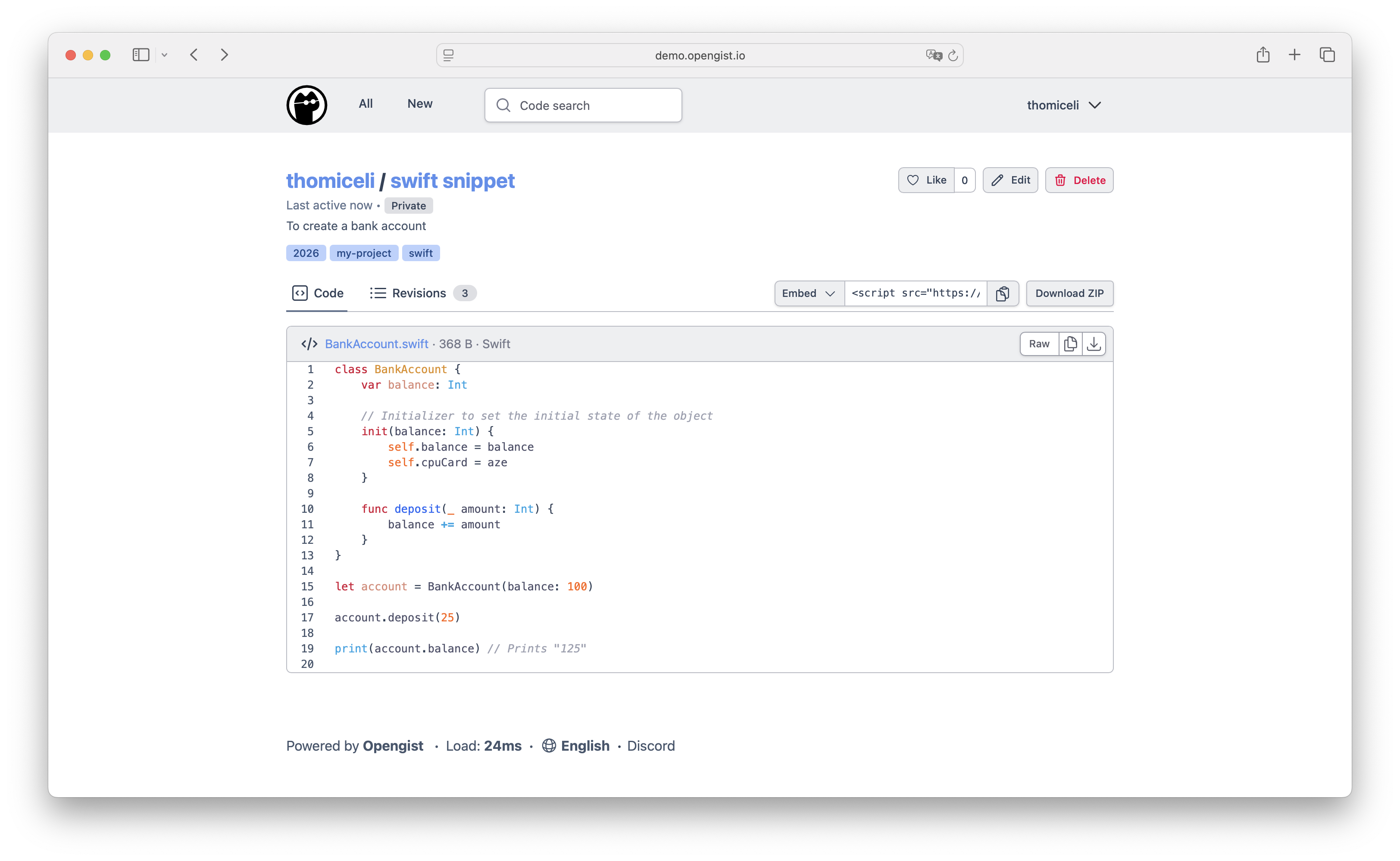
Opengist's gist editor — upstream screenshot from the Opengist project (docs/public/opengist-demo.png).
Deploy and Host
Opengist is a self-hosted pastebin powered by Git — an open-source alternative to GitHub Gist. Create code snippets and notes as gists, each one a real Git repository you can clone, pull, and push over HTTP. One-click deploy creates a single Go service with a persistent volume and no companion database: gists, users, and settings live in SQLite on the volume. After deploy, open the public URL and register — the first account created becomes the admin. There is no setup wizard and no email step.
About Hosting
Hosting Opengist on Railway keeps your snippets on your own volume instead of a SaaS. The deployment is a single always-on Go service: the wrapper maps Railway's injected PORT onto Opengist's HTTP port on every boot (upstream ignores generic PORT), derives the public URL at boot from the live Railway domain, and seeds a stable session secret from the deploy form. The deploy form has one generated field and nothing to type. Signup stays open by default — disable it under Admin → Configuration once your users are in.
Why Deploy
- Your snippets, your Git repos: every gist is a Git repository — clone it, push updates, keep full history, instead of a paste that rots in a chat log.
- Tiny footprint: a single Go binary with embedded SQLite and Bleve search, a few MB of RAM at rest — no database service to run or pay for.
- No account needed to read: public gists are readable without logging in, so a shared link just works for anyone.
- Search that finds code: the built-in index searches gist content, titles, and authors.
- Git over HTTP: clone and push gists with plain
gitthrough the public URL — no SSH keys or extra ports. - Self-hosted data: your gists stay on your Railway volume, with no tracking and no subscription.
Common Use Cases
- A personal snippet library: shell one-liners, SQL queries, and config fragments, versioned in Git instead of scattered across notes.
- Sharing code with a team: send a gist link instead of a 200-line paste, and let teammates clone it.
- A public code notebook: publish reusable snippets with syntax highlighting and Markdown rendering.
- Replacing GitHub Gist for private work: internal snippets that never leave your own server.
Dependencies for
- A single Opengist service (Go, SQLite, no companion service).
- One persistent volume mounted at
/opengist(database at/opengist/opengist.db, gist Git repos, Bleve index, logs). - Environment variables (condensed reference — full documentation in the repo README):
| Variable | Default | Description |
|---|---|---|
OG_SECRET_KEY | ${{secret(32)}} | Random secret for session signing and MFA data encryption. Keep it stable — changing it invalidates all user sessions. |
OG_HTTP_PORT | (derived from $PORT at boot) | HTTP port Opengist listens on. Set by the entrypoint from Railway's injected PORT. |
OG_OPENGIST_HOME | /opengist | Data home on the volume. Baked into the image. |
OG_EXTERNAL_URL | (derived from RAILWAY_PUBLIC_DOMAIN at boot) | Public URL of the instance. Set manually only for a custom domain. |
OG_SSH_GIT_ENABLED | false | Built-in SSH server disabled: Railway's public edge is HTTP-only, so port 2222 is not publicly reachable. Git over HTTP works through the proxy. |
Deployment Dependencies
- Plan tier: Hobby is enough — the service idles at a few MB of RAM.
- No companion database, no extra services.
Template Content
opengist
INAPP-Mobile/opengist
