
Deploy OpenProject
Open source project management with Gantt charts and agile boards

Just deployed
/var/lib/postgresql/data
openproject-cron
Just deployed

Redis
Just deployed
/data
openproject-web
Just deployed

openproject-proxy
Just deployed
openproject-worker
Just deployed
hocuspocus
Just deployed
openproject-attachments
Bucket
Just deployed
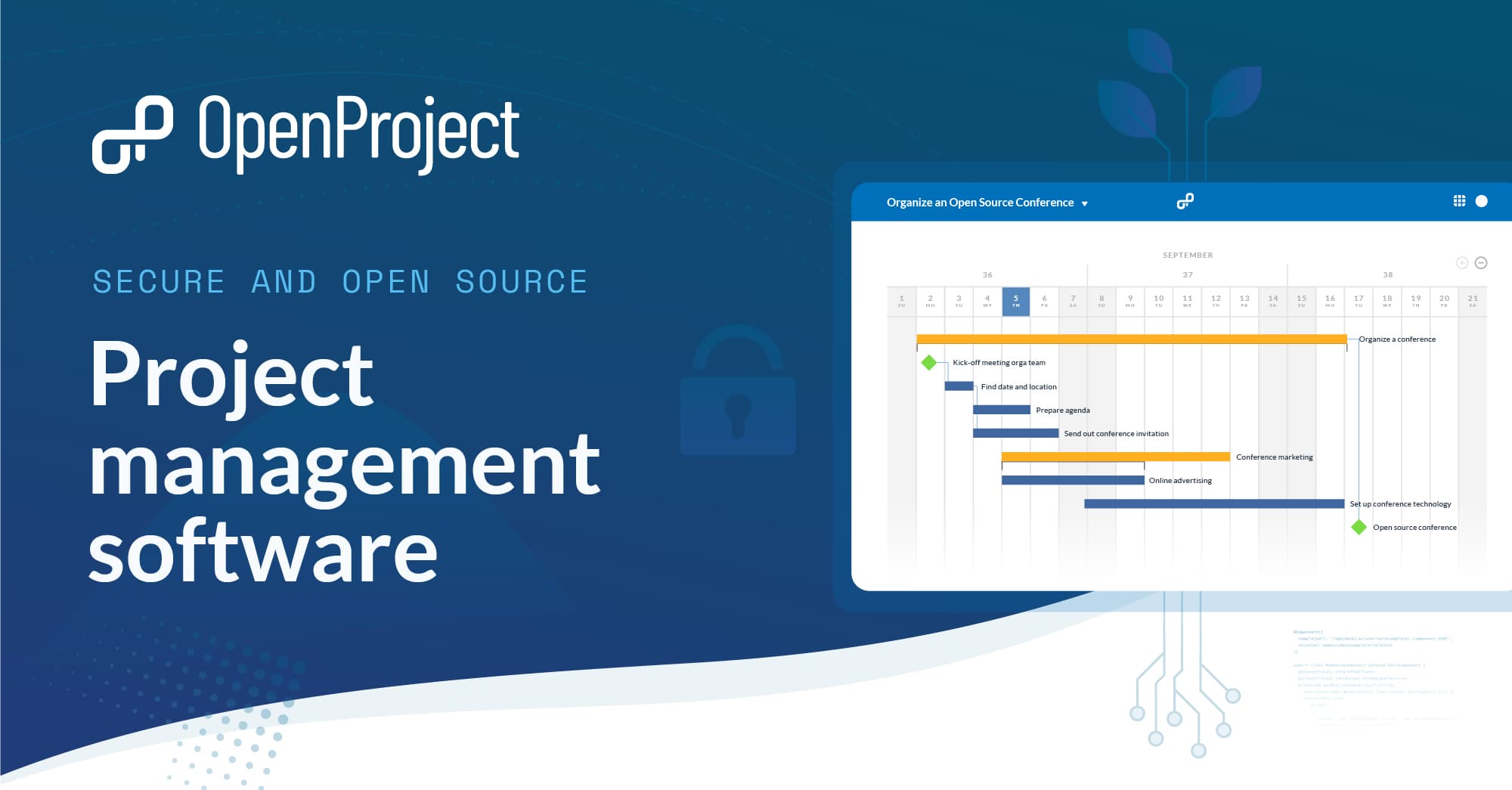
Deploy and Host OpenProject on Railway
OpenProject is open source project management software for teams that plan real work: work packages with hierarchies and custom fields, Gantt charts, Scrum and Kanban boards, a team planner, meetings with agendas, wikis, and time and cost tracking. It shares Redmine's Ruby on Rails lineage but has moved well past it, with an Angular front end and a documented REST API. Teams self-host OpenProject for data residency, for classic scheduling beside agile boards, or because per-seat pricing stops adding up. Deploy OpenProject on Railway and you get the Community edition in full — GPL-licensed, no seat limit, no trial clock.
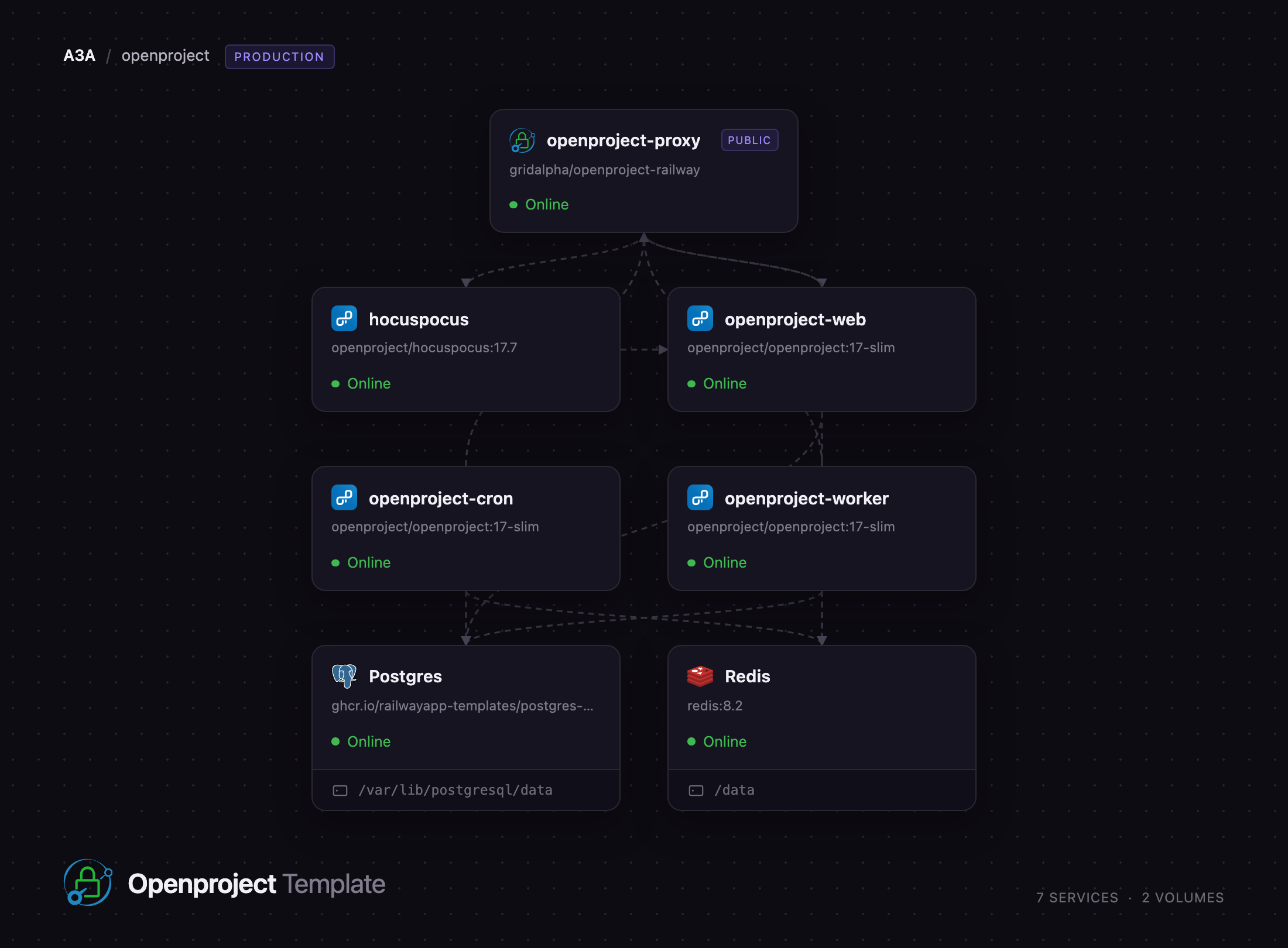
It runs the multi-process topology OpenProject documents for production, not a single all-in-one container. A Caddy service is the public entry point and the only thing exposed to the internet. Behind it sit a Puma web service, a GoodJob worker, a scheduler for inbound email, and a Hocuspocus websocket server for collaborative editing. PostgreSQL holds every record, Redis is the shared Rails cache, and an object storage bucket holds attachments — which is what lets web and worker read each other's uploads without a shared disk.
Getting Started with OpenProject on Railway
Open the public URL and you land on the sign-in page. Log in as admin with the password from OPENPROJECT_SEED_ADMIN_USER_PASSWORD; if you left the generated default, copy it from that variable in the Railway dashboard. OpenProject forces a password change on that first sign-in, and the replacement needs ten characters with upper and lower case, a digit and a symbol. Pick a language and the home screen appears with a seeded demo project.
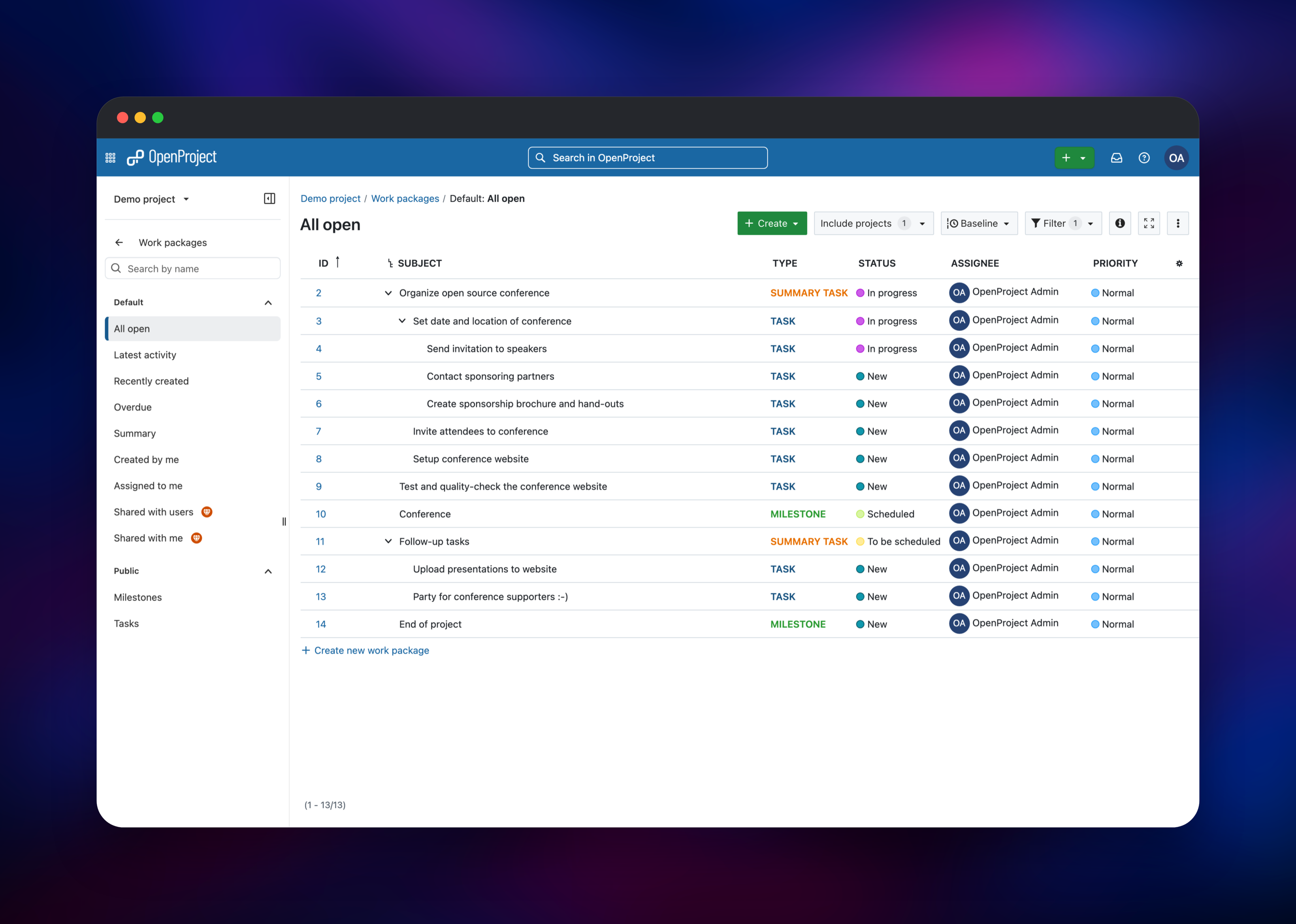
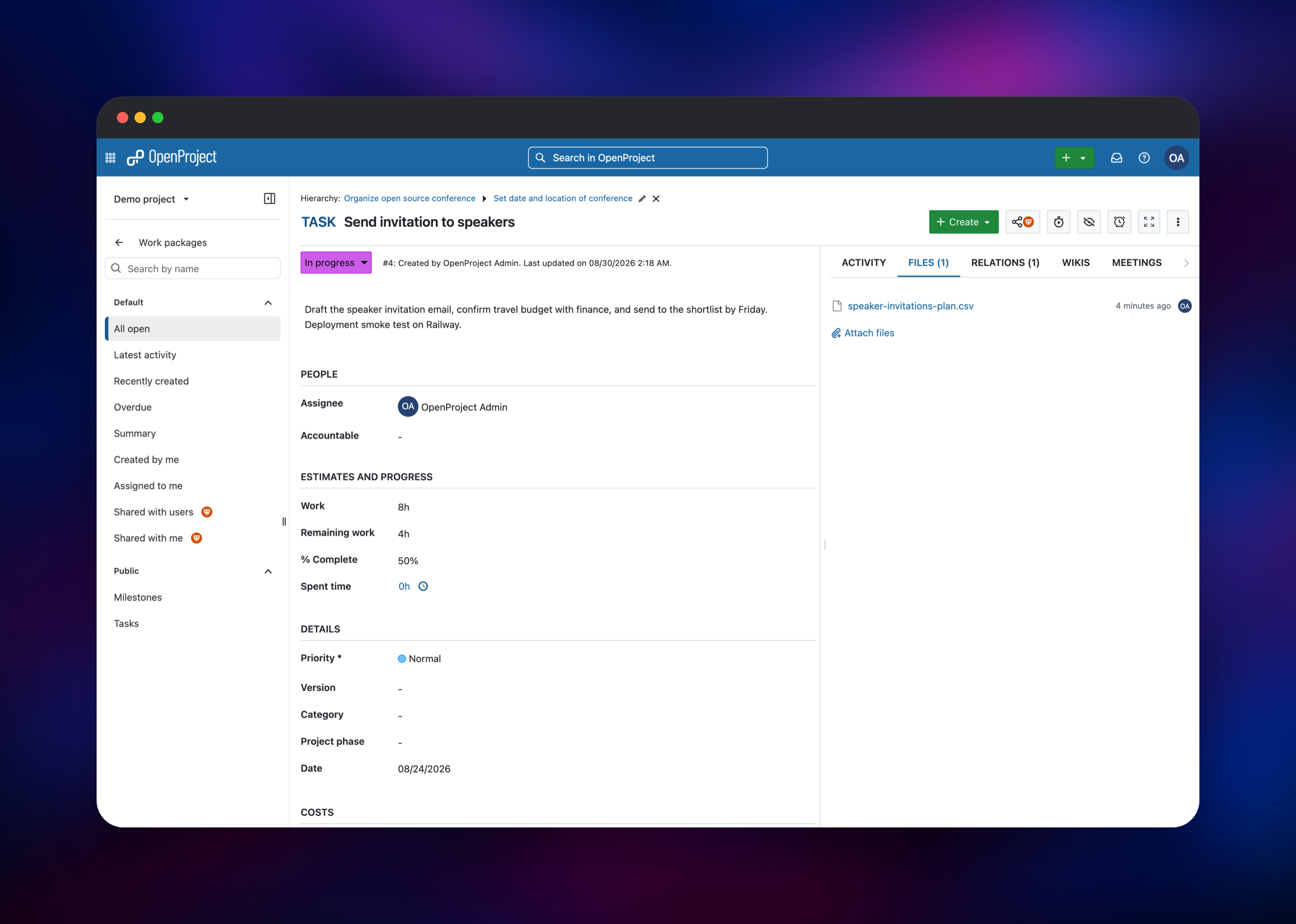
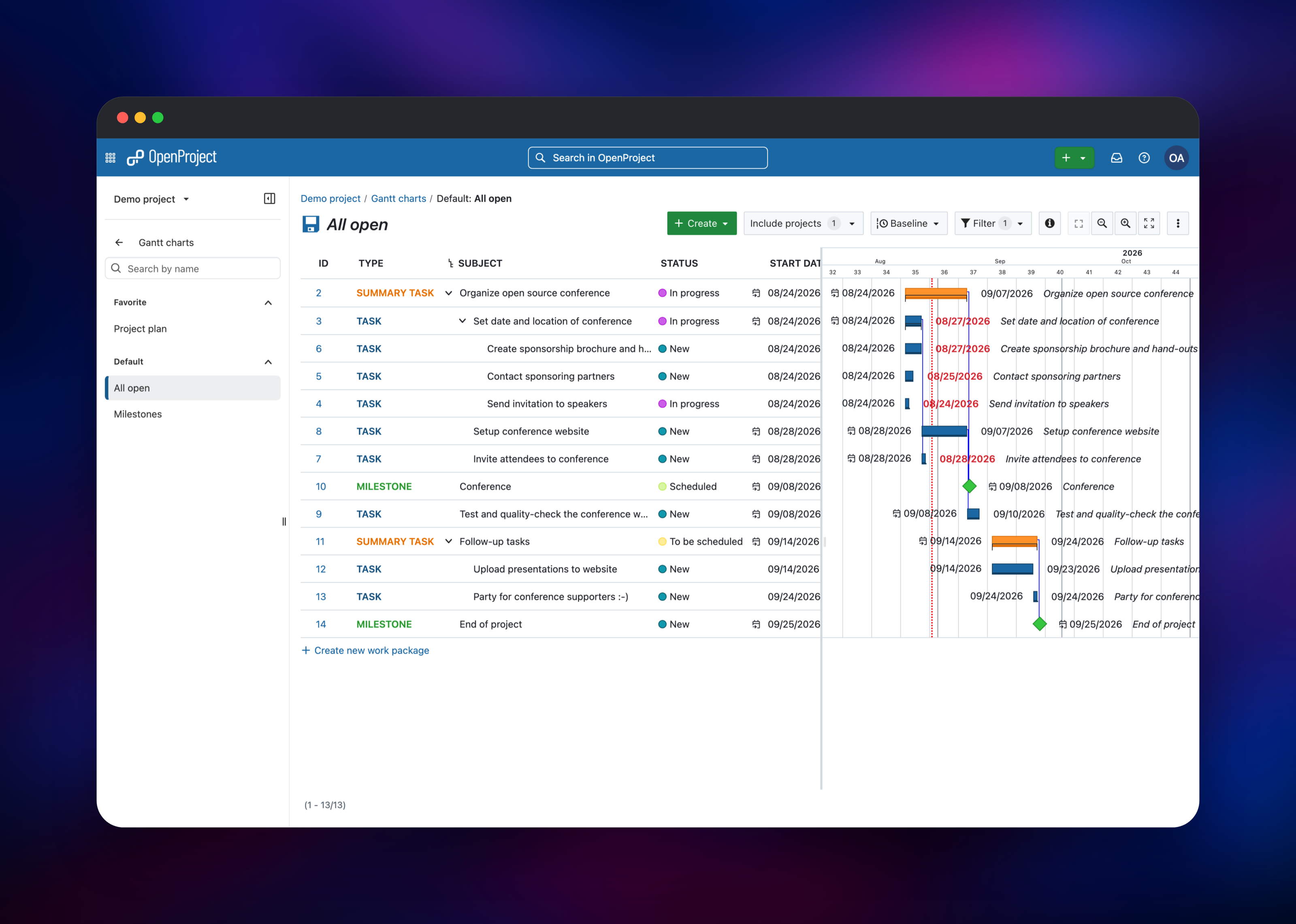
Open Demo project → Work packages, create one of your own, give it a description and attach a file. That attachment is the best end-to-end check: the browser uploads straight to object storage and the app signs the download link, so a file that comes back proves the database, the bucket and the front end are all wired. Switch to Gantt charts to confirm scheduling renders, then use Administration → Users & permissions to invite your team.
About Hosting OpenProject
OpenProject is a full project management suite, not an issue tracker with extras bolted on. One instance carries a portfolio of projects, each with its own modules, roles and workflows, and rolls them into shared views.
- Work packages with hierarchies, custom fields and type-specific workflows
- Gantt charts with dependencies, baselines and automatic scheduling
- Scrum backlogs, sprints, action boards and a drag-and-drop team planner
- Meetings with recurring series and linked work packages
- Wikis, documents, attachments, budgets and time tracking
- REST API v3, OAuth 2 applications and webhooks
The deployment splits OpenProject the way its own production compose file does. The web service answers browser and API traffic. The worker runs GoodJob, which executes exports, notification digests and scheduled cleanups — without it the app looks fine while long-running actions never finish. The scheduler polls an IMAP mailbox so email replies become work packages, and stays idle until configured. Caddy routes /hocuspocus to the websocket server and everything else to the app, because the browser must reach both on one origin.
Why Deploy OpenProject on Railway
Railway removes the infrastructure work that self-hosting OpenProject normally involves.
- Managed PostgreSQL, Redis and object storage, provisioned with the app
- Private networking between services; only the Caddy entry point is public
- HTTPS and a domain on first deploy, custom domains a few clicks away
- Migrations run on every deploy, so upgrades are just a redeploy
- Per-service logs, metrics and health checks, no monitoring stack to run
Common Use Cases
- Replacing a per-seat Jira or Asana subscription with an instance your team owns
- Agency and client projects where scope, budget and logged time live in one place
- Coordinating a roadmap in Gantt view while squads work day to day on Kanban boards
- Public-sector, healthcare and research work whose data residency rules out SaaS
Dependencies for OpenProject
openproject/openproject:17-slim— the Rails application, shared by the web, worker and scheduler services (opf/openproject)openproject/hocuspocus:17.7— collaborative editing websocket servercaddy:2-alpine— the public entry point, built from gridalpha/openproject-railway- PostgreSQL 13+ — every project, work package and comment record
- Redis — the shared Rails cache
- S3-compatible object storage — attachments, shared by every application process
Environment Variables Reference
| Variable | Purpose |
|---|---|
SECRET_KEY_BASE | Signs sessions and cookies. Identical on all three application services, and never changed. |
OPENPROJECT_HOST__NAME | Public hostname. Also arms host-header checking, so add a custom domain to OPENPROJECT_ADDITIONAL__HOST__NAMES too. |
OPENPROJECT_SEED_ADMIN_USER_PASSWORD | Password for the first admin account, read once while the user table is empty. |
OPENPROJECT_SELF__REGISTRATION | 0 off, 1 admin approval, 2 email activation, 3 open. Defaults to 0. |
OPENPROJECT_ATTACHMENTS__STORAGE | fog sends attachments to object storage instead of local disk. |
OPENPROJECT_SMTP__ADDRESS | Outgoing mail relay. Unset by default, which disables email. |
Deployment Dependencies
- Source: github.com/opf/openproject
- Images: openproject/openproject, openproject/hocuspocus
- Docs: openproject.org/docs, configuration reference
Hardware Requirements for Self-Hosting OpenProject
| Resource | Minimum | Recommended |
|---|---|---|
| CPU | 2 vCPU total | 4 vCPU |
| RAM | 4 GB total | 8 GB, 4 GB of it for the worker |
| Storage | 10 GB Postgres | 20 GB plus object storage |
| Runtime | Ruby 4 (in the image) | PostgreSQL 13+, Redis 7+ |
The worker is the memory-hungry process, because PDF and Excel exports are built in RAM. If exports fail on large projects, raise its memory first.
Self-Hosting OpenProject with Docker
Upstream publishes a production compose file:
git clone https://github.com/opf/openproject-docker-compose
cd openproject-docker-compose
cp .env.example .env
docker compose up -d
The all-in-one image takes one command, but bundles its own PostgreSQL and is not a production shape:
docker run -d -p 8080:80 --name openproject \
  -e OPENPROJECT_HOST__NAME=localhost:8080 \
  -e OPENPROJECT_SECRET_KEY_BASE=$(openssl rand -hex 64) \
  -v /var/lib/openproject/pgdata:/var/openproject/pgdata \
  -v /var/lib/openproject/assets:/var/openproject/assets \
  openproject/openproject:17
How Much Does OpenProject Cost to Self-Host?
The Community edition is free and GPLv3-licensed, with no user cap and no time limit, and it is what this template deploys. The Enterprise on-premises add-on unlocks extras such as custom themes, baseline comparison and enforced 2FA, at roughly €5.95 per member per month with a 25-user floor. Self-hosting on Railway costs only the compute, database and storage you use.
FAQ
What is OpenProject? Open source project management software covering work packages, Gantt scheduling, agile boards, meetings, wikis, and time and cost tracking. GPLv3-licensed and self-hostable in full.
What does this Railway template deploy? A Caddy entry point, the OpenProject web application, a GoodJob worker, an inbound-mail scheduler, a Hocuspocus collaborative editing server, PostgreSQL, Redis, and an object storage bucket.
Why does the template include a separate worker service? OpenProject runs exports, notification digests and scheduled cleanups as background jobs. Without a worker the interface loads but those jobs never run.
Why is object storage used instead of a disk volume? The web, worker and scheduler processes all read and write attachments, and a Railway volume attaches to exactly one service. Object storage gives all three the same files.
How do I add users to self-hosted OpenProject?
Self-registration ships disabled. Use Administration → Users & permissions to invite people, or set OPENPROJECT_SELF__REGISTRATION to 1 for admin-approved signups or 2 for email activation, which needs SMTP first.
How do I enable email notifications in self-hosted OpenProject?
Set OPENPROJECT_EMAIL__DELIVERY__METHOD=smtp plus OPENPROJECT_SMTP__ADDRESS, OPENPROJECT_SMTP__PORT, OPENPROJECT_SMTP__USER__NAME and OPENPROJECT_SMTP__PASSWORD on all three application services, then send a test mail from Administration → Emails and notifications.
Do I need the Enterprise edition? No. Everything above is Community edition, and the instance keeps working as it is without a licence key.
Template Content
openproject-cron
openproject/openproject:17-slimRedis
redis:8.2openproject-web
openproject/openproject:17-slimopenproject-proxy
gridalpha/openproject-railwayopenproject-worker
openproject/openproject:17-slimhocuspocus
openproject/hocuspocus:17.7openproject-attachments
Bucket