
Deploy OpenSEO
Open-source SEO platform for keyword research and site audits

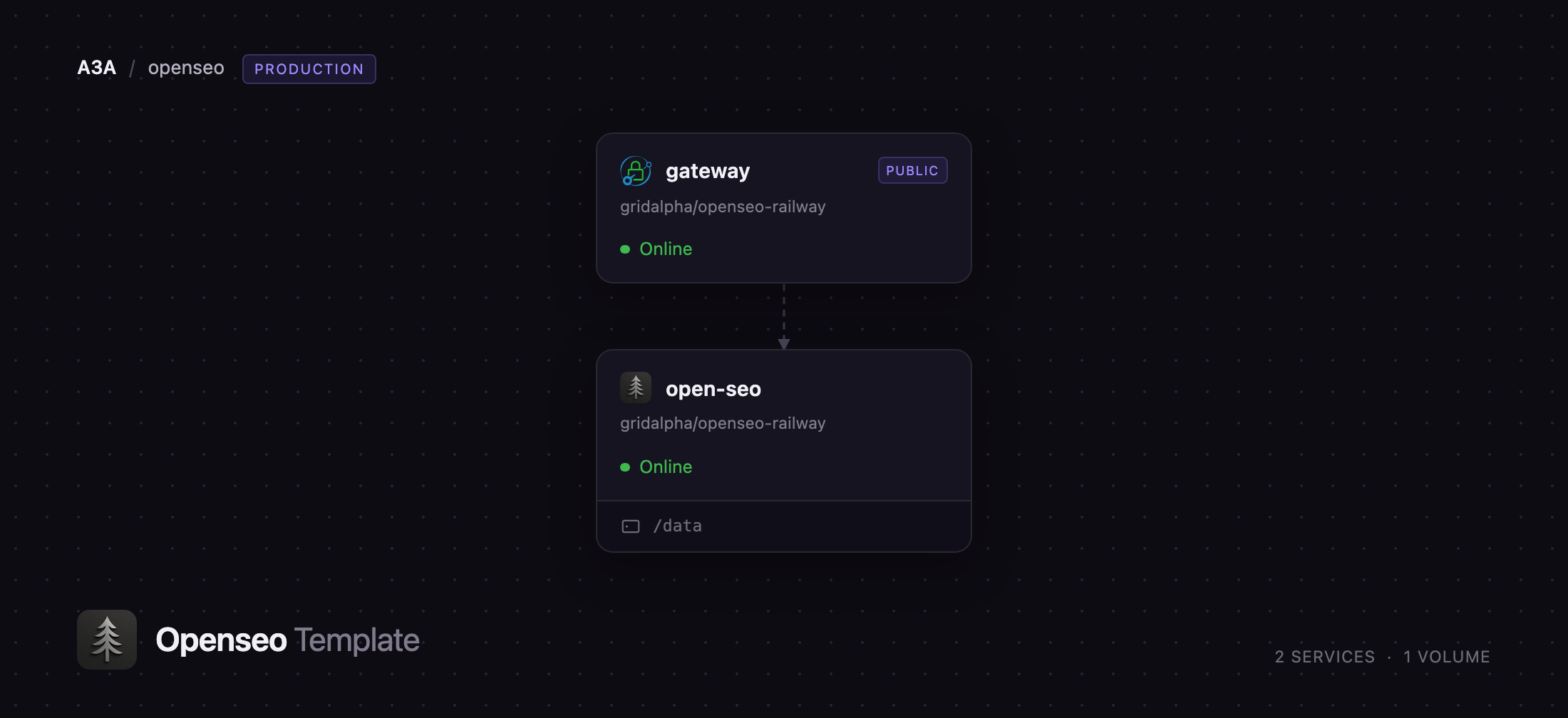
gateway
Just deployed
open-seo
Just deployed
/data
Deploy and Host OpenSEO on Railway
OpenSEO is an open-source SEO platform — keyword research, rank tracking, backlink and competitor analysis, site audits and AI-visibility tracking — built as an alternative to Semrush, Ahrefs and Ubersuggest. Instead of a per-seat subscription it runs on your own DataForSEO API key, so you pay the data vendor directly for the queries you make. It is MIT-licensed, ships first-class MCP support so agents like Claude Code and Codex can pull SEO data themselves, and is aimed at founders and small teams.
Self-host OpenSEO on Railway and this template gives you two services. open-seo is the application, built from upstream's self-host image with the client and worker bundle already compiled, so a container starts serving in seconds. gateway is a Caddy reverse proxy holding the only public domain and HTTP basic auth. That split matters: OpenSEO's Docker self-host mode has no authentication of its own, just a single injected admin user, and upstream's docs say to run it behind an auth-protected proxy. Requests hit gateway, the credential is checked, and the call is forwarded over the private network to open-seo, which has no public domain.
Getting Started with OpenSEO on Railway
Deploy the template, set a GATEWAY_PASSWORD, and wait for both services to go green. Open the public URL on gateway and the browser asks for a username and password; the username defaults to openseo. There is no second login inside the app, so that credential is the whole access control — pick something long.
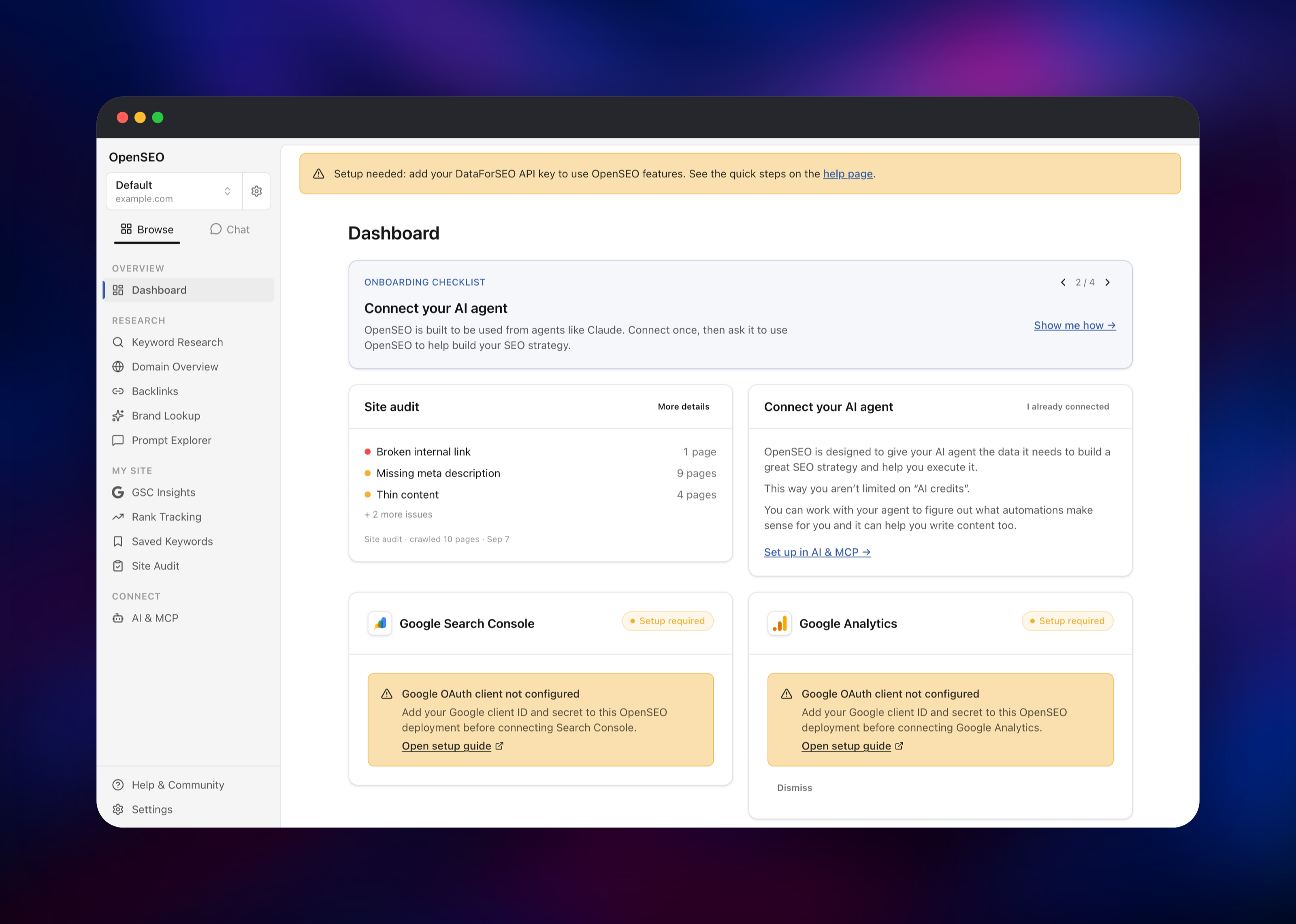
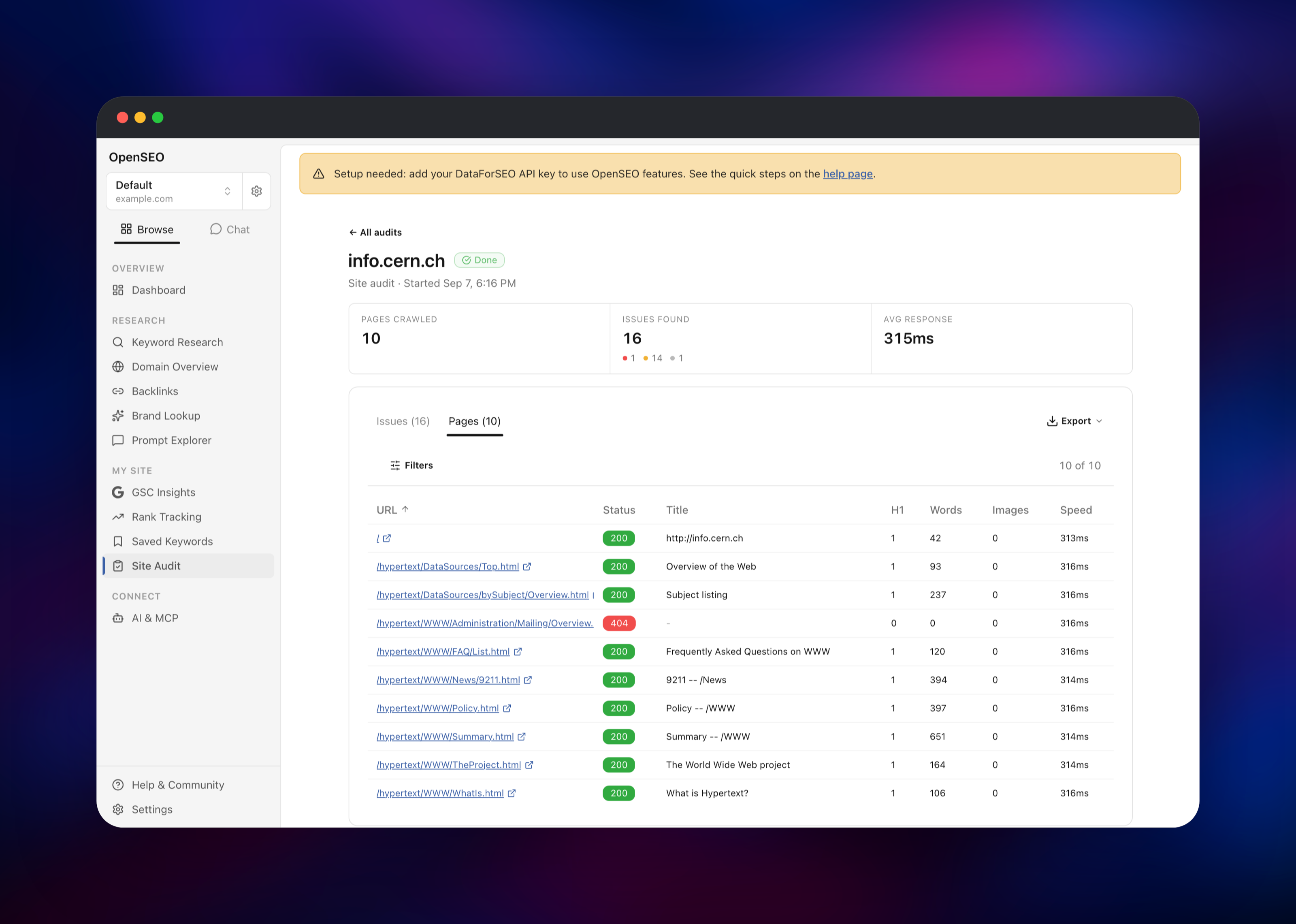
You land on the dashboard of a project called "Default" with an onboarding checklist. The first card asks what site you are working on; enter your domain and save, and the other cards start working against it. The quickest proof the deployment is healthy is the Site Audit page: enter a URL, set a page limit, leave Lighthouse unchecked and start it. The crawler is part of the app, so it runs before anything external is configured, and in a minute or two you get pages crawled, response times, and issues by severity.
Everything else — keyword volumes, backlinks, domain overviews, rank checks — needs a DataForSEO account. Set DATAFORSEO_API_KEY on open-seo to the base64 of your login and API password, not the key shown on the DataForSEO dashboard:
printf 'you@example.com:your-api-password' | base64
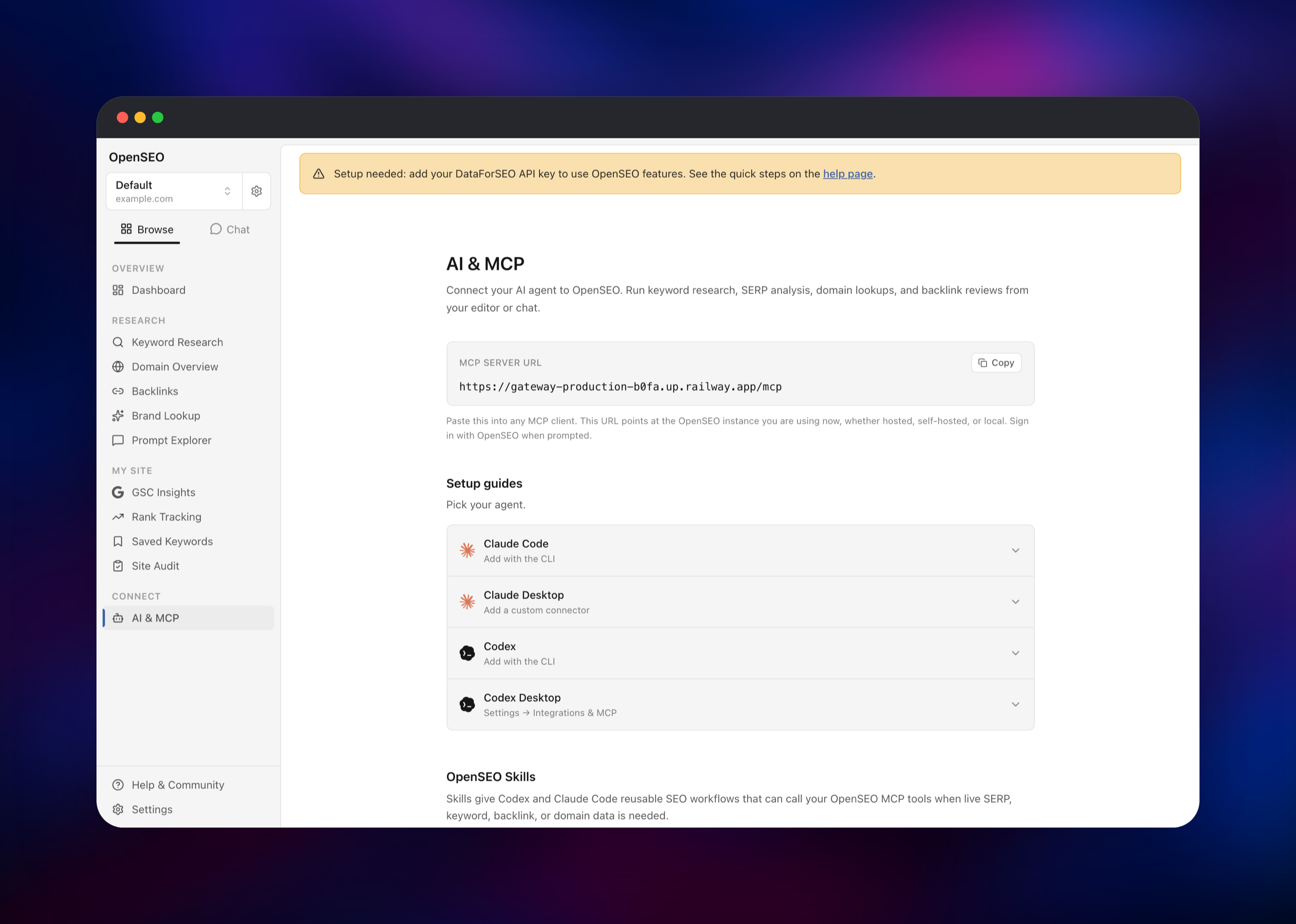
/api/health reports database status and, per feature, whether that key, a Google OAuth client and an OpenRouter key are configured. The AI & MCP page has the MCP server URL for your agent.
About Hosting OpenSEO
Commercial SEO suites bundle data and interface into one agency-priced subscription. OpenSEO separates them: the interface is yours to run, the data comes from DataForSEO at wholesale rates, and your keyword lists and crawl results stay in your own database.
Key features:
- Keyword research with volume, difficulty and CPC, plus clustering and saved lists
- Rank tracking across domains, with position history
- Backlink and competitor analysis, and domain overviews
- Site audits: an in-app crawler that reads
robots.txt, stays on the audited origin, and reports broken links, redirect chains, missing tags, thin content and indexability problems - AI visibility: brand lookup and a prompt explorer
- Search Console and Analytics connections, an MCP server, and packaged SEO skills
The app is one Cloudflare Worker bundle running under workerd. Its database, key-value stores, object storage, durable objects and background workflows all write to a single directory, which is why the template mounts a volume rather than provisioning Postgres or Redis. Caddy is the only piece with a public address, and serves an unauthenticated /healthz so Railway can probe it without the credential.
Why Deploy OpenSEO on Railway
Railway removes the setup work self-hosting normally implies:
- Both services build from one source repository and deploy on push
- A managed volume keeps projects, audits and keyword lists across redeploys
- Private networking keeps the application off the public internet
- HTTPS, a public domain, health checks and restart policies are configured for you
Common Use Cases
- A founder or in-house marketer replacing a Semrush or Ahrefs seat with a per-query bill
- An agency running keyword research and monthly audits across client domains
- A developer wiring the MCP server into Claude Code or Codex so the agent researches keywords and audits pages as it writes
Dependencies for OpenSEO
ghcr.io/every-app/open-seo:latest— the applicationcaddy:2-alpine— the basic-auth gateway in front of it- A persistent volume at
/dataon theopen-seoservice - A DataForSEO account, for every feature that queries live SEO data
Environment Variables Reference
| Variable | Service | Purpose |
|---|---|---|
GATEWAY_PASSWORD | gateway | The password you sign in with. Required |
GATEWAY_USERNAME | gateway | Defaults to openseo |
DATAFORSEO_API_KEY | open-seo | base64 of your DataForSEO login:password; unlocks keyword, backlink, domain and rank data |
ALLOWED_HOST | open-seo | Host allow-list. Use a leading-dot form of your own domain when you attach one |
OPENROUTER_API_KEY | open-seo | Enables SAM, the in-app SEO agent |
GOOGLE_CLIENT_ID / GOOGLE_CLIENT_SECRET / BETTER_AUTH_SECRET | open-seo | Search Console and Analytics; all three together |
OPENSEO_TELEMETRY_DISABLED | open-seo | 1 switches off upstream's anonymous usage heartbeat |
Deployment Dependencies
- Source and image: every-app/open-seo (MIT), published as
ghcr.io/every-app/open-seo - Docs: self-hosting, DataForSEO key setup
- Runtime: Node 22 with the Cloudflare workerd runtime
Hardware Requirements for Self-Hosting OpenSEO
| Resource | Minimum | Recommended |
|---|---|---|
| CPU | 1 vCPU | 2 vCPU |
| RAM | 1 GB | 2 GB |
| Storage | 5 GB volume | 5–10 GB, by audit history |
| Runtime | Node 22 / workerd | Node 22 / workerd |
Crawling is spiky: a large audit fetches and parses many pages at once, so raise memory before the page limit.
Self-Hosting OpenSEO
Upstream ships a Compose file. Clone the repo, add your key to .env and start it:
git clone https://github.com/every-app/open-seo.git
cd open-seo
cp .env.example .env
echo "DATAFORSEO_API_KEY=your-base64-key" >> .env
docker compose up -d
That listens on 127.0.0.1:3001 with authentication disabled — fine on a laptop, unsafe elsewhere. To run one container by hand:
docker run -d --name open-seo -p 127.0.0.1:3001:3001 \
  -e AUTH_MODE=local_noauth \
  -e CLOUDFLARE_INCLUDE_PROCESS_ENV=true \
  -e DATAFORSEO_API_KEY=your-base64-key \
  -v open_seo_data:/app/.wrangler \
  ghcr.io/every-app/open-seo:latest
Deploying on Railway skips the proxy, TLS and volume work, and adds the authentication Docker mode leaves out.
How Much Does OpenSEO Cost to Self-Host?
OpenSEO itself is free and MIT-licensed. Self-hosting costs the Railway container plus a 5 GB volume, and DataForSEO for the queries you run. Most single-site or small-agency usage lands in single-digit to low double-digit dollars a month, against the hundreds a comparable commercial seat costs. There is no licence key, seat count or feature gate in the open-source build.
FAQ
What is OpenSEO?
An open-source SEO platform covering keyword research, rank tracking, backlinks, competitor analysis, site audits and AI visibility. MIT-licensed, reading its data from DataForSEO with your own key, so there is no per-seat subscription.
What does this Railway template deploy?
Two services: open-seo, the application, and gateway, a Caddy reverse proxy holding HTTP basic auth and the public domain. The app gets a volume; nothing else is required.
Why is there a proxy service in front of the app?
OpenSEO's self-host mode has no login screen: it runs with a single injected admin user and expects to sit behind your own authentication. The gateway supplies that and keeps the app off the public internet, which is why the only credential you choose is a password.
Why does the app service need a volume?
The app runs as a Cloudflare Worker under workerd, and its database, key-value stores, object storage and workflow state all live on disk in one directory. The volume keeps projects, audits, keywords and rank history across redeploys.
Do I need a DataForSEO key to try it?
Not to deploy it. The app boots, the dashboard works, and the site audit crawler runs without one, because that crawler is part of the app. Keyword volumes, backlinks, domain overviews and rank checks query DataForSEO, so they wait on the key.
How do I connect OpenSEO to Claude Code or Codex?
Open the AI & MCP page and copy the MCP server URL — your public URL plus /mcp. Add it to your agent as a custom MCP server; the page carries per-agent instructions and an installer for OpenSEO's packaged SEO skills.
Template Content
gateway
gridalpha/openseo-railwayopen-seo
gridalpha/openseo-railway