Deploy SpacetimeDB
Database that runs your app's logic and streams live query results
Just deployed
spacetimedb
Just deployed
/stdb
Deploy and Host SpacetimeDB on Railway
SpacetimeDB is a relational database that runs your application's logic inside the database itself. Instead of a database, a backend and a socket layer, you publish one module — tables and reducer functions compiled to WebAssembly from Rust, C#, TypeScript or C++ — and clients connect straight to it over a WebSocket, subscribing to SQL queries that push updates as rows change.
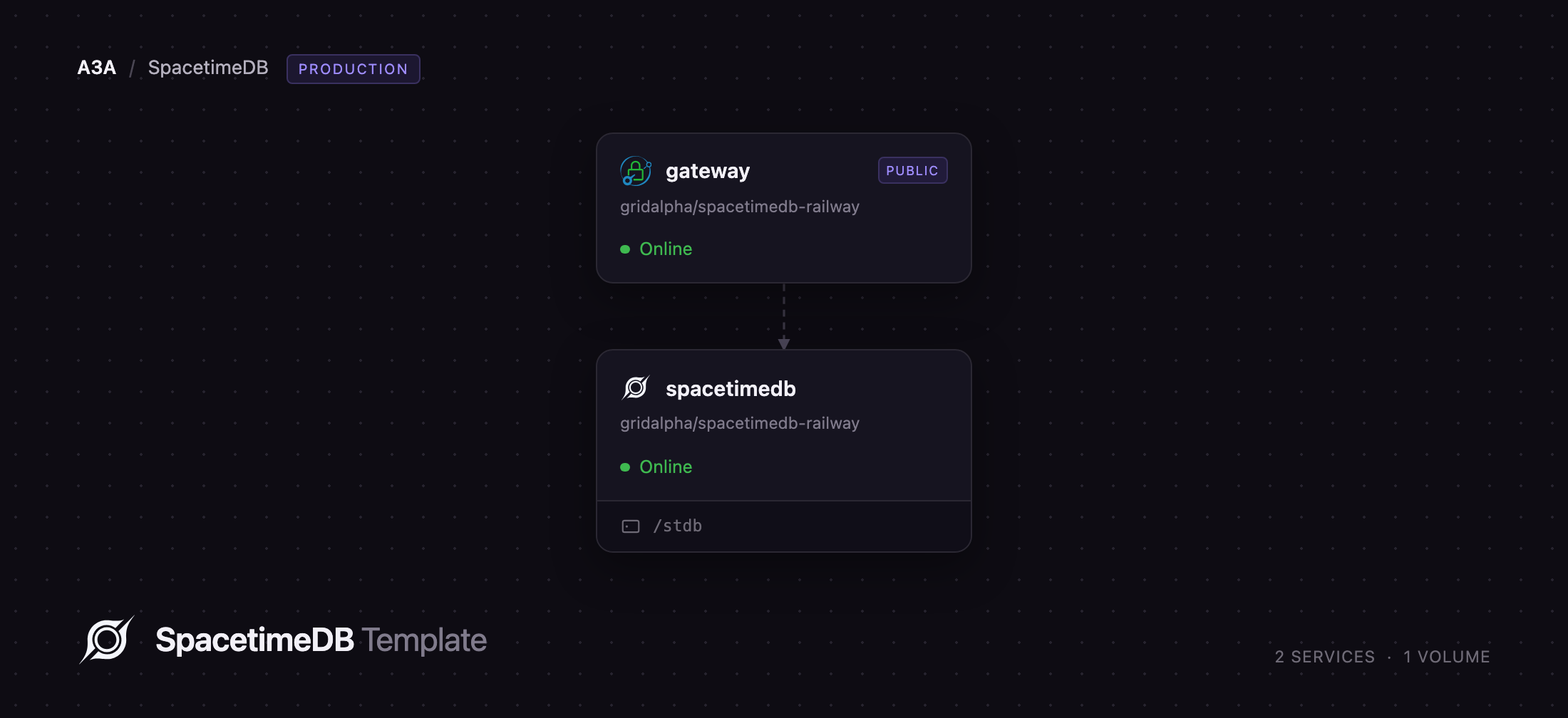
Deploy SpacetimeDB on Railway with this template and you get a spacetimedb service running the standalone node from the official clockworklabs/spacetime image, its commitlog and JWT signing keys on a volume at /stdb, behind a Caddy gateway. The gateway matters: a bare node authenticates nobody, so anyone who found the URL could publish a module onto it. It publishes only what clients need — identity issuance, the subscription WebSocket, module HTTP handlers, read-only schema lookups — and serves the full API under a private admin path only you know. Source: github.com/gridalpha/spacetimedb-railway.
Getting Started with SpacetimeDB on Railway
SpacetimeDB has no web console — you drive it with the spacetime CLI from spacetimedb.com/install. Once the deploy is live, copy the gateway service's public domain and read STDB_ADMIN_PATH from its variables; that is the prefix your admin URL is built from:
spacetime server add --url https:/// railway
spacetime server ping railway
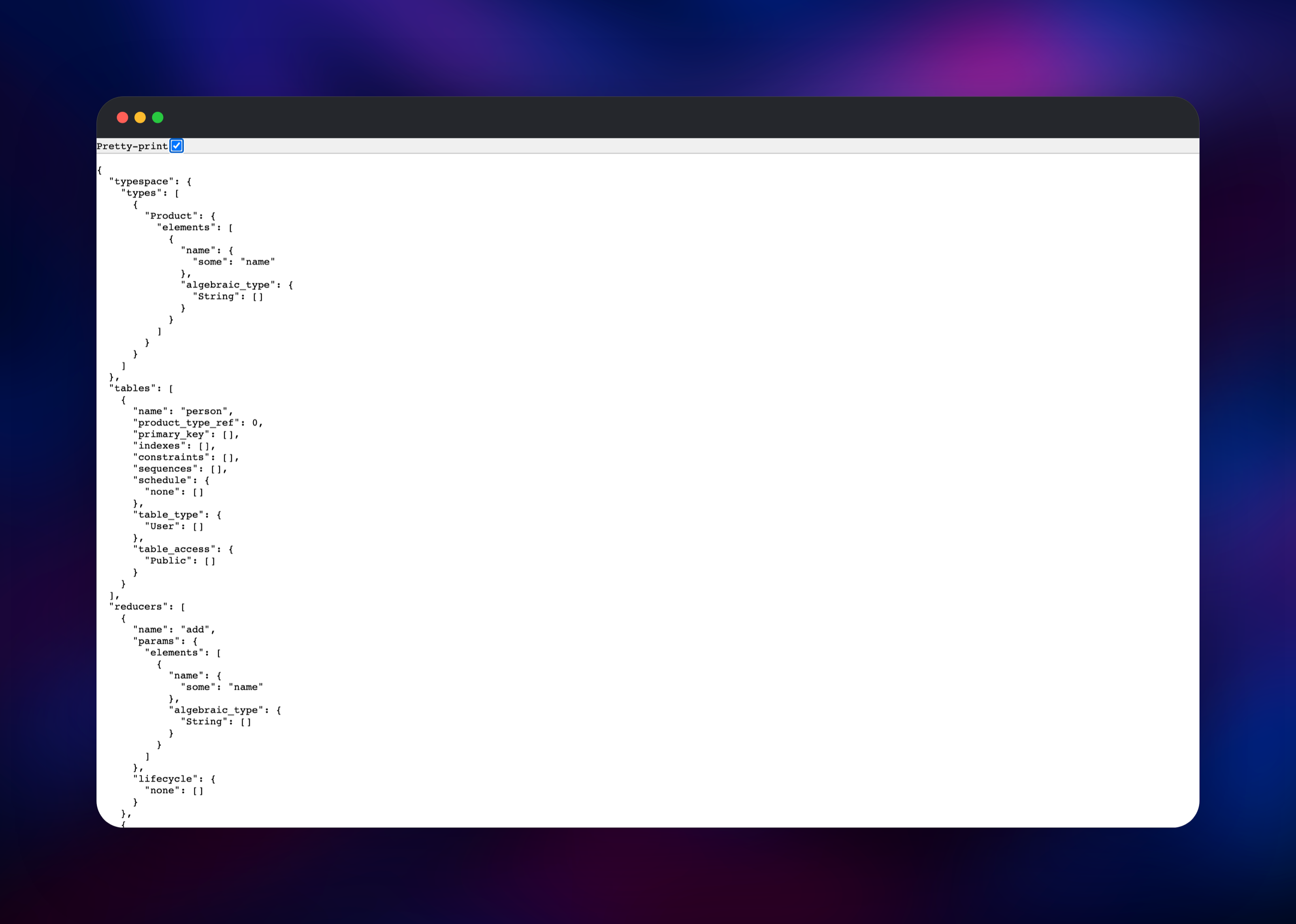
spacetime init scaffolds a person table with add and say_hello reducers — enough to prove the whole path:
spacetime init --lang rust my-app && cd my-app
spacetime publish --server railway my-app
spacetime call --server railway my-app add "Ada Lovelace"
spacetime sql --server railway my-app "SELECT * FROM person"
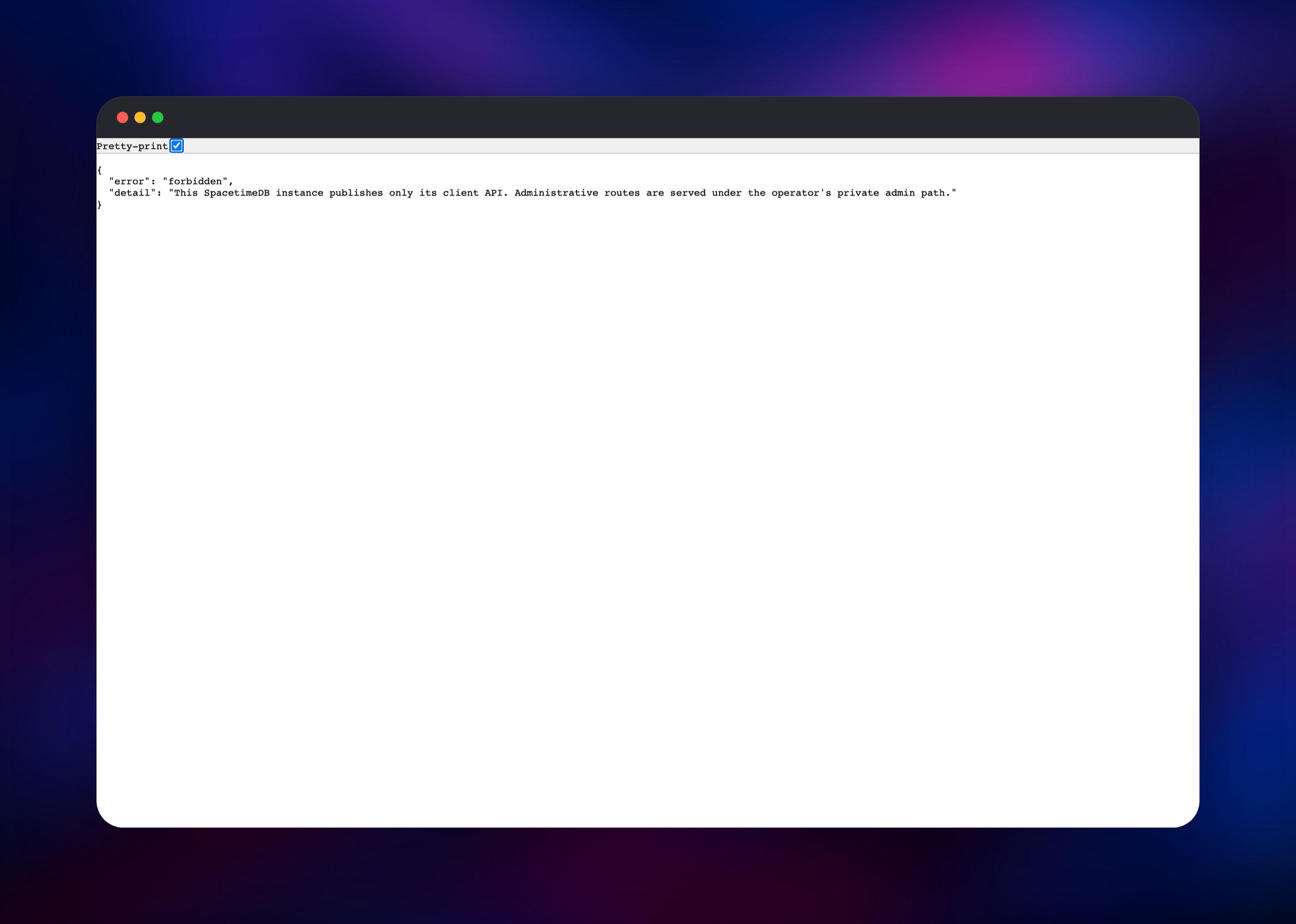
If the query returns the row you inserted, the deployment works. Clients then connect to the plain public domain with no admin path and no credential. https:///v1/health returns 200 in a browser; any administrative path returns a JSON 403.
About Hosting SpacetimeDB
Conventional realtime stacks put a database, a stateless API and a WebSocket fan-out layer in a row, and most of the code and latency is the plumbing between them. SpacetimeDB removes the middle: reducers run inside the database as serialisable transactions, and each subscription is a live SQL query pushed on commit.
- Modules in Rust, C#, TypeScript or C++, compiled to WebAssembly and published in one command
- Live subscriptions — clients subscribe to
SELECTqueries and get row deltas over a WebSocket - Reducers as the only write path, each one ACID transaction with the caller in
ctx.sender - Row-level security, and built-in identity that OIDC providers such as Auth0 or Clerk can extend
- Client SDKs for Rust, C#, TypeScript, Unity and Unreal, generated from your schema
Self-host it when the data must sit on infrastructure you control, when a game server must sit near your players, or when a container costs less than metered capacity.
Why Deploy SpacetimeDB on Railway
- No Dockerfile, volume permissions or proxy config to write yourself
- The administrative API is gated by default rather than open to the internet
- Private networking between gateway and database, with one public service
- Managed TLS, custom domains and one-click redeploys from Git
- The volume keeps databases and identity signing keys across deploys
Common Use Cases
- Multiplayer game backends needing authoritative world state at low latency, with no game server to operate
- Collaborative apps — whiteboards, editors, planning tools — where people mutate the same documents and see each other's changes at once
- Live dashboards driven by subscriptions, not polling
- Simulations whose tick loop belongs beside the data
Dependencies for SpacetimeDB
spacetimedb— the standalone node, fromclockworklabs/spacetime:latest(2.10.0 at time of writing). Private, port 3000, with a volume at/stdbholding the commitlog, control database and JWT keypair.gateway— Caddy, fromcaddy:2-alpine, the only public service. It decides which routes are anonymous and tunnels the full API underSTDB_ADMIN_PATH.
No external database, cache or object store: SpacetimeDB is the database.
Environment Variables Reference
| Variable | Description | Required |
|---|---|---|
STDB_ADMIN_PATH | Secret path prefix the full API is served under. Generated for you | Yes |
STDB_PUBLIC_HTTP_CALL | Publish /v1/database//call/ anonymously. Default false | No |
STDB_PUBLIC_HTTP_SQL | Publish /v1/database//sql anonymously. Default false | No |
STDB_LOG_LEVEL | Server log level. Default info | No |
STDB_MODULE_HTTP | Whether modules may make outbound HTTP requests. Default true | No |
STDB_PAGE_POOL_MAX_SIZE | Page pool ceiling in bytes. Unset means half the memory limit | No |
PORT | Port the node listens on. Default 3000 | No |
Deployment Dependencies
- github.com/gridalpha/spacetimedb-railway · upstream clockworklabs/SpacetimeDB · image
clockworklabs/spacetime· docs - Publishing needs the
spacetimeCLI plus your language's toolchain — Rust with thewasm32-unknown-unknowntarget, .NET 8, or Node for TypeScript.
Server Requirements to Self-Host SpacetimeDB
| Resource | Minimum | Recommended |
|---|---|---|
| CPU | 1 vCPU | 2–4 vCPU |
| RAM | 1 GB | 4 GB or more |
| Storage | 5 GB volume | 20 GB+, sized to the commitlog |
| Runtime | Linux container, x86-64 or arm64 | — |
Hot table data is kept in memory and every transaction appended to a commitlog, so RAM should exceed your working set and storage grows with write volume, not row count. The page pool defaults to 8 GB upstream; this template caps it at half the memory limit. Raise the volume before it fills — a full commitlog refuses writes.
Self-Hosting SpacetimeDB Outside Railway
The published image runs the server directly. Give it a volume and a JWT key directory, and keep both across restarts or every identity token you issued becomes invalid:
docker run -d --name spacetimedb -p 3000:3000 -v stdb:/stdb \
  -e SPACETIMEDB_DISABLE_DISK_LOGGING=1 \
  --entrypoint /opt/spacetime/spacetimedb-standalone \
  clockworklabs/spacetime:latest start --data-dir /stdb/data \
  --jwt-pub-key-path /stdb/keys/id_ecdsa.pub \
  --jwt-priv-key-path /stdb/keys/id_ecdsa \
  --listen-addr 0.0.0.0:3000 --non-interactive
The image runs as the unprivileged spacetime user, so /stdb must be writable by it. On Linux, curl -sSf https://install.spacetimedb.com | sh installs the server without Docker. Either way, never expose port 3000 on its own — front it with a reverse proxy that blocks database creation, as upstream's self-hosting guide describes.
How Much Does SpacetimeDB Cost?
SpacetimeDB is published under the Business Source License 1.1, converting to AGPL v3 with a linking exception in 2031. Its Additional Use Grant allows free production use of a single instance provided you are not reselling it as a database service — exactly what this template deploys — so there is no licence fee and no seat count. On Railway you pay only for the compute, memory and volume the two services use. Clockwork Labs also runs Maincloud, a managed option with a free tier and a Pro plan from $25/month.
FAQ
What is SpacetimeDB? A relational database that also runs your application code. You publish a WebAssembly module of tables and reducers, and clients connect to the database over a WebSocket rather than to a backend server.
What does this Railway template deploy? A private SpacetimeDB standalone node with a persistent volume, and a public Caddy gateway that publishes the client routes and keeps the admin API behind a secret path.
Why does the template include a gateway instead of exposing SpacetimeDB directly? A standalone node performs no server-level authentication — database creation is open to any caller, so a bare public URL lets strangers run their own modules on it. Upstream's self-hosting guide recommends this reverse-proxy allow-list; the template ships it configured.
How do I publish a module to my self-hosted SpacetimeDB on Railway?
spacetime server add --url https:/// railway, then spacetime publish --server railway from the module directory. Re-running it updates.
Can my game clients connect without the admin path?
Yes, and they should. The subscription WebSocket, identity issuance and schema lookups are open on the plain public domain — point your SDK at https://, no secret needed.
Will my data survive a redeploy?
Yes. Databases, the commitlog and the JWT signing keypair live on the volume at /stdb, so identities already issued to clients keep working after the container is recreated.
Template Content
spacetimedb
gridalpha/spacetimedb-railway