
Deploy Sylius
Open-source eCommerce platform for building custom online stores
worker
Just deployed
scheduler
Just deployed
Redis
Just deployed
/data

mailpit
Just deployed
/data

MySQL
Just deployed
/var/lib/mysql
sylius
Just deployed
/data
Deploy and Host Sylius on Railway
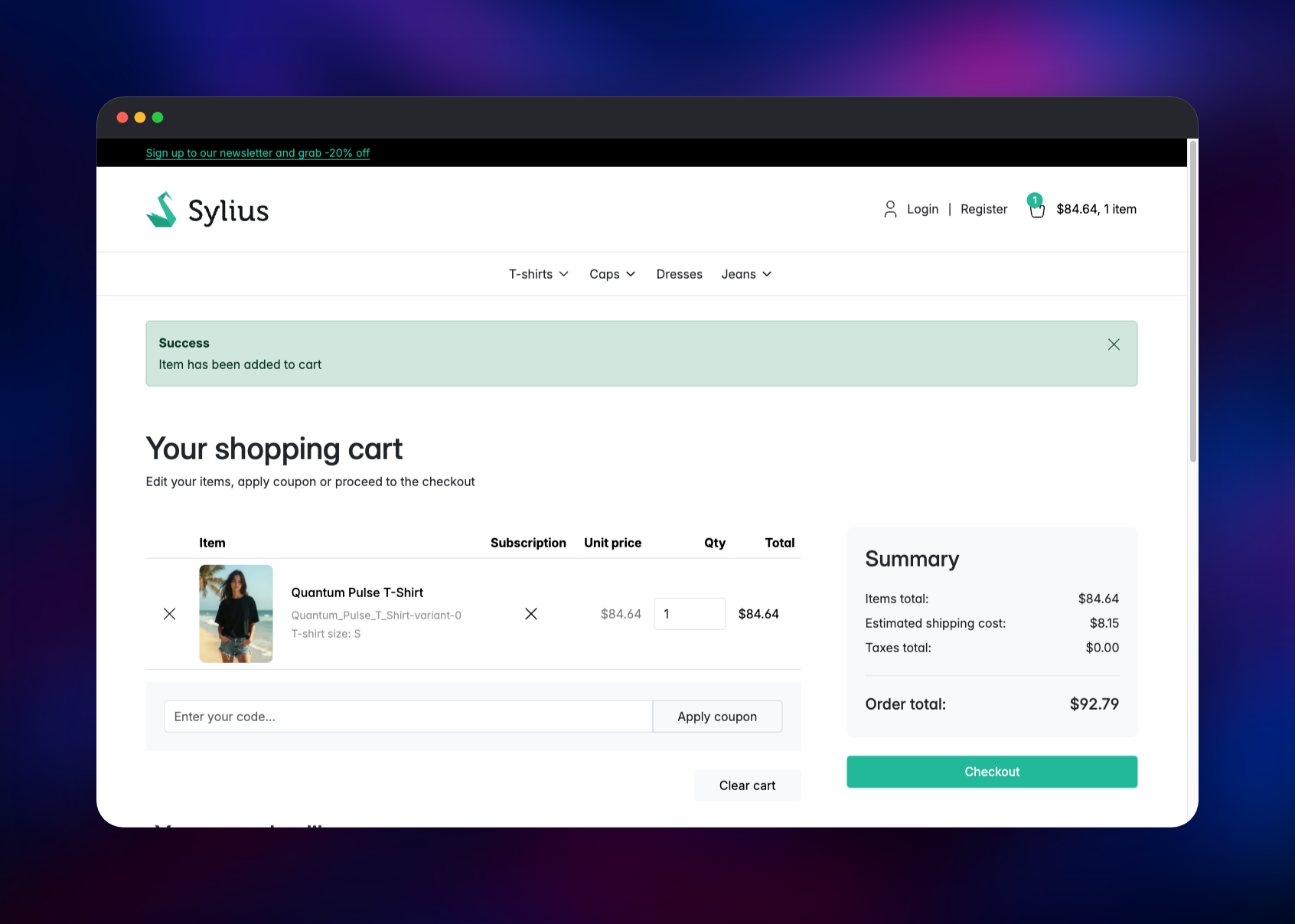
Sylius is an open-source eCommerce platform built on Symfony and API Platform. It gives developers a real commerce domain model — channels, catalogues, promotions, taxes, shipping, payments and orders — as an application you own outright rather than a product you rent. Agencies and in-house teams pick it when a store needs behaviour a SaaS checkout will not bend to: multi-channel pricing, B2B rules, custom fulfilment, or a headless front end on the bundled REST API. Deploy Sylius on Railway and you get the storefront, the admin panel and the API on one domain, with persistence and background processing already wired up.
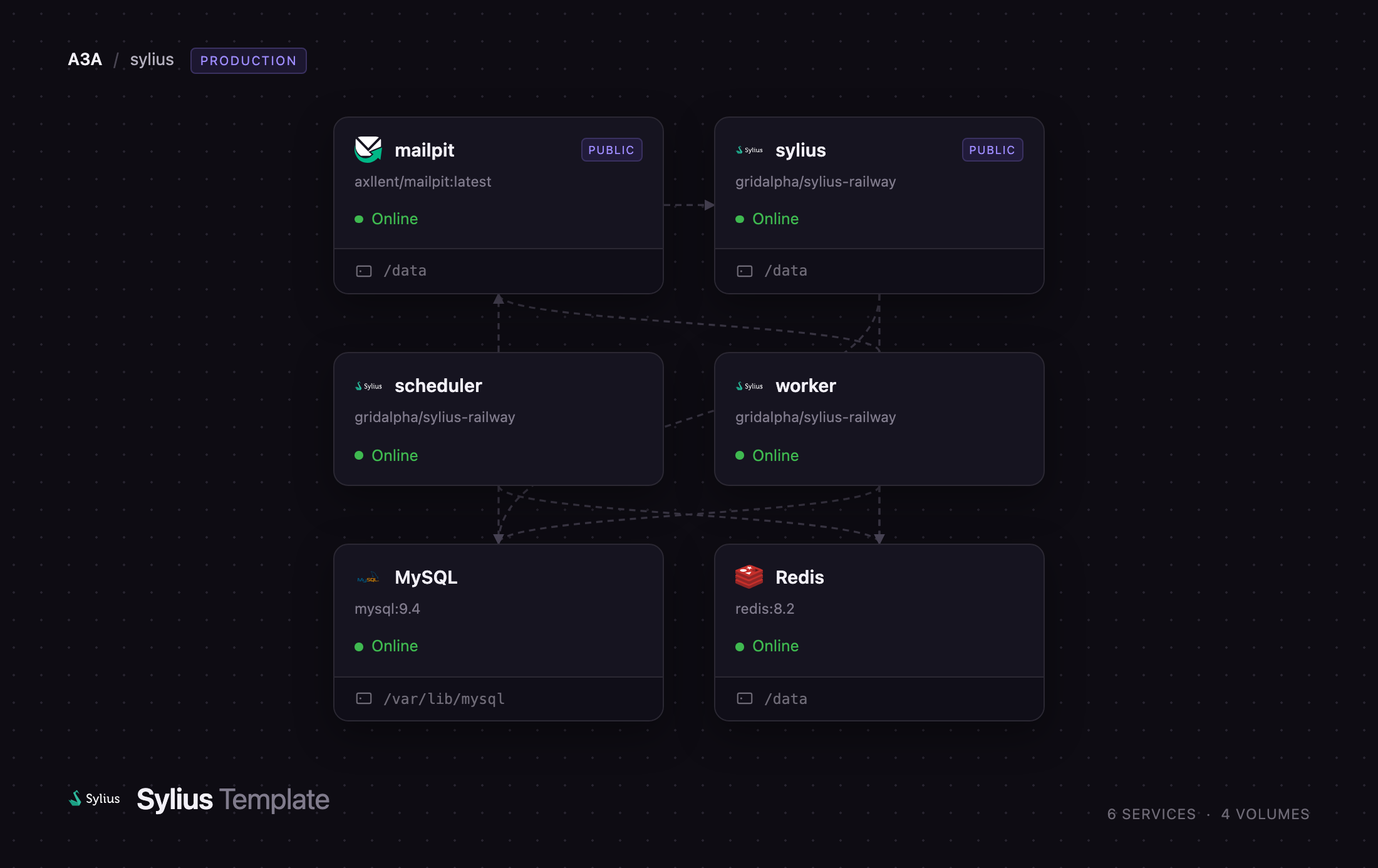
This template runs Sylius the way its own documentation describes for production. The sylius service serves the storefront and admin through nginx and PHP-FPM. A separate worker service consumes the Symfony Messenger queues, so catalogue promotions and other deferred work never block a shopper's request. A scheduler service runs Sylius' recurring maintenance commands. MySQL stores the catalogue and orders, Redis holds the application cache and shopper sessions, and mailpit captures every outgoing email so you can read order confirmations before wiring a real SMTP relay.
Getting Started with Sylius on Railway
Set SYLIUS_ADMIN_EMAIL and SYLIUS_ADMIN_PASSWORD before you deploy — those become the first administrator, and no default account is left behind. The first boot runs migrations, seeds a channel, currency and locale, generates the API JWT keypair and the payment encryption key, and loads the demo catalogue. That takes a few minutes; watch the sylius log until it prints starting php-fpm and nginx.
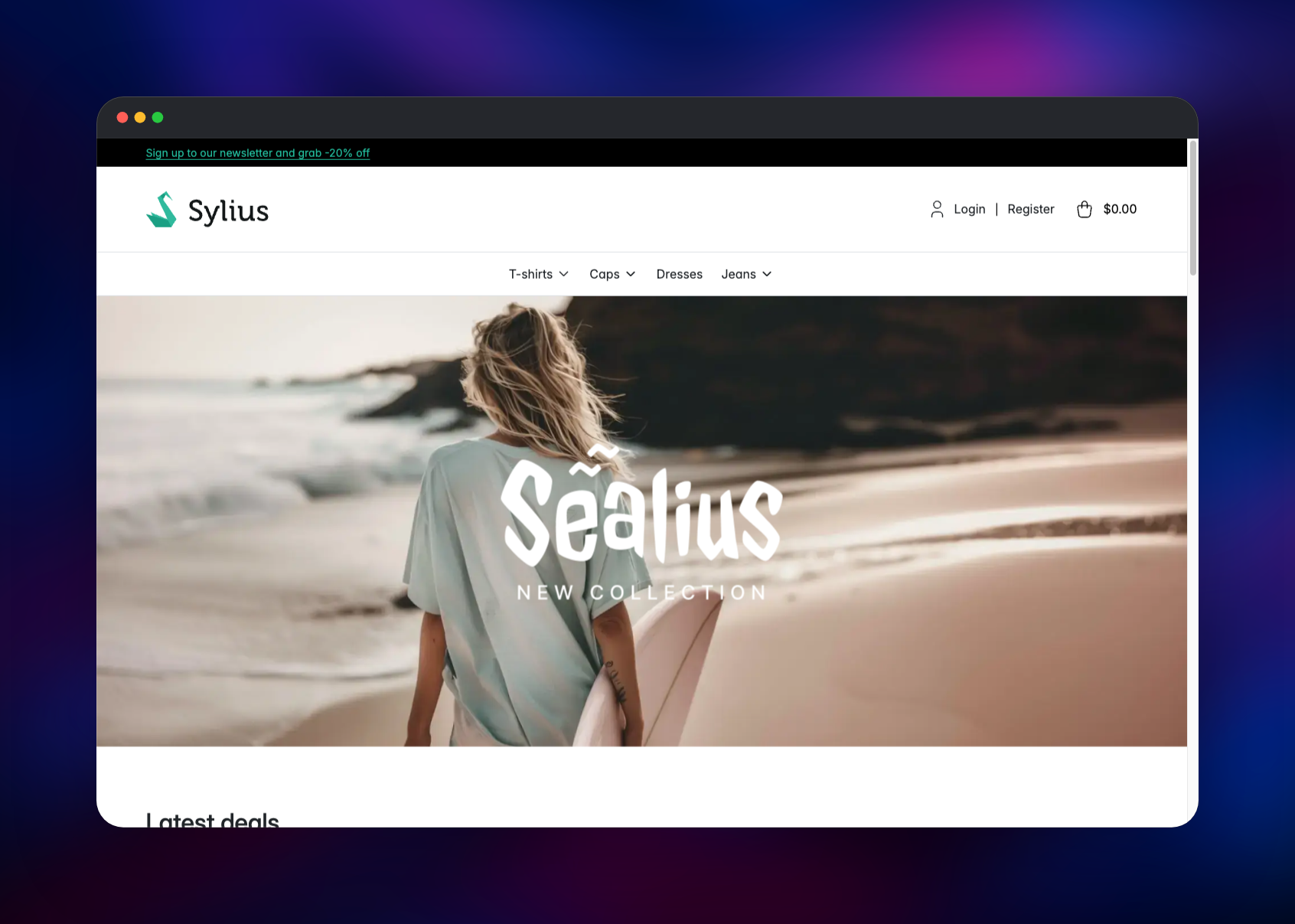
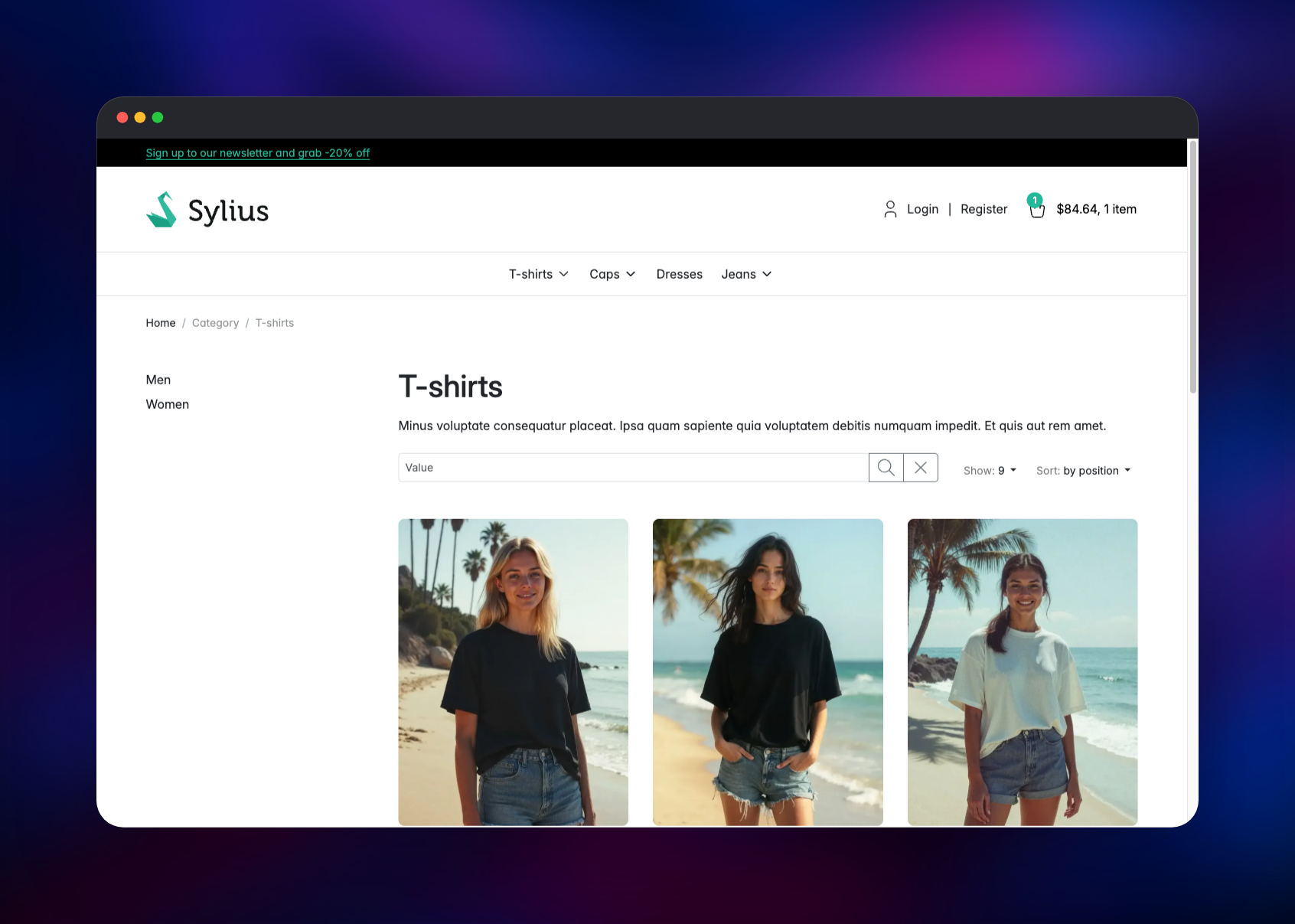
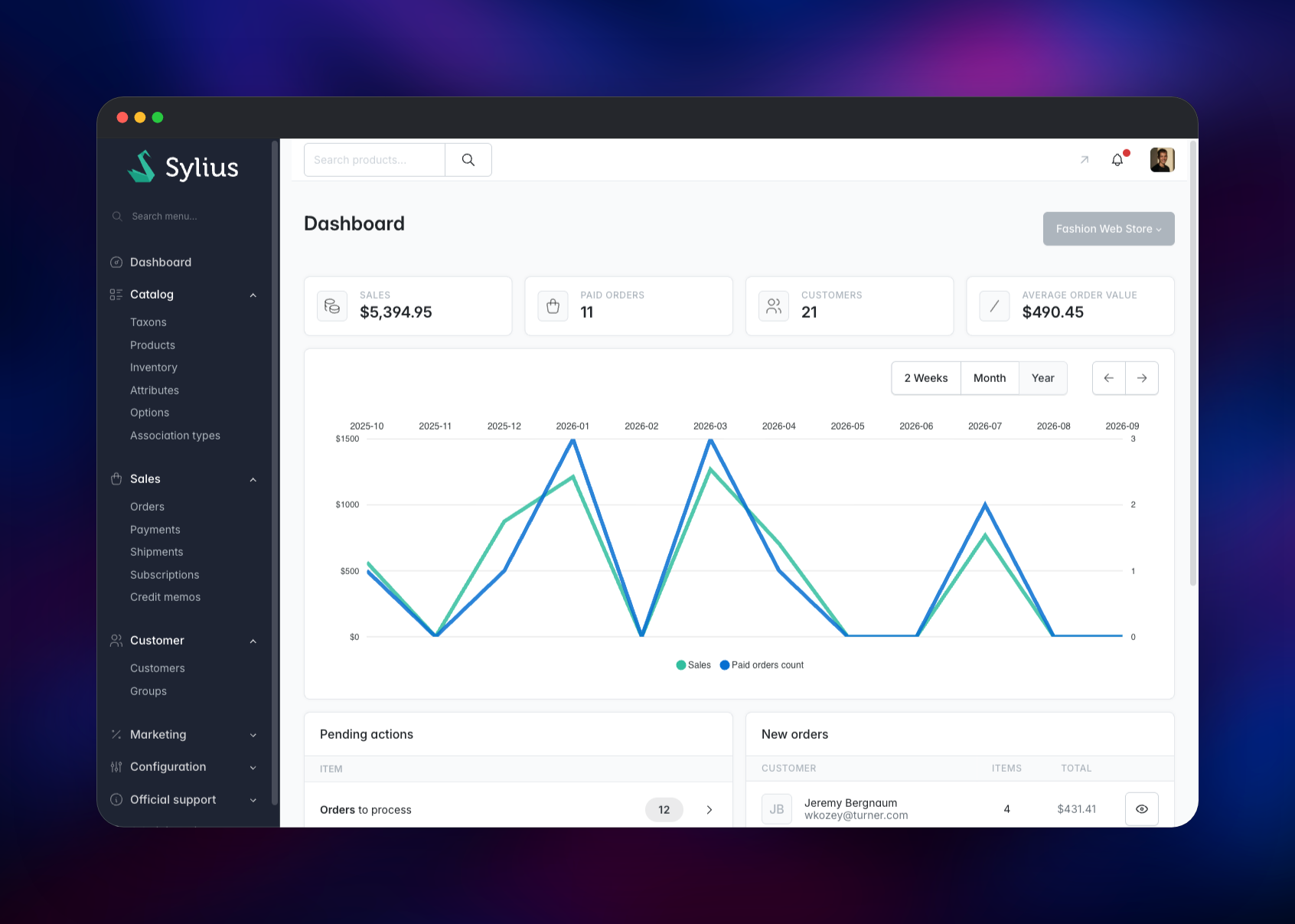
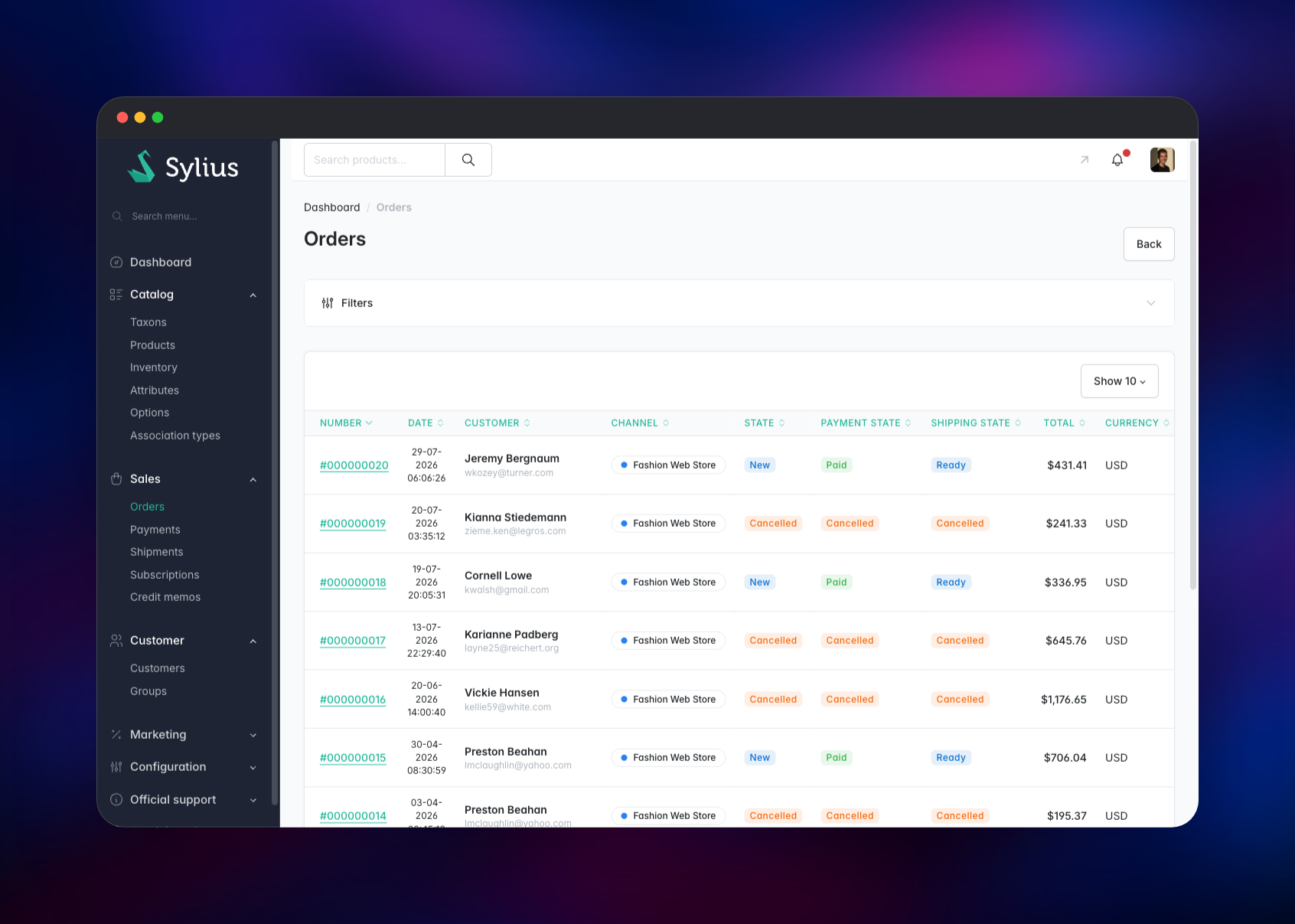
Open the public URL and you land on a storefront already populated with categories and products. Sign in at /admin with the email and password you set. Go to Catalog → Products to edit or delete the samples, then Configuration → Channels to rename the shop and set your currency. To confirm the deployment end to end, add a product to the cart and check the order reaches Sales → Orders. Set SYLIUS_SAMPLE_DATA to false before the first deploy to start with an empty catalogue.
About Hosting Sylius
Sylius is a framework as much as a product. The order state machine, the pricing engine and the admin grids are all Symfony services you can decorate or replace, which is why teams choose it over a plugin-driven platform when requirements are unusual. Self-hosting is the point: your catalogue, customer data and payment configuration stay in a database you control, with no per-order fee between you and your revenue.
Key capabilities:
- Multi-channel, multi-currency selling with per-channel catalogues and pricing
- A promotions engine covering catalogue promotions and coupon rules
- A REST API with JWT auth, for headless storefronts and mobile apps
- Taxation, shipping and payment methods configured per channel and zone
- An admin panel built on Symfony UX, Live Components and Twig
- First-party Stripe, PayPal, Adyen and Mollie payment plugins
The Railway architecture splits Sylius into the roles its production guide recommends. The web role handles HTTP. The worker runs messenger:consume on the main and catalog_promotion_removal transports, which recalculates prices when a catalogue promotion changes. The scheduler cancels unpaid orders and clears abandoned carts hourly, work that would normally be a cron entry. All three run the same image over MySQL and Redis.
Why Deploy Sylius on Railway
Railway removes the infrastructure work that usually surrounds a Symfony commerce stack.
- MySQL and Redis provisioned and connected, no connection strings to copy
- Private networking between the web, worker and scheduler roles
- A persistent volume for product media and generated keys
- HTTPS and a public domain on first deploy
- Logs and metrics for every role in one place
Common Use Cases
- A B2C store whose checkout, pricing or fulfilment rules do not fit a hosted platform
- A B2B portal with customer-group pricing and account-specific catalogues
- A headless backend serving a Next.js or mobile storefront through the Sylius API
- A multi-brand setup running several channels and locales from one admin
Dependencies for Sylius
- sylius — the storefront, admin panel and API, built from
Sylius/Sylius-Standardonghcr.io/sylius/sylius-php:8.3-alpine - worker — the same image running the Symfony Messenger consumer
- scheduler — the same image running Sylius' recurring maintenance commands
- MySQL —
mysql:9.4, the catalogue, customers and orders - Redis —
redis:8.2, the Symfony cache pool and shopper sessions - mailpit —
axllent/mailpit:latest, an SMTP sink with a web inbox
Redis matters more than it looks: Railway replaces the container on every deploy, so file-based sessions would empty every cart.
Environment Variables Reference
| Variable | Purpose |
|---|---|
SYLIUS_ADMIN_EMAIL | Email of the administrator created on first boot |
SYLIUS_ADMIN_PASSWORD | Password for that administrator |
SYLIUS_SAMPLE_DATA | true loads the demo catalogue once; false starts empty |
APP_SECRET | Symfony signing secret; changing it invalidates sessions |
MAILER_DSN | SMTP endpoint; point it at your relay to send real mail |
SYLIUS_SCHEDULER_INTERVAL | Seconds between scheduler passes, default 3600 |
TRUSTED_PROXIES | Proxy ranges Symfony trusts for the real client IP |
Deployment Dependencies
- Source repository: https://github.com/gridalpha/sylius-railway
- Upstream project: https://github.com/Sylius/Sylius
- Application skeleton: https://github.com/Sylius/Sylius-Standard
- Documentation: https://docs.sylius.com
- Runtime: PHP 8.3, Symfony 7.4, Node 22 for the asset build
Hardware Requirements for Self-Hosting Sylius
| Resource | Minimum | Recommended |
|---|---|---|
| CPU | 1 vCPU | 2–4 vCPU |
| RAM | 1 GB for the web role | 2 GB web, 512 MB each for worker and scheduler |
| Storage | 5 GB volume for media | 10 GB+ as the catalogue grows |
| Database | MySQL 8.0+ | MySQL 9.4 with 1 GB RAM |
| Runtime | PHP 8.3, MySQL, Redis | Same, plus a real SMTP relay |
Symfony's cache warmup is the peak memory moment; PHP's limit is set to 512 MB for it.
Self-Hosting Sylius
Sylius publishes no ready-made application image: the deployable artifact is your own project, built from the skeleton. Composer creates it locally:
composer create-project sylius/sylius-standard my-store
cd my-store
yarn install && yarn build:prod
bin/console sylius:install -s default
Upstream also ships a Docker Compose environment for development, which pulls the same PHP-FPM base image this template builds on:
git clone https://github.com/Sylius/Sylius-Standard.git
cd Sylius-Standard
make init
This template's image does the equivalent at build time — Composer install plus a Webpack Encore build — then runs migrations and first-boot setup at startup.
Is Sylius Free to Self-Host?
Sylius is open source under the MIT licence, so there are no per-order or per-seat fees. Sylius Plus is a paid edition adding multi-source inventory, RBAC and returns management, but the open-source edition is a complete store on its own. On Railway you pay only for the compute, database and storage the services use.
FAQ
What is Sylius? An open-source eCommerce platform built on Symfony and API Platform, providing a storefront, an admin panel and a REST API, designed to be extended in PHP rather than configured through plugins.
What does this Railway template deploy? Six services: the Sylius web application, a Messenger worker, a scheduler, MySQL, Redis and Mailpit. Only the web service and the Mailpit inbox are public; everything else stays on the private network.
Why does the template include Redis? Redis holds the Symfony cache pool and shopper sessions. Railway recreates the container on every deploy, so disk-based sessions would empty every cart; Redis makes deploys invisible to customers.
How do I send real order confirmation emails from self-hosted Sylius?
Set MAILER_DSN on the sylius, worker and scheduler services to your provider's SMTP DSN, such as smtp://user:pass@smtp.example.com:587. Until then Mailpit captures everything in its own web inbox.
How do I use the Sylius API on Railway?
The API lives under /api/v2 on the same domain. Post your administrator credentials to /api/v2/admin/authentication-token for a token; the JWT keypair is generated on first boot and kept on the volume, so tokens survive redeploys.
Can I attach a custom domain to a self-hosted Sylius store? Yes. Add the domain in Railway, then set the channel hostname to match under Configuration → Channels — Sylius resolves the channel from the request host.
How do I remove the sample products?
Delete them under Catalog → Products in the admin, or set SYLIUS_SAMPLE_DATA to false before the first deploy so the demo catalogue is never loaded.
Template Content
worker
gridalpha/sylius-railwayscheduler
gridalpha/sylius-railwayRedis
redis:8.2mailpit
axllent/mailpit:latestMySQL
mysql:9.4sylius
gridalpha/sylius-railway