Deploy VictoriaTraces (Open-Source Distributed Tracing Platform)
VictoriaTraces [Oct ’26] (Jaeger & Zipkin Alternative), Self Host
victoriametrics/victoria-traces
Just deployed
Deploy and Host VictoriaTraces with One Click on Railway
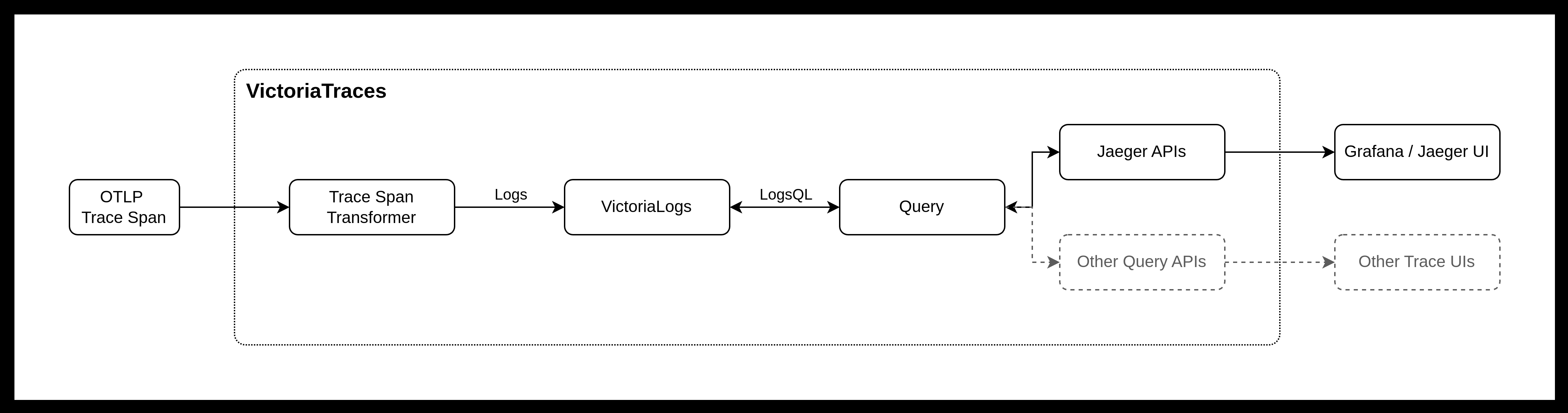
VictoriaTraces is a database designed specifically for storing and querying distributed tracing data. It is part of the VictoriaMetrics ecosystem and focuses on high-performance ingestion, efficient storage, and fast querying of traces generated by modern distributed systems.
With Railway, deploying VictoriaTraces becomes a true one-click experience, making it easy to run your own tracing backend without managing complex infrastructure.
About Hosting VictoriaTraces on Railway (Self Hosting VictoriaTraces on Railway)
Self hosting VictoriaTraces gives you full control over your observability data. Traces often contain sensitive metadata about services, endpoints, and internal architecture. Running your own tracing database ensures this data stays within your infrastructure.
Traditionally, hosting a tracing backend involves:
-
Provisioning storage-heavy servers
-
Managing ingestion pipelines
-
Handling retention and performance tuning
-
Ensuring high availability
With Railway, these challenges are greatly reduced.
Railway runs VictoriaTraces in a managed container environment, automatically handling networking, restarts, logs, and environment variables. You deploy the service, connect your tracing exporters, and start collecting traces immediately.
Why Deploy VictoriaTraces on Railway
Deploying VictoriaTraces on Railway is ideal for teams that want production-grade tracing without operational complexity.
Another major benefit is cost predictability. Managed SaaS tracing platforms often charge per span or per GB ingested. Self hosting VictoriaTraces on Railway gives you clear infrastructure-based costs with no surprise overages.
Railway also makes experimentation easy. You can deploy VictoriaTraces for staging, testing, or internal tools without committing to long-term contracts.
Railway vs DigitalOcean
On DigitalOcean, running VictoriaTraces requires provisioning VMs, managing disks, configuring storage performance, and handling scaling manually.
Railway simplifies this into a one-click VictoriaTraces deployment, removing server and storage management overhead.
Railway vs Linode
Linode offers raw servers that require OS updates, disk tuning, and monitoring. For a tracing backend, this adds operational burden.
Railway abstracts these responsibilities and provides a ready-to-use VictoriaTraces instance instantly.
Railway vs AWS X-Ray / Managed Tracing SaaS
Managed tracing services are convenient but often expensive and opaque in pricing.
VictoriaTraces on Railway offers full data ownership, open-source transparency, and predictable costs.
Railway vs Kubernetes-Based Deployments
Running tracing systems on Kubernetes adds complexity and maintenance overhead.
Railway provides container orchestration without requiring Kubernetes expertise.
Railway vs Hetzner
Hetzner offers strong performance at low cost but expects sysadmin expertise. Railway prioritizes ease of use, speed, and reliability, making it ideal for observability tooling.
Common Use Cases
VictoriaTraces is commonly used for microservices observability, debugging latency issues, analyzing request flows, monitoring API performance, and understanding system bottlenecks. It is especially valuable for teams running distributed systems where logs and metrics alone are not enough.
Dependencies for VictoriaTraces Hosted on Railway
Deployment Dependencies
VictoriaTraces typically requires:
- A container runtime
- Persistent storage for trace data
- Network access from tracing exporters
Railway handles service orchestration, storage, and environment configuration automatically.
How Does VictoriaTraces Compare to Other Tracing Backends
Compared to general-purpose databases, VictoriaTraces is optimized for trace workloads. Compared to heavyweight tracing stacks, it is simpler and more cost-efficient. Compared to SaaS platforms, it is open source and fully self-hosted.
VictoriaTraces is ideal when you want control, performance, and cost efficiency in your tracing backend.
How to Use VictoriaTraces
After deploying VictoriaTraces on Railway, you configure your tracing system (such as OpenTelemetry exporters) to send trace data to the VictoriaTraces endpoint. You can then query traces to analyze latency, service dependencies, and request paths.
How to Self Host VictoriaTraces on Other VPS
Self hosting VictoriaTraces manually involves provisioning storage, tuning performance, managing updates, and monitoring uptime. Railway automates these steps and significantly reduces operational risk.
Features of VictoriaTraces
VictoriaTraces provides high-ingestion performance, efficient trace storage, fast querying, compatibility with modern tracing standards, open-source transparency, and scalable architecture.
Official Pricing of VictoriaTraces
VictoriaTraces is free and open source.
There are no licenses or per-span usage fees.
You only pay for the infrastructure you run it on.
Monthly Cost of Hosting VictoriaTraces on Railway
For most teams, hosting VictoriaTraces on Railway costs $10–$30 per month, depending on trace volume and storage retention-often far cheaper than managed tracing SaaS platforms.
FAQs
What exactly is VictoriaTraces?
VictoriaTraces is an open-source database purpose-built for storing and querying distributed tracing data. Unlike general-purpose databases, it is optimized specifically for traces - spans, relationships, timing, and metadata-making it efficient at high ingestion rates and fast during trace exploration.
What problem does VictoriaTraces solve?
In distributed systems, understanding why something is slow or failing is hard. Logs show details, metrics show trends, but neither shows the full request journey. VictoriaTraces solves this by storing complete request traces so you can see how a request moved across services, where time was spent, and where failures occurred.
How is VictoriaTraces different from metrics databases?
Metrics databases store aggregated numbers over time. VictoriaTraces stores individual request traces with detailed context. This allows you to debug single slow requests, dependency chains, and cross-service behavior that metrics alone cannot explain.
Is VictoriaTraces production-ready?
Yes. VictoriaTraces is designed for production-scale workloads, handling high trace ingestion volumes with predictable performance. It is suitable for real-world microservices, APIs, and distributed systems.
Can VictoriaTraces replace SaaS tracing tools like Datadog or Honeycomb?
For many teams, yes. VictoriaTraces provides the core tracing backend functionality without per-span pricing, vendor lock-in, or opaque costs. While SaaS tools may offer additional UI features, VictoriaTraces excels at ownership, performance, and cost control.
Does VictoriaTraces require Kubernetes?
No. VictoriaTraces can run as a standalone service. Kubernetes is optional, not required. This makes it much simpler to deploy and operate for small and mid-sized teams.
How does VictoriaTraces store trace data efficiently?
VictoriaTraces uses storage layouts optimized for trace workloads, allowing it to compress and index trace data efficiently. This keeps storage usage manageable while maintaining fast query times.
Can I control trace retention?
Yes. When self hosted, you decide how long traces are retained. You can tune retention to balance observability depth with storage cost.
Is VictoriaTraces suitable for high-traffic systems?
Yes. VictoriaTraces is built to handle high ingestion rates, making it suitable for systems processing large numbers of requests per second.
Can VictoriaTraces help with performance optimization?
Absolutely. By analyzing trace timelines, service dependencies, and latency breakdowns, VictoriaTraces helps teams identify bottlenecks, slow dependencies, and inefficient code paths.
Does VictoriaTraces support querying individual traces?
Yes. You can query and inspect individual traces, making it easier to debug specific user requests or incidents.
Is VictoriaTraces secure?
Security depends on deployment. When self hosted, you control network access, authentication layers, and data exposure. Railway adds container isolation and secure environment handling.
How does VictoriaTraces compare to logging systems?
Logs show discrete events, while VictoriaTraces shows request flow and timing across services. They complement each other, but tracing provides context logs alone cannot.
Can VictoriaTraces be used alongside metrics systems like Prometheus?
Yes. VictoriaTraces fits naturally into an observability stack alongside metrics and logs. Many teams use metrics for trends, logs for details, and traces for flow analysis.
How does VictoriaTraces scale over time?
VictoriaTraces scales with increased storage and compute resources. Railway makes it easy to adjust resources as trace volume grows.
Does VictoriaTraces introduce vendor lock-in?
No. VictoriaTraces is fully portable. You can migrate data and deployments to any VPS or cloud provider at any time.
How are backups handled?
Backups depend on your storage setup. Since VictoriaTraces stores data on persistent volumes, standard backup strategies apply.
Is VictoriaTraces suitable for small teams?
Yes. VictoriaTraces works well for small teams and startups who want deep observability without enterprise SaaS costs.
Ready to own your distributed tracing data?
Deploy VictoriaTraces on Railway and gain deep visibility into your systems without SaaS lock-in.
🚀 Deploy Now on Railway
Template Content
victoriametrics/victoria-traces
victoriametrics/victoria-traces