
Deploy Activepieces | Open-Source Alterative of n8n, Zapier, Make.com
Self Host Activepieces: Workflow Automation with 500+ App Integrations
DBs

Redis
Just deployed
/data

Just deployed
/var/lib/postgresql/data
Activepieces
Just deployed
Deploy and Host Activepieces on Railway
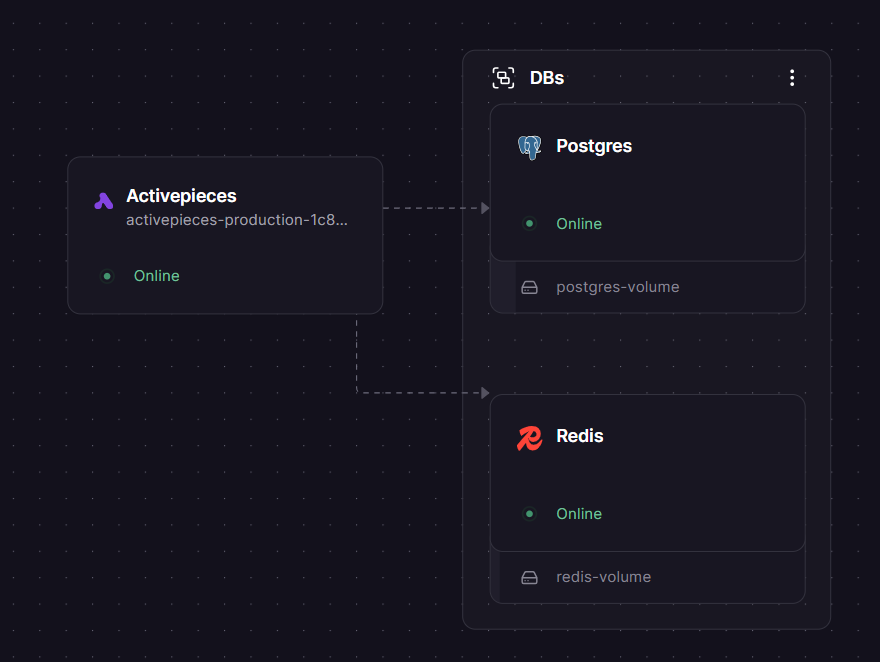
Self-host Activepieces on Railway with a single click — no server provisioning, no manual Docker setup. This template deploys the full production stack: the Activepieces application (activepieces/activepieces:latest from Docker Hub), a managed PostgreSQL 17 database for persistent storage, and a Redis instance powering the BullMQ job queue. All three services communicate over Railway's private network, with automatic TLS and a public URL out of the box.
Run Activepieces on Railway and get a fully operational, open-source workflow automation platform — a privacy-first alternative to Zapier and Make — in under five minutes.
Getting Started with Activepieces on Railway
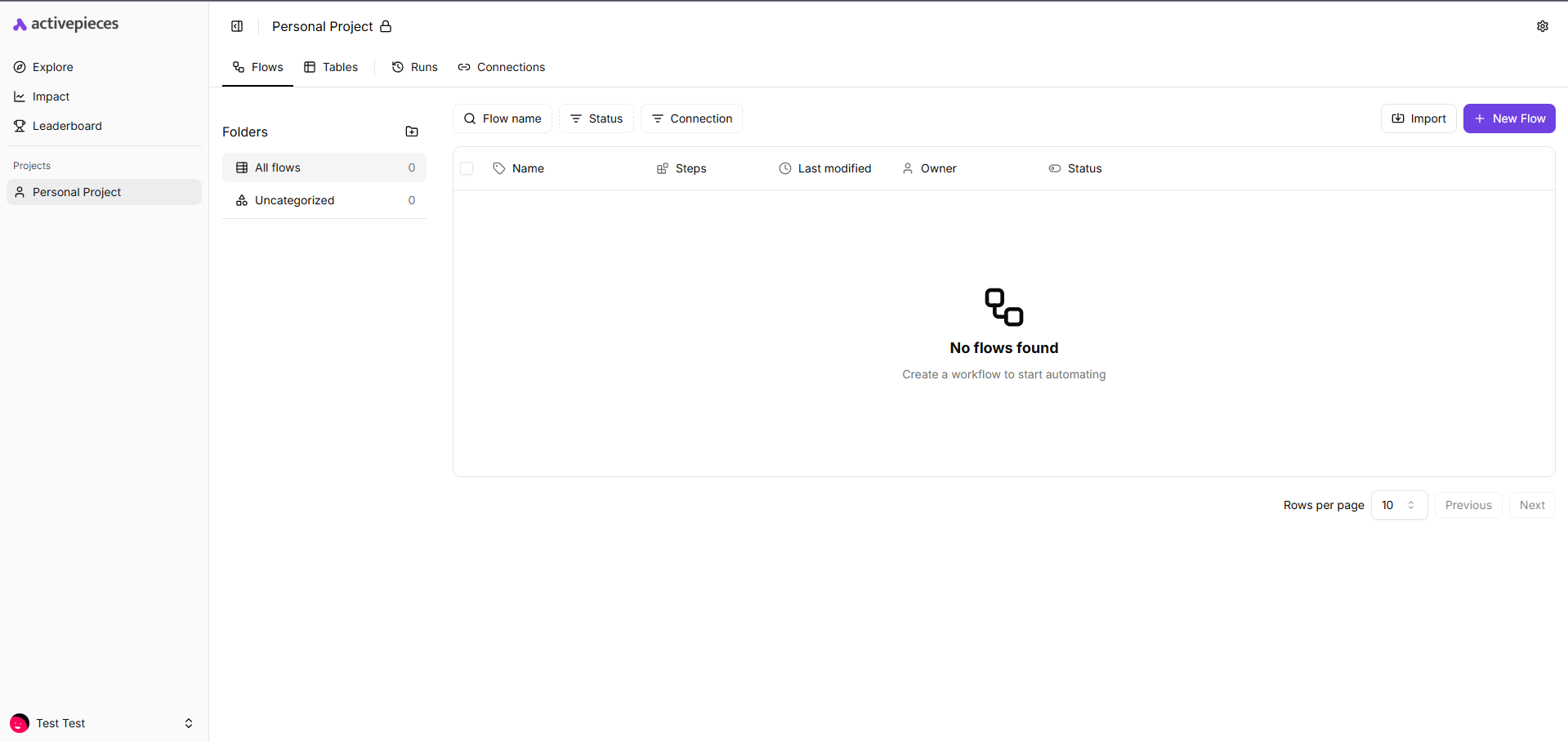
Once the deploy completes, Railway provides a public URL for your Activepieces instance. Open that URL in your browser and you'll be taken to the sign-up screen to create your admin account. After registering, you land on the Flows dashboard — click New Flow, choose a trigger (webhook, schedule, or an app event), and start connecting actions. The piece library is pre-synced from the Activepieces cloud on first boot, so all 500+ integrations are immediately available without any manual installation.
To set up webhooks correctly, make sure AP_FRONTEND_URL is set to your Railway public domain (e.g. https://your-app.up.railway.app) — this is what Activepieces uses to construct webhook URLs for external services to call back into.
About Hosting Activepieces
Activepieces is an open-source, MIT-licensed workflow automation platform that lets teams build multi-step automations across any combination of apps — without vendor lock-in, task limits, or monthly usage bills scaling against you. It's the self-hostable answer to Zapier and Make.
Key features:
- Visual flow builder with branches, loops, and conditional logic
- 500+ pre-built pieces (Google Sheets, Slack, OpenAI, HTTP, webhooks, and more)
- AI Agents and AI Copilot built into the flow builder
- Human-in-the-loop approval steps
- Custom code steps (JavaScript/TypeScript via Bun)
- BullMQ-backed job queue for reliable, retryable execution
- MCP (Model Context Protocol) server support for AI tool integrations
- Full REST API for programmatic flow management
Why Deploy Activepieces on Railway
Deploy in one click and skip the infrastructure work entirely:
- No Docker config, volumes, or compose file management
- Private networking between Activepieces, Postgres, and Redis — zero extra config
- Managed TLS and public domain provisioned automatically
- One-click redeploys pull the latest
activepieces/activepieces:latestimage - Railway's managed Postgres includes automatic backups
- Scale CPU and RAM from the Railway dashboard without touching the app
Common Use Cases
- Internal business automation — sync CRM records, send Slack alerts on new deals, auto-assign support tickets from inbound email
- AI-powered pipelines — chain OpenAI/Anthropic calls with data lookups, approval gates, and outbound actions in a single flow
- Data sync and ETL — move rows between Google Sheets, Airtable, Postgres, and external APIs on a schedule
- Webhook processing — receive events from Stripe, GitHub, or any service and fan out actions across multiple destinations
Dependencies for Activepieces
- Activepieces —
activepieces/activepieces:latest(Docker Hub · GitHub) - PostgreSQL — Railway managed Postgres 17 (SSL-enabled)
- Redis — Railway managed Redis 8
Deployment Dependencies
- Runtime: Node.js 18+ (bundled in the Docker image), Bun (bundled for piece execution)
- GitHub: github.com/activepieces/activepieces
- Docker Hub: hub.docker.com/r/activepieces/activepieces
- Official docs: activepieces.com/docs/install/options/railway
Activepieces vs n8n vs Zapier
| Activepieces | n8n | Zapier | |
|---|---|---|---|
| Open source | ✅ MIT | ⚠️ Sustainable Use License | ❌ Proprietary |
| Self-hostable | ✅ | ✅ | ❌ |
| Task limits (paid) | Unlimited | 2,500/month (cloud) | Per-tier caps |
| Starting price | Free (self-hosted) | ~$24/month cloud | Free (100 tasks) |
| UI complexity | Beginner-friendly | Moderate | Beginner-friendly |
| AI agents built-in | ✅ | ✅ | Limited |
| MCP support | ✅ | ❌ | ❌ |
Activepieces sits between Zapier's simplicity and n8n's power — it's the best pick if you want a clean UI, truly unlimited self-hosted runs, and modern AI capabilities without n8n's steeper learning curve.
Minimum Hardware Requirements for Activepieces
| Resource | Minimum | Recommended |
|---|---|---|
| CPU | 1 vCPU | 2 vCPU |
| RAM | 512 MB | 1–2 GB |
| Storage (Postgres) | 1 GB | 5+ GB |
| Node.js | 18+ | 20+ (bundled) |
Railway's Starter plan (512 MB RAM per service) is sufficient for personal use and light team workloads. For production with many concurrent flows, upgrade to 1–2 GB RAM on the Activepieces service.
Self-Hosting Activepieces
Docker (single container, dev/testing only):
docker run -d -p 8080:80 \
  -e AP_DB_TYPE=PGLITE \
  -e AP_REDIS_TYPE=MEMORY \
  -e AP_JWT_SECRET=$(openssl rand -hex 32) \
  -e AP_ENCRYPTION_KEY=$(openssl rand -hex 16) \
  -e AP_FRONTEND_URL=http://localhost:8080 \
  -v ~/.activepieces:/root/.activepieces \
  activepieces/activepieces:latest
Docker Compose (production with Postgres + Redis):
services:
  activepieces:
    image: activepieces/activepieces:latest
    ports: ["80:80"]
    environment:
      AP_DB_TYPE: POSTGRES
      AP_POSTGRES_HOST: postgres
      AP_POSTGRES_PORT: 5432
      AP_POSTGRES_USERNAME: activepieces
      AP_POSTGRES_PASSWORD: strongpassword
      AP_POSTGRES_DATABASE: activepieces
      AP_REDIS_TYPE: STANDALONE
      AP_REDIS_HOST: redis
      AP_REDIS_PORT: 6379
      AP_JWT_SECRET:
      AP_ENCRYPTION_KEY:
      AP_FRONTEND_URL: https://yourdomain.com
    depends_on: [postgres, redis]

  postgres:
    image: postgres:17
    environment:
      POSTGRES_USER: activepieces
      POSTGRES_PASSWORD: strongpassword
      POSTGRES_DB: activepieces
    volumes: [pgdata:/var/lib/postgresql/data]

  redis:
    image: redis:8
    volumes: [redisdata:/data]

volumes:
  pgdata:
  redisdata:
Is Activepieces Free?
Activepieces is fully open-source under the MIT license — self-hosting is completely free with no task limits, no seat limits, and no expiry. You pay only for the infrastructure you run it on (e.g. Railway usage).
The managed cloud offers a free tier (10 active flows), a Standard plan starting at $5/flow/month with unlimited runs, and an Enterprise plan for large teams. On Railway, self-hosted Activepieces costs whatever your Railway resource usage amounts to — typically $5–15/month for a modest deployment.
FAQ
What is Activepieces? Activepieces is an open-source, MIT-licensed workflow automation platform — a self-hostable alternative to Zapier and Make. It lets you connect apps, automate multi-step workflows, and build AI agents through a visual no-code builder.
What does this Railway template deploy? It deploys three services: the Activepieces application container, a managed PostgreSQL 17 database, and a managed Redis instance. All three are wired together automatically using Railway's private networking and reference variables.
Why does the template include PostgreSQL and Redis? PostgreSQL stores all persistent data — flows, execution logs, credentials, users, and tables. Redis powers BullMQ, the job queue Activepieces uses to schedule triggers, process flow runs reliably, and handle retries. Both are required for a production deployment.
Can I use this in production?
Yes. This stack (Activepieces + Postgres + Redis) is the recommended production configuration from the Activepieces docs. For high-volume workloads, increase AP_WORKER_CONCURRENCY and bump RAM on the Activepieces service in Railway's dashboard.
Why use UNSANDBOXED execution mode on Railway?
The SANDBOX_PROCESS mode requires Linux user namespaces and seccomp, which aren't available in Railway's container runtime. UNSANDBOXED runs flow steps directly in the Node.js process — it's safe for trusted flows and is the correct setting for any managed container platform.
Does Activepieces support custom integrations? Yes. You can write custom pieces using TypeScript and publish them to your instance, or use the built-in HTTP / webhook steps to connect any API without writing a formal piece.
How do I upgrade Activepieces on Railway?
Go to your Activepieces service in Railway → Deployments → click Redeploy. Railway pulls the latest activepieces/activepieces:latest image. Database migrations run automatically on startup. Check the breaking changes page before each upgrade.
Template Content
Redis
redis:8.2.1Activepieces
activepieces/activepieces:latest