
Deploy ElectricSQL
Streams live rows from Postgres to apps over a simple HTTP API

Just deployed
electric
Just deployed
/data

Postgres
Just deployed
/var/lib/postgresql/data
Deploy and Host ElectricSQL on Railway
ElectricSQL is a Postgres sync engine. It reads your database's logical replication stream and serves any subset of it — a "shape" — over an ordinary, cacheable HTTP API, so browsers, mobile apps and edge workers hold a live local copy of exactly the rows they care about. Instead of writing polling loops, websocket fan-out and cache invalidation by hand, you point a client at a URL carrying a table name and a where clause, and Electric keeps it current. It is Apache-2.0 licensed, has over 10,000 GitHub stars, and is the sync layer behind TanStack DB.
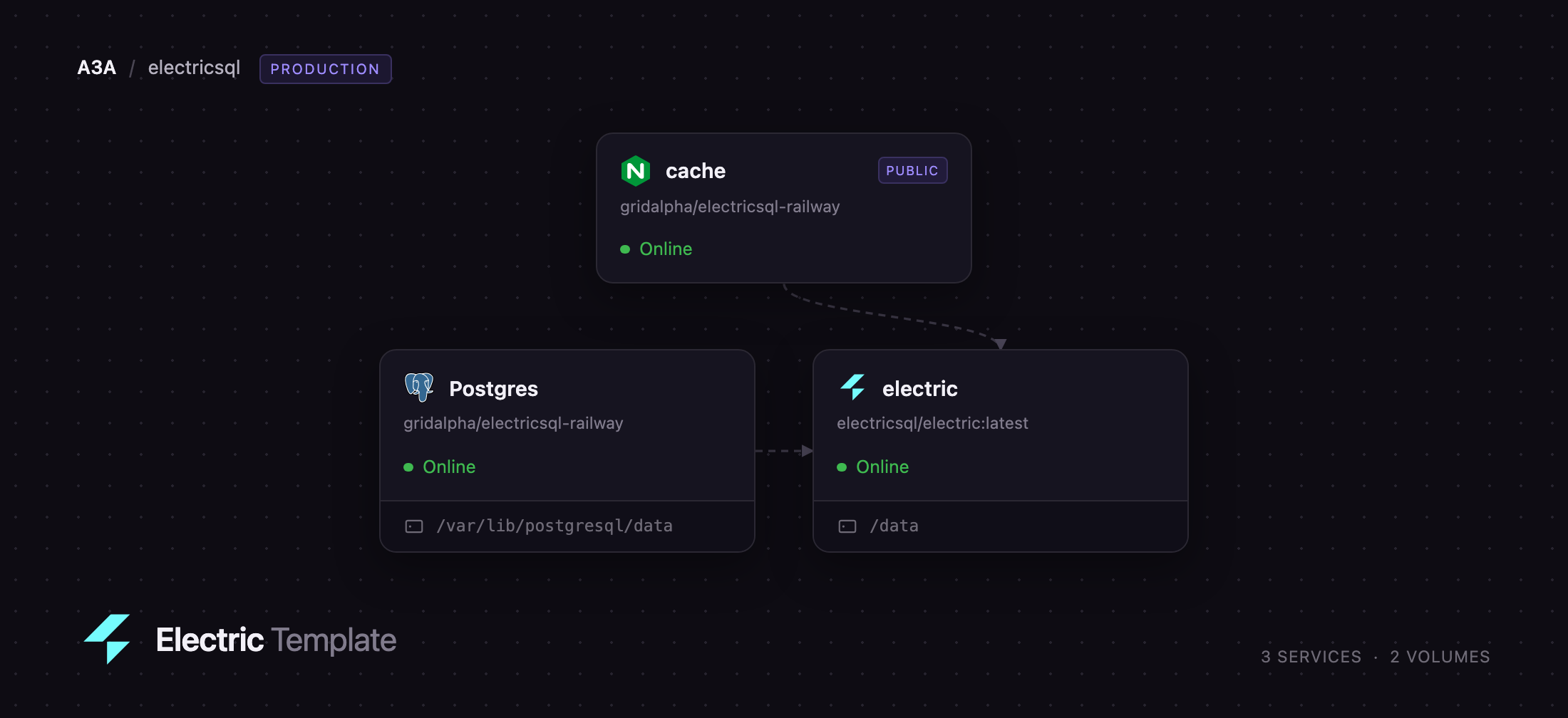
Deploy ElectricSQL on Railway and you get three wired-up services: Postgres 18 started with logical replication enabled, the electricsql/electric sync service holding its shape logs on a volume, and an nginx caching proxy as the only public entry point. Requests hit the proxy, which caches immutable shape-log pages and collapses concurrent live subscriptions into one upstream request before forwarding to Electric over private networking. Self-hosting ElectricSQL elsewhere means configuring wal_level and standing up that cache yourself; here it is already done.
Getting Started with ElectricSQL on Railway
Electric has no web dashboard — it is an HTTP API, and the public URL Railway gives you is its root. Open https:///v1/health first: a healthy deployment answers {"status":"active"}, while {"status":"waiting"} means it is still connecting to Postgres. Every other request needs the ELECTRIC_SECRET the template generates, passed as a secret query parameter; without it the service answers 401, so the endpoint is never open. Copy that value from the electric service's variables.
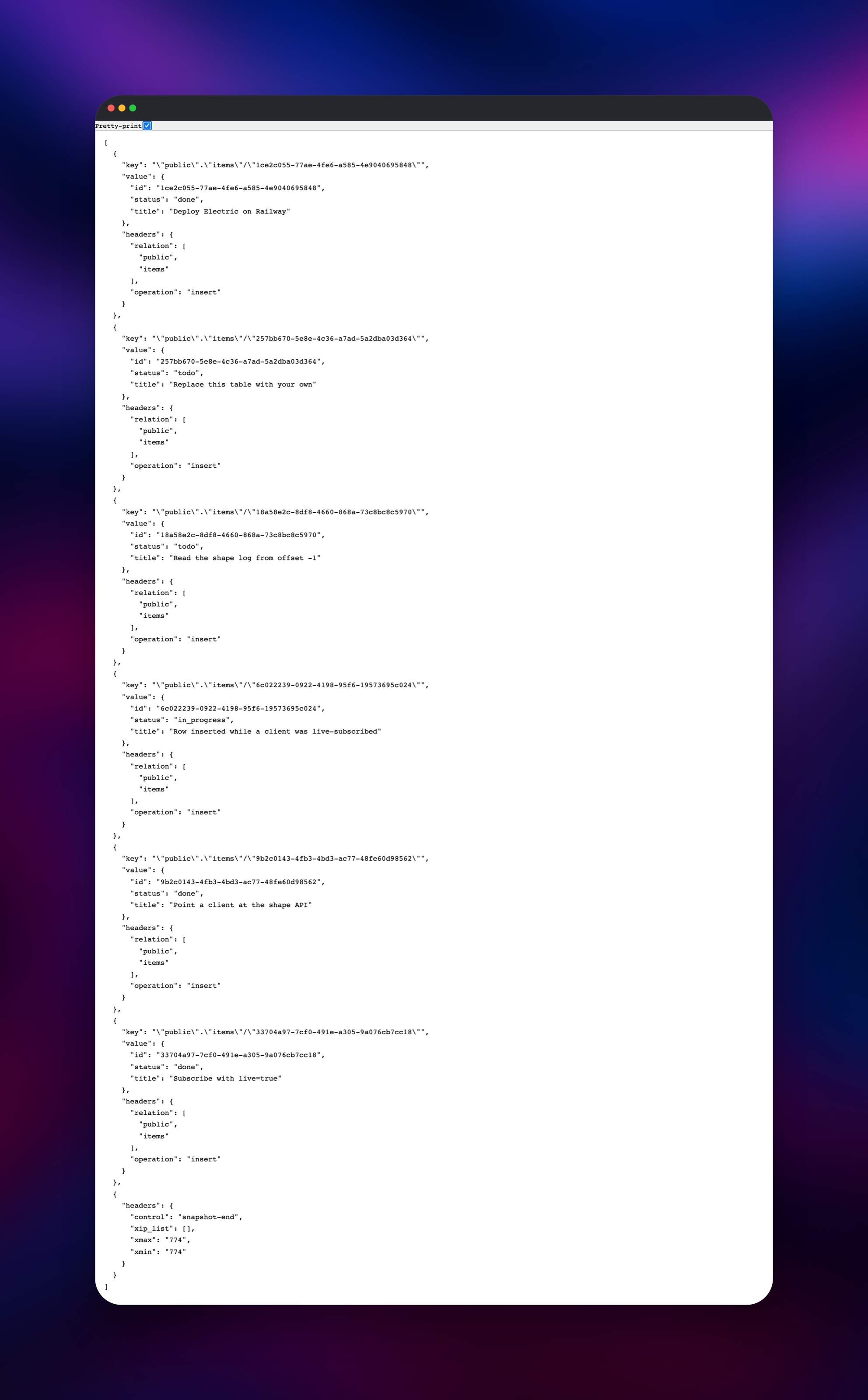
The database ships with a small demo table called items, so your first request returns real data rather than an error. Fetch the whole table as a shape log:
curl "https:///v1/shape?table=items&offset=-1&secret="
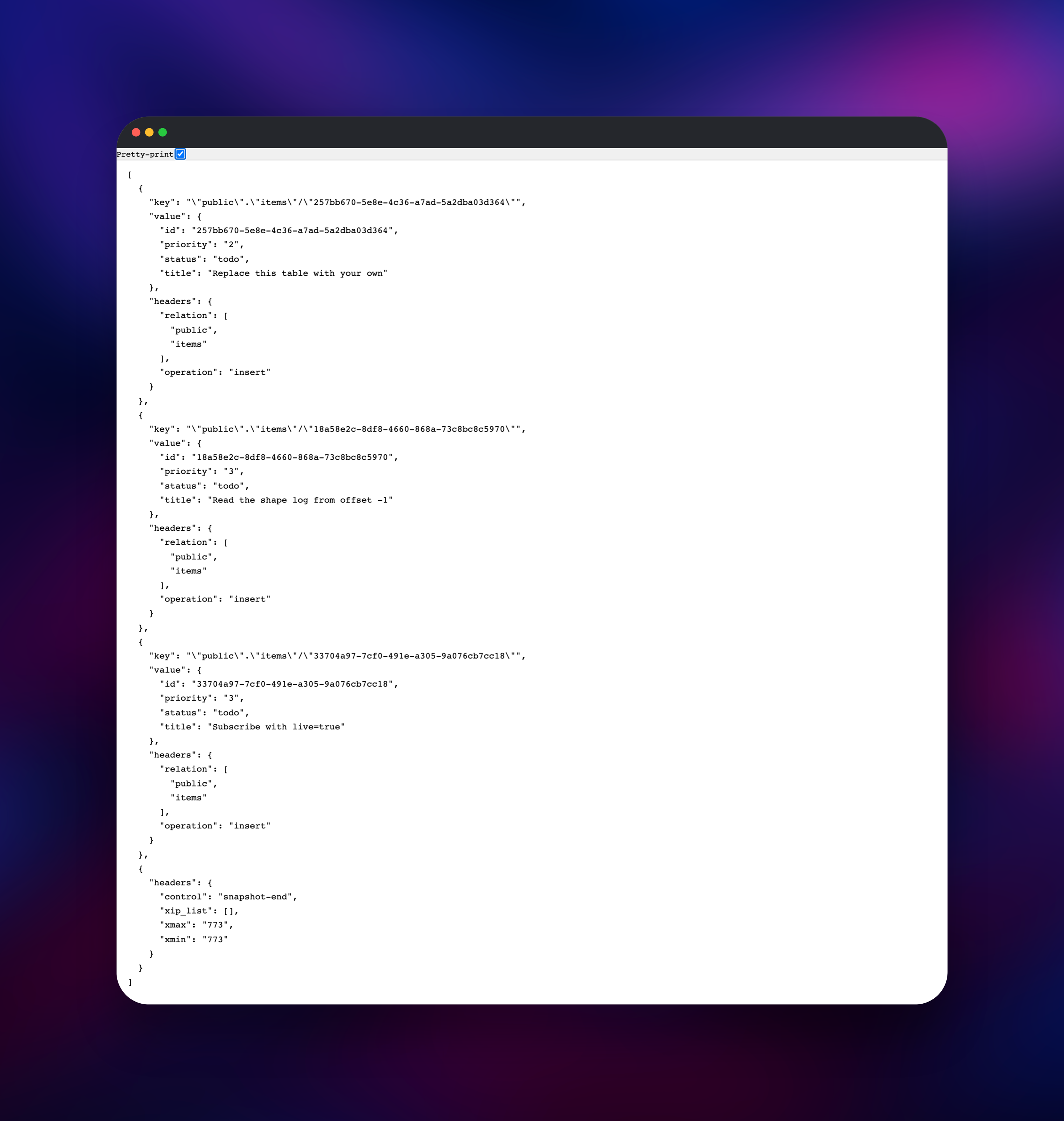
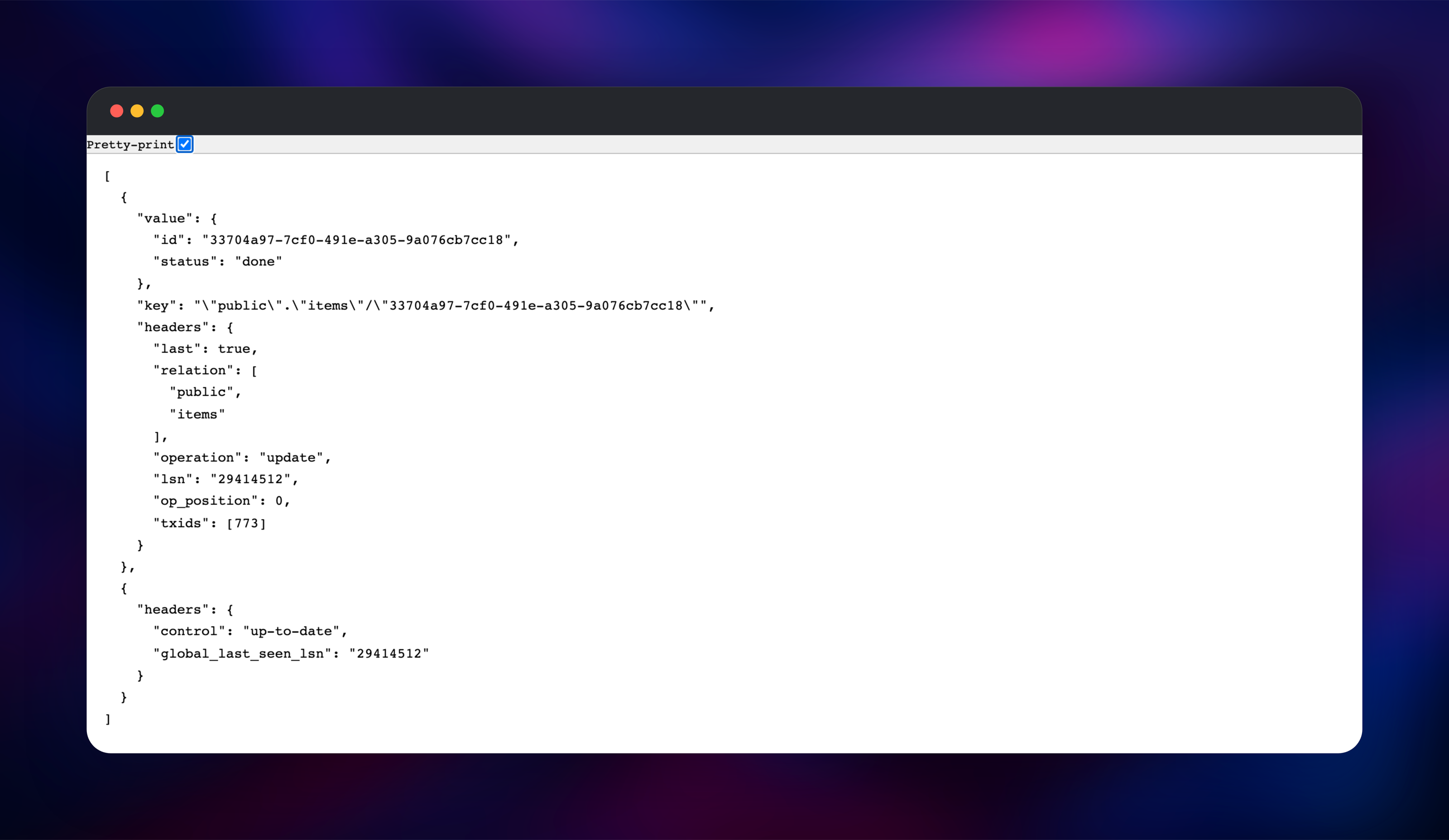
You get a JSON array of log entries, each with a key, the row value and headers naming the operation. The response also carries electric-handle and electric-offset — pass those back with live=true to hold a long-poll open and receive changes as they commit. Add where and columns to sync only part of a table:
curl "https:///v1/shape?table=items&columns=id,title,status&where=status%20%3D%20%27todo%27&offset=-1&secret="
Once that works, connect a client with npm install @electric-sql/client, or @electric-sql/react for a useShape hook, pointing its url at your Railway domain. Then create your own tables in the Postgres service and drop items. Any table is syncable immediately — Electric adds it to its publication on the first shape request, with no registration step.
About Hosting ElectricSQL
Electric solves the hardest part of real-time and local-first applications: getting a correct, resumable subset of a Postgres database into a client and keeping it there. It replaces neither your database nor your API — it sits beside them as a read path, and teams self-host it to keep that path on their own infrastructure rather than routing customer data through a third party.
- Partial replication through shapes: a table, a
whereclause and a column list - A plain HTTP API — no custom protocol, no websocket server to operate
- Resumable, append-only logs that survive client restarts and network loss
- Built for CDN and proxy caching, so repeat syncs never touch Postgres
- Reads only: writes go through your own API, so your auth rules stay put
The deployment splits into three roles. Postgres owns every durable byte and runs with wal_level=logical. electric connects over a replication slot, keeps its shape logs on a 5 GB volume, and serves the API privately on port 3000. cache is nginx with proxy_cache and proxy_cache_lock, the only service with a public domain; its request collapsing lets subscribers share one upstream long-poll.
Why Deploy ElectricSQL on Railway
Railway removes the setup between you and a working sync engine.
- Logical replication configured before first boot — no manual
wal_levelchange - The caching proxy Electric's docs recommend, already wired up
- Private networking keeps Postgres and the sync service off the public internet
- Persistent volumes for the database and the shape logs
- Scale CPU, memory and storage without redeploying
Common Use Cases for Self-Hosted ElectricSQL
- Local-first apps that keep a working copy of user data in the browser
- Live dashboards and collaborative UIs, replacing polling with a change stream
- Syncing reference data — pricing, feature flags, catalogues — into edge workers
- Multi-tenant SaaS where each client syncs only the rows its
whereclause matches
Dependencies for ElectricSQL on Railway
electricsql/electric:latest— the sync service, an Elixir release serving the shape APIghcr.io/railwayapp-templates/postgres-ssl:18— Postgres 18 with logical replicationnginx:1-alpine— the caching proxy in front of Electric
Environment Variables Reference
| Variable | Service | Purpose |
|---|---|---|
DATABASE_URL | electric | Postgres connection; the role needs REPLICATION |
ELECTRIC_SECRET | electric | Required on every shape request as ?secret= |
ELECTRIC_CONSUMER_PARTITIONS | electric | Concurrency; set to the CPU quota |
ELECTRIC_UPSTREAM | cache | Host and port the proxy forwards to |
POSTGRES_PASSWORD | Postgres | Superuser password, generated at deploy |
Deployment Dependencies
- GitHub: electric-sql/electric
- Docker Hub: electricsql/electric
- Docs: electric.ax/docs
- Source repository: gridalpha/electricsql-railway
Hardware Requirements for Self-Hosting ElectricSQL
Electric is disk-first: shape logs are written and re-read constantly, so storage speed matters more than cores do.
| Resource | Minimum | Recommended |
|---|---|---|
| CPU | 1 vCPU | 2–4 vCPU |
| RAM | 1 GB | 2–4 GB |
| Storage | 5 GB volume | 10 GB+, scaled to shape count |
| Runtime | Docker / OCI container | Docker / OCI container |
Postgres needs its own headroom, and each active shape keeps a log on disk — raise the Electric volume before shape count grows.
Self-Hosting ElectricSQL with Docker
Electric needs a Postgres with wal_level=logical and a role carrying the REPLICATION attribute. Start the database with that setting on the command line:
docker run -d --name pg -e POSTGRES_PASSWORD=pw postgres:18 \
  postgres -c wal_level=logical -c max_wal_senders=10 -c max_replication_slots=10
Then run the sync service against it, giving it a directory to keep shape logs in:
docker run -d --name electric -p 3000:3000 \
  -e DATABASE_URL="postgresql://postgres:pw@pg:5432/postgres?sslmode=disable" \
  -e ELECTRIC_SECRET="a-long-random-string" \
  -e ELECTRIC_STORAGE_DIR=/data/electric \
  -v electric-data:/data electricsql/electric:latest
Electric creates the publication and replication slot itself on first connection. In production, put a caching proxy or CDN in front of port 3000.
How Much Does ElectricSQL Cost to Self-Host?
The sync service is open source under Apache-2.0, with no paid tier, seat limit or feature gate in the self-hosted build. The company behind it sells Electric Cloud, a managed version, but nothing here depends on it. On Railway you pay only for the compute, memory and storage the three services use.
FAQ
What is ElectricSQL? A Postgres sync engine that turns logical replication into a cacheable HTTP API, so clients subscribe to a filtered subset of your database and keep it current.
What does this Railway template deploy? Three services: Postgres 18 with logical replication enabled, the Electric sync service on a persistent volume, and an nginx caching proxy fronting the API publicly.
Why does the template include Postgres instead of my existing database?
Electric requires wal_level=logical, which most managed Postgres instances do not enable by default. The bundled database has it set from first boot. Point DATABASE_URL at your own Postgres if it already meets that requirement.
Why is there a caching proxy in front of ElectricSQL? Shape-log pages below the current offset never change, so they cache indefinitely, and the proxy collapses concurrent live subscriptions into one upstream request. Electric's docs treat a cache as part of a production deployment, not an optimisation.
How do I secure my self-hosted ElectricSQL endpoint?
Every request must carry the generated ELECTRIC_SECRET. For end-user traffic, keep it server-side and proxy shape requests through your own API, applying per-user authorisation before forwarding.
Can ElectricSQL write back to Postgres? No — Electric is a read path only. Writes go through your existing API or database connection, and the change comes back to clients through the shape log.
Template Content