
Deploy Gatus | Open Source Website & API Health Monitoring
Self Host Gatus. Health checks - HTTP, DNS, TCP, ICMP probes & more
Just deployed
/data

Deploy and Host Gatus on Railway

Gatus is an open-source, developer-oriented health dashboard that continuously probes your endpoints over HTTP, ICMP, TCP, DNS, gRPC, WebSocket, SSH, and more, then surfaces the results on a public-or-private status page and alerts you through Slack, Discord, PagerDuty, Telegram, email, and dozens of other providers. Unlike heavier observability stacks, Gatus is a single Go binary configured by a single YAML file — perfect for monitoring your own SaaS, APIs, databases, and internal services without standing up Prometheus + Alertmanager + Grafana.
This Railway template lets you deploy Gatus on Railway in one click. The template builds a hardened Alpine image from twinproduction/gatus:stable, attaches a Railway volume for the embedded SQLite database, exposes a public HTTPS domain, and ships a configurable GATUS_CONFIG_YAML environment variable so you can paste your full Gatus configuration into the Railway dashboard without ever touching a shell.
Getting Started with Gatus on Railway
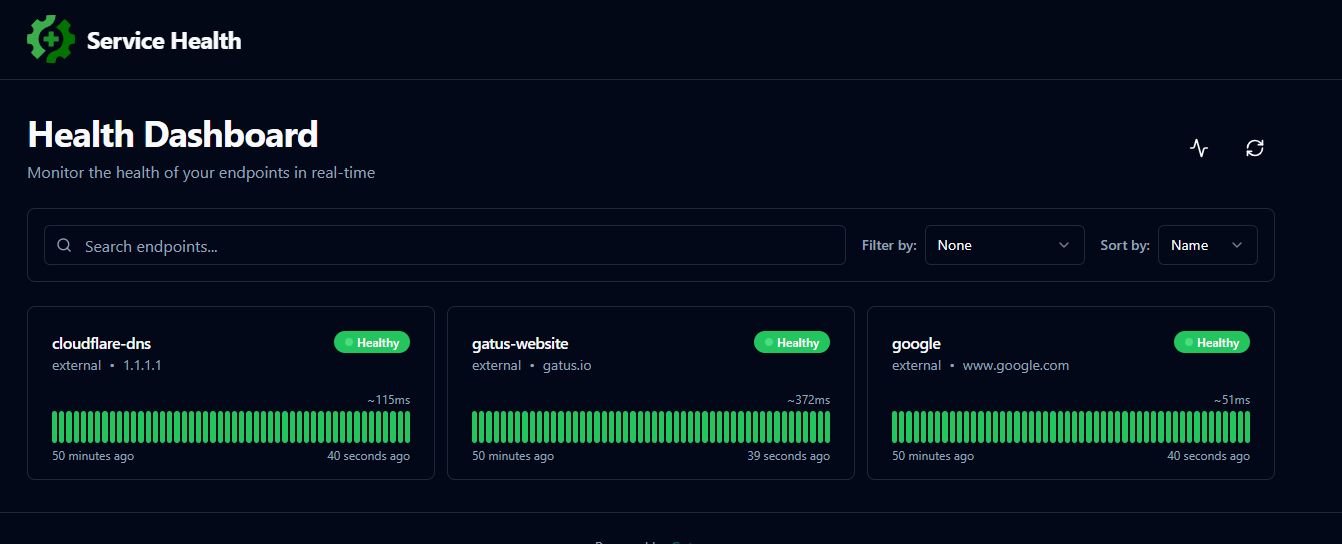
After your Railway deployment finishes, open the generated *.up.railway.app URL to see the Gatus status page running with three demo endpoints already being probed (gatus.io, google.com, 1.1.1.1). To monitor your own services, edit/add the GATUS_CONFIG_YAML variable on the Gatus service in the Railway dashboard and paste your full Gatus YAML — the entrypoint rewrites /data/config.yaml on every restart, so the next deploy picks up your changes. To lock the page behind HTTP basic auth, set GATUS_ADMIN_USERNAME and GATUS_ADMIN_PASSWORD, then redeploy — the entrypoint will bcrypt the password and inject a security: block at boot. The SQLite database at /data/gatus.db persists across redeploys thanks to the attached volume.
About Hosting Gatus
Gatus is a YAML-driven uptime monitor that runs as a single static binary. Each endpoint definition specifies a target URL, a probe interval, and a list of conditions (e.g. [STATUS] == 200, [RESPONSE_TIME] < 500, [BODY].status == UP). When any condition fails, Gatus triggers alerts and updates the status page.
Key features:
- Probes over HTTP, ICMP (ping), TCP, DNS, gRPC, WebSocket, SSH, STARTTLS, TLS
- 25+ alerting providers including Slack, Discord, Teams, PagerDuty, Telegram, email, generic webhooks
- Built-in OIDC and HTTP basic auth for protecting the status page
- Endpoint groups, maintenance windows, response-body assertions, and certificate-expiry checks
- Per-endpoint history with response-time graphs and uptime percentages
This template runs a single Gatus service backed by an embedded SQLite database on a Railway volume — no external Postgres required for small-to-medium dashboards.
Why Deploy Gatus on Railway
Railway eliminates the manual work of self-hosting Gatus:
- One-click deploy from this template — no Docker, no
docker-compose - Persistent Railway volume mounted at
/datafor SQLite + config - HTTPS public domain auto-provisioned, port routing wired
- Edit
GATUS_CONFIG_YAMLin the dashboard, redeploy, done - Built-in metrics, logs, and rollback in the Railway UI
- Scale CPU/RAM independently as your endpoint list grows
Common Use Cases
- Public status page for your SaaS, surfacing uptime and response times to customers
- Internal monitoring of microservices, databases, and queues over Railway's private network
- Certificate-expiry and DNS-record sanity checks across multiple production domains
- SLA reporting with Slack/PagerDuty alerts when conditions break
Dependencies for Gatus on Railway
This template deploys one Railway service built from a custom Dockerfile that combines two upstream images:
- Gatus binary:
twinproduction/gatus:stable(copied via multi-stage build) - Runtime base:
alpine:3.20(provides shell,htpasswd,ca-certificates,wget) - Source repository:
praveen-ks-2001/gatus-railway
Environment Variables Reference for Gatus on Railway
| Variable | Required | Description |
|---|---|---|
GATUS_CONFIG_PATH | ✅ | Path inside the container where Gatus reads config.yaml |
GATUS_CONFIG_YAML | optional | Full YAML config — overrides baked-in default on every boot |
Deployment Dependencies for Self-Hosting Gatus
- Upstream project: github.com/TwiN/gatus
- Official documentation: gatus.io
Hardware Requirements for Self-Hosting Gatus on Railway
| Resource | Minimum | Recommended |
|---|---|---|
| CPU | 0.25 vCPU | 0.5 vCPU |
| RAM | 256 MB | 512 MB |
| Storage | 1 GB volume | 5 GB volume |
| Runtime | Alpine 3.20 / Go static binary | Alpine 3.20 / Go static binary |
Gatus is extremely lightweight — the binary idles around 30 MB RAM.
Self-Hosting Gatus With a Custom Configuration
The fastest way to self-host Gatus on Railway is to click Deploy and then paste your Gatus YAML into GATUS_CONFIG_YAML. A minimal config that monitors two endpoints and sends a Slack alert when either fails looks like this — the YAML is what you paste into the GATUS_CONFIG_YAML env var:
storage:
  type: sqlite
  path: /data/gatus.db

alerting:
  slack:
    webhook-url: ${SLACK_WEBHOOK_URL}

endpoints:
  - name: api
    url: https://api.example.com/health
    interval: 60s
    conditions:
      - "[STATUS] == 200"
      - "[BODY].status == UP"
    alerts:
      - type: slack
        failure-threshold: 3
        send-on-resolved: true

  - name: marketing
    url: https://www.example.com
    interval: 5m
    conditions:
      - "[STATUS] == 200"
      - "[CERTIFICATE_EXPIRATION] > 168h"
Gatus performs its own ${VAR} substitution inside the YAML, so referencing Railway service variables like ${SLACK_WEBHOOK_URL} or ${{SomeService.VAR}} (Railway resolves the latter at deploy time) works without escaping. To run Gatus outside of Railway with this same image, the following is the equivalent Docker command:
docker run -d \
  -p 8080:8080 \
  -v gatus-data:/data \
  -e GATUS_CONFIG_PATH=/data/config.yaml \
  -e GATUS_CONFIG_YAML="$(cat config.yaml)" \
  ghcr.io/praveen-ks-2001/gatus-railway:latest
How Much Does Gatus Cost to Self-Host?
Gatus is fully open-source under the Apache 2.0 license — the software itself is free forever, with no paid tier. On Railway you only pay for the underlying compute, RAM, egress, and volume storage; a typical small deployment monitoring 10–50 endpoints fits comfortably inside the Hobby plan's $5 monthly credit.
FAQ
What is Gatus and Why Self-Host It on Railway?
Gatus is an open-source automated status page and health monitoring tool. Self-hosting on Railway gives you full control over the endpoints you probe (including internal services on Railway's private network) without paying per-monitor fees to a SaaS like Pingdom or Better Uptime.
How Do I Export Monitoring Data From Gatus via the REST API?
Gatus exposes every status check over HTTP, so you can pull data from anywhere with curl. The main endpoints are /api/v1/endpoints/statuses (full snapshot of all endpoints), /api/v1/endpoints/{group}_{name}/statuses?page=1&pageSize=100 (paginated history for one endpoint), and /metrics (Prometheus format, if enabled in config). Without auth:
curl https://your-gatus.up.railway.app/api/v1/endpoints/statuses > snapshot.json
If you've set GATUS_ADMIN_USERNAME / GATUS_ADMIN_PASSWORD, pass them with -u:
curl -u admin:yourpassword https://your-gatus.up.railway.app/api/v1/endpoints/statuses > snapshot.json
The response is JSON containing every endpoint, every probe result, response times, and condition pass/fail — pipe it into jq, store it in S3, or feed it to a BI tool.
Why is SQLite Used Instead of an External Postgres for Gatus?
For small-to-medium dashboards (under a few hundred endpoints), Gatus's embedded SQLite storage is faster, cheaper, and zero-maintenance compared to running a separate Postgres service. You can swap to Postgres later by editing GATUS_CONFIG_YAML.
How Do I Enable HTTP Basic Auth in Self-Hosted Gatus on Railway?
Set GATUS_ADMIN_USERNAME and GATUS_ADMIN_PASSWORD on the Gatus service in Railway, then trigger a redeploy. The entrypoint script bcrypts the password and injects a security.basic block into /data/config.yaml automatically. To switch to OIDC instead, add a security.oidc: block directly inside GATUS_CONFIG_YAML.
What Format Should I Use for the GATUS_CONFIG_YAML Variable?
Paste a standard Gatus YAML configuration — the same format the upstream project uses, with storage:, endpoints:, and optional alerting: / security: blocks. Gatus does its own ${VAR} substitution at load time, so secrets can stay as env-var references. A minimal working example:
storage:
  type: sqlite
  path: /data/gatus.db

endpoints:
  - name: my-api
    url: https://api.example.com/health
    interval: 60s
    conditions:
      - "[STATUS] == 200"
      - "[RESPONSE_TIME] < 1000"
      - "[BODY].status == UP"

  - name: marketing-site
    url: https://www.example.com
    interval: 5m
    conditions:
      - "[STATUS] == 200"
      - "[CERTIFICATE_EXPIRATION] > 168h"
After pasting and saving, Railway redeploys automatically. The entrypoint writes the YAML to /data/config.yaml on boot, so your changes take effect on the next container start. Full schema reference: gatus.io/docs.
Template Content