Deploy OpenCode 2 CLI + Web App
OpenCode 2 from day one: web app, your own TUI, or SSH. Free models.
OpenCode
Just deployed
/workspace
Deploy and Host OpenCode 2 on Railway
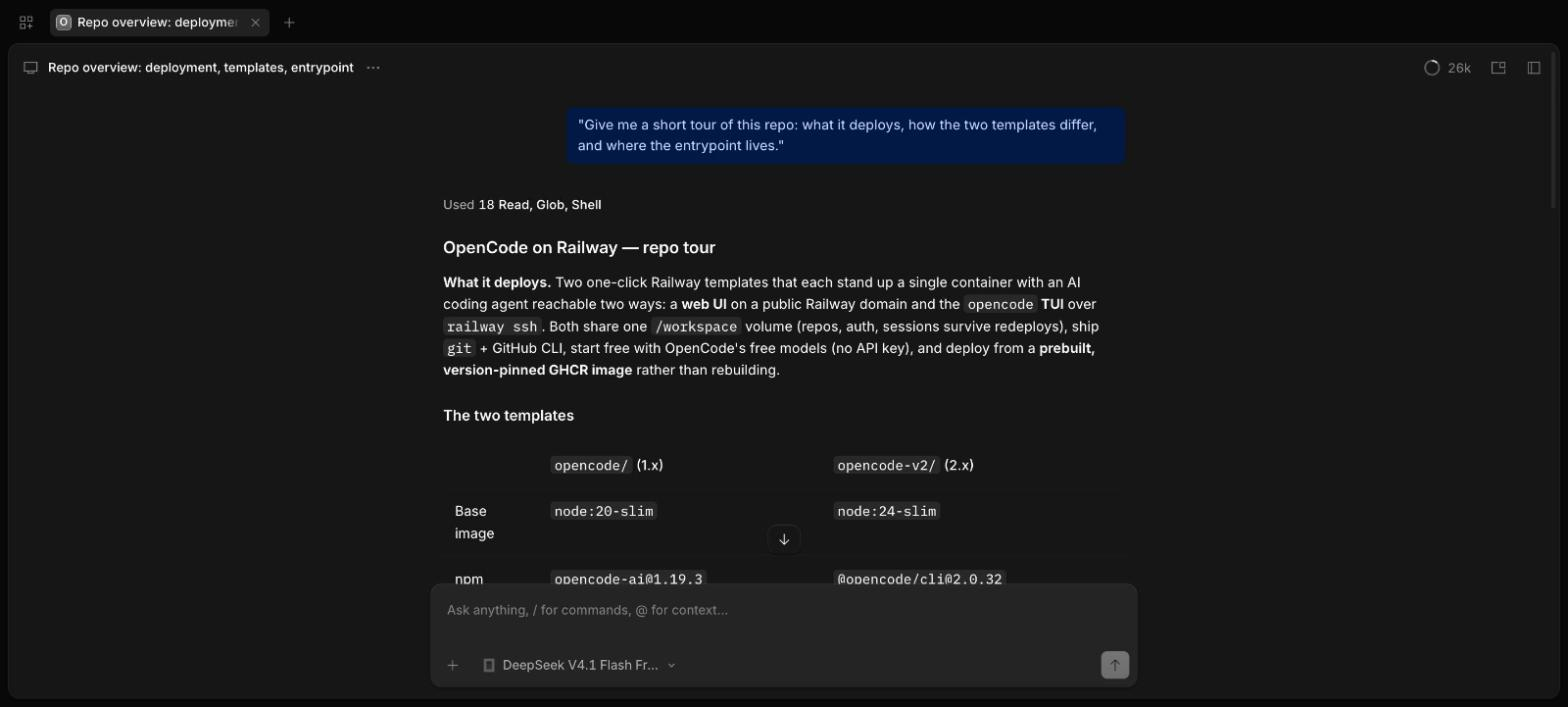
OpenCode is the open-source AI coding agent — it reads your repo, writes
and edits code, runs commands, and opens pull requests. OpenCode 2 rebuilt it around one shared
server that the terminal, web and desktop apps all connect to. This template runs that server on
Railway: the OpenCode 2 web app on a public domain — and when you'd rather work in a terminal,
your own OpenCode 2 or railway ssh connects to the same server and the same sessions.
About Hosting OpenCode 2
One container runs opencode serve — OpenCode 2's server, which serves both the web app and
its API — on a public Railway domain, with every API call password-protected. A /workspace volume
keeps sessions, credentials and repos across redeploys; git + the GitHub CLI are preinstalled.
Three ways in, one set of sessions — start a task in one, pick it up in another:
- Browser — open the public URL, choose Use password, and paste the password from the
deploy logs (
[boot] opencode web auth → …) or theOPENCODE_PASSWORDvariable. It is generated for your deploy. - Your own OpenCode 2 — on any machine with OpenCode 2 installed:
OPENCODE_PASSWORD= opencode --server https://. The TUI runs locally; the agent, repos and sessions stay in the cloud. It needs OpenCode 2 (a 1.x client cannot talk to a 2.x server), ideally the same version the box runs. railway ssh— thenopencodefor the TUI, with a real shell,gitandghon the box beside it.
Deploys come from a prebuilt, version-pinned image — no build to sit through, and every deploy runs the exact OpenCode 2 build that was tested. OpenCode 2 is moving fast; pinning is what keeps a bad upstream release from breaking your deploy. You can start coding free with no API key: OpenCode's free models (such as DeepSeek) work as soon as the box boots.
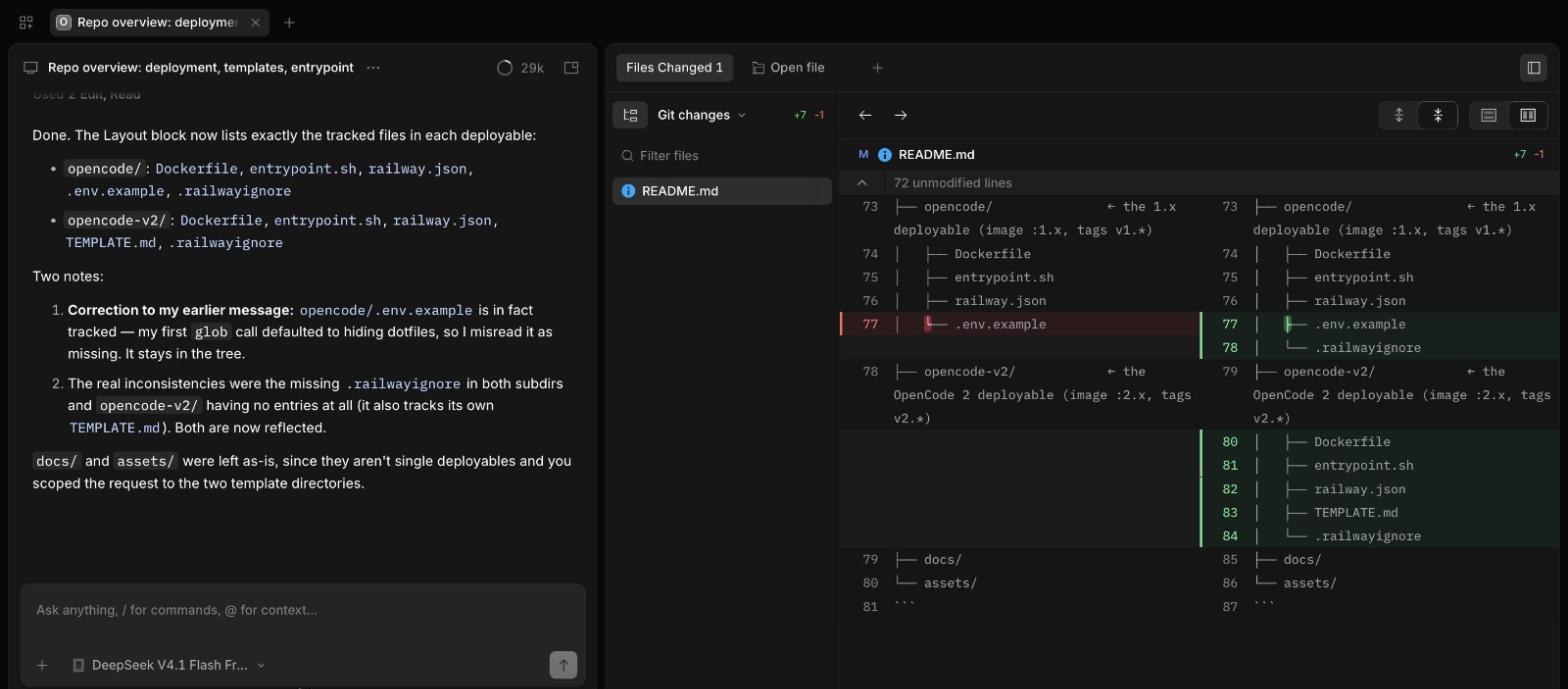
Every edit the agent makes shows up in the web app's Review panel as a side-by-side diff, next to the conversation that produced it, alongside a file browser for the repo.
Why Deploy OpenCode 2 on Railway?
- OpenCode 2 from day one — the new shared-server architecture and redesigned web app, pinned to a tested build and upgraded deliberately, not whatever was published an hour ago.
- Start free, no API key — OpenCode's free models (such as DeepSeek) work out of the box. The free lineup is set by OpenCode and changes over time.
- Review every change in the browser — the Review panel shows each file the agent touched as a side-by-side diff, so you can check its work from any device.
- Bring your own terminal — point your local OpenCode 2 at the box with
--server: your TUI, a cloud agent, no SSH required. - A real shell when you need one —
railway sshgives you the TUI plus a shell,gitandghon the box itself. - One set of sessions everywhere — browser, your own OpenCode 2 and SSH all attach to the same server: same sessions, same history, same repos.
- Your laptop can sleep — the agent lives in the cloud; reopen the link, reconnect your TUI or SSH back in and pick up where you left off.
- Secure by default — the API refuses every call, from the browser or a remote TUI, without the password generated for your deploy; SSH is Railway-authenticated.
- Provider-agnostic — add an Anthropic, OpenAI or OpenRouter key, or
opencode auth loginto anything OpenCode supports.
Common Use Cases
- Try OpenCode 2 without installing anything — free models, one click.
- A cloud coding-agent workstation you drive from a browser, your own OpenCode 2, or SSH.
- Long-running refactors or migrations that keep going regardless of your local machine.
Dependencies for OpenCode 2 Hosting
- No API key required to start — OpenCode's free models work out of the box. For premium
models, add
ANTHROPIC_API_KEY,OPENAI_API_KEY, orOPENROUTER_API_KEY(all on the deploy form), or runopencode auth loginafter connecting. - Nothing to install for the web app — just a browser. Your own terminal needs OpenCode 2
plus the URL and password;
railway sshneeds the Railway CLI.
The box also honours GITHUB_TOKEN, GIT_USER_NAME and GIT_USER_EMAIL if you add
them under Variables later. It generates its own SSH key on first boot
(cat ~/.ssh/id_ed25519.pub → add it to GitHub).
Deployment Dependencies
- OpenCode — the open-source AI coding agent
(
@opencode/clion npm). - GitHub CLI — bundled so the agent can manage issues and pull requests.
Why This Template?
OpenCode 2 on one server you can reach three ways — the web app, your own OpenCode 2 terminal, or SSH — all sharing the same sessions, pinned to a tested build, free models included. Prefer the 1.x line? OpenCode CLI + Web App. Source and docs: github.com/yuting1214/opencode-railway.
Template Content


