
Deploy PicoShare
PicoShare — minimalist self-hosted file sharing with direct links
picoshare
Just deployed
/data

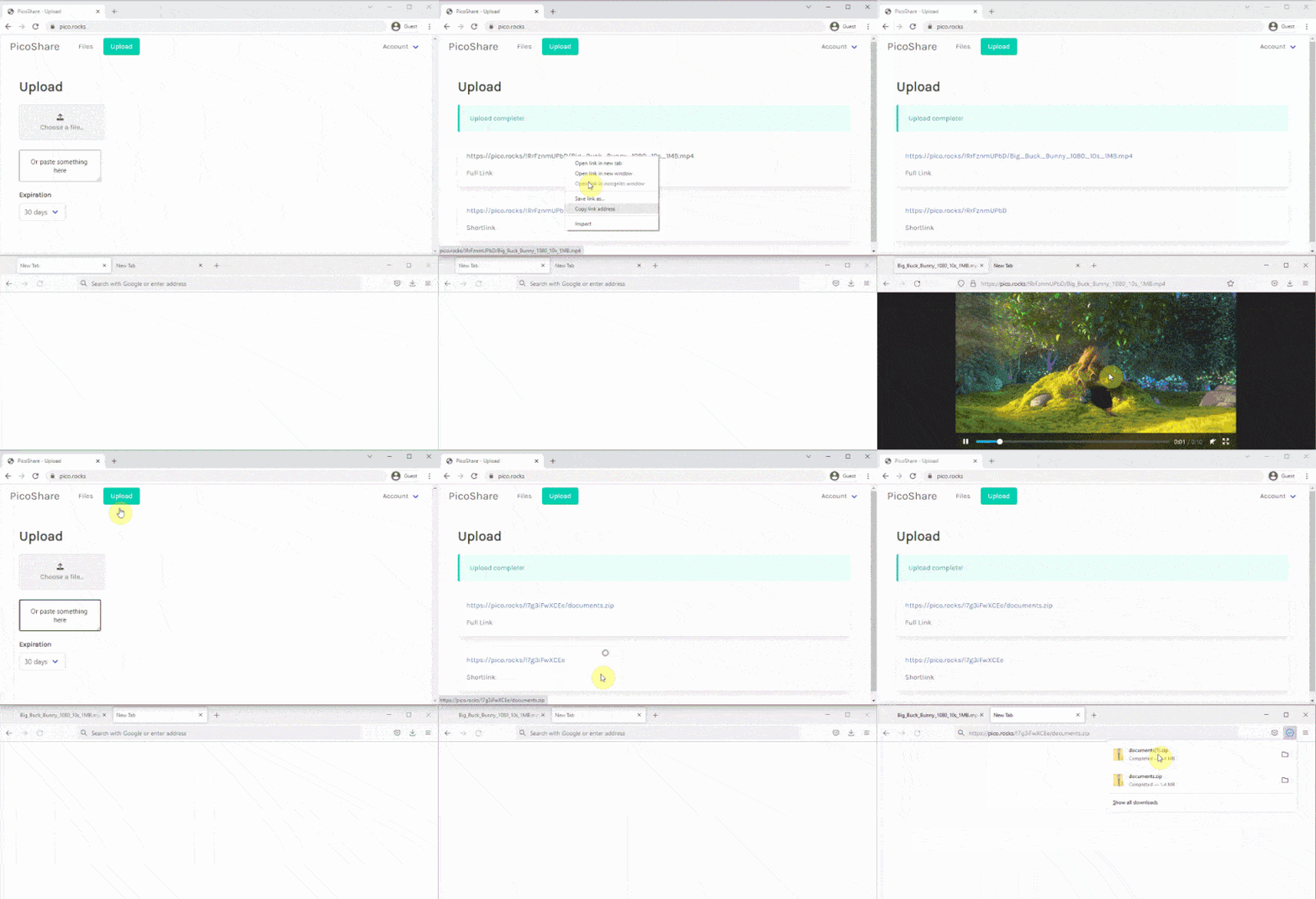
Screenshot: upstream demo (from mtlynch/picoshare, docs/readme-assets/demo.gif).
Deploy and Host
PicoShare is a minimalist service for sharing images and other files: upload a file, get a direct download link, share it with anyone. Deploy it on Railway in one click — the form has a single field, a generated admin passphrase. PicoShare listens on Railway's injected PORT and stores everything (files included) in a SQLite database on a persistent volume at /data.
About Hosting
This template runs the pinned upstream PicoShare v1.5.4 image (mtlynch/picoshare, AGPL-3.0) as a single Go service. There is no companion database and no worker: the SQLite file on the /data volume is the whole store, and a nightly garbage collector reclaims space from deleted files. The admin logs in with the generated PS_SHARED_SECRET passphrase; guest links let anyone else upload without an account. PS_BEHIND_PROXY=true is baked in so HTTPS and client IPs behave correctly behind Railway's edge.
Why Deploy
- Direct download links: every upload gets a short link anyone can open — no account, no ads, no waiting room.
- Any file, any size: images, video, audio, documents, archives — PicoShare never forces a file type and never re-encodes your media.
- Guest links: hand someone a link and they can upload files to you without an account.
- Private by default: your files live in your own Railway volume, not on a third-party sharing site.
- Tiny footprint: a single Go binary with embedded SQLite, idling on a few tens of MB.
Common Use Cases
- Sharing screenshots, videos, and documents with friends, clients, or a community without an ad-supported host.
- A private drop-box: give collaborators a guest link and have them upload files straight to your server.
- Quick file handoff between your own devices — upload from your phone, download on your desktop.
- Hosting images and files you link from a blog, forum, or chat, under your own domain.
Dependencies for
Deployment Dependencies
- Plan: Hobby is plenty — PicoShare is a single small Go binary.
- RAM: ~50 MB at rest; uploads stream through without loading whole files into memory.
- Storage: one Railway volume mounted at
/data(the SQLite database holds all files, so volume size is your file budget). - Networking: one public HTTP service; no extra ports, no background workers, no companion database.
- Upstream: PicoShare v1.5.4, pinned by manifest digest, AGPL-3.0.
Environment variables: PS_SHARED_SECRET (generated admin passphrase, required — the only deploy-form field). Automatic: PORT (Railway-injected), PS_BEHIND_PROXY=true. Optional upstream extras: PS_SHARED_SECRET_FILE, and Litestream replication (LITESTREAM_BUCKET, LITESTREAM_ENDPOINT, LITESTREAM_ACCESS_KEY_ID, LITESTREAM_SECRET_ACCESS_KEY, LITESTREAM_PATH, LITESTREAM_RETENTION) — unset by default; the Railway volume is the store. Full reference in the repo README.
Template Content
picoshare
INAPP-Mobile/picoshare

