Deploy Qdrant
Vector database for storing embeddings and searching by similarity
qdrant-3
Just deployed
/qdrant/storage
qdrant-1
Just deployed
/qdrant/storage
Just deployed
qdrant-2
Just deployed
/qdrant/storage
snapshots
Bucket
Just deployed
Deploy and Host Qdrant on Railway
Qdrant is an open-source vector database written in Rust that stores embeddings alongside arbitrary JSON payloads and answers nearest-neighbour queries in milliseconds. It is the retrieval layer behind retrieval-augmented generation, semantic search, recommendations and deduplication — anywhere an app needs "find the things most similar to this" rather than "the rows matching this WHERE clause". Its distinguishing feature is filtered vector search: payload conditions are applied during graph traversal, so "the ten closest documents for this tenant, tagged policy" stays fast instead of degrading into a post-filter scan.
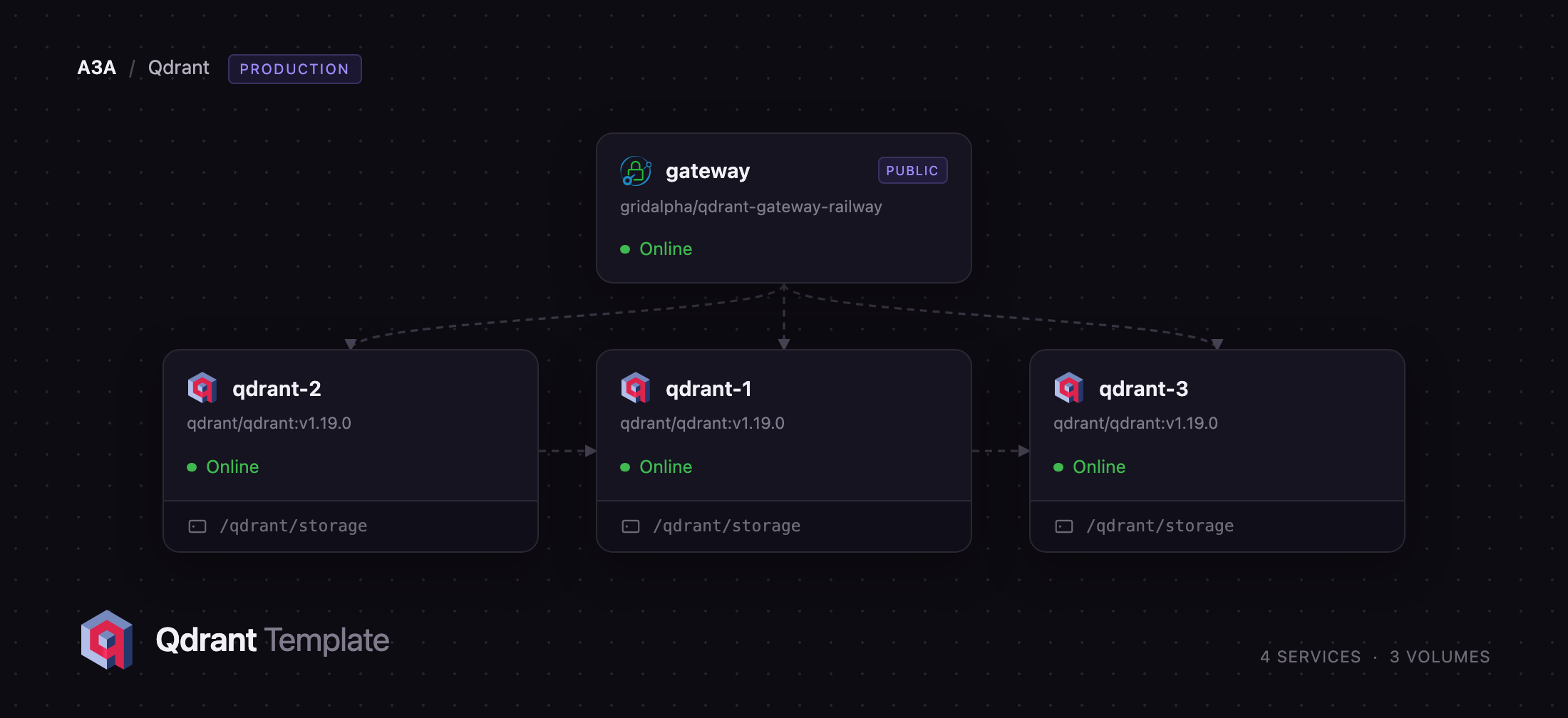
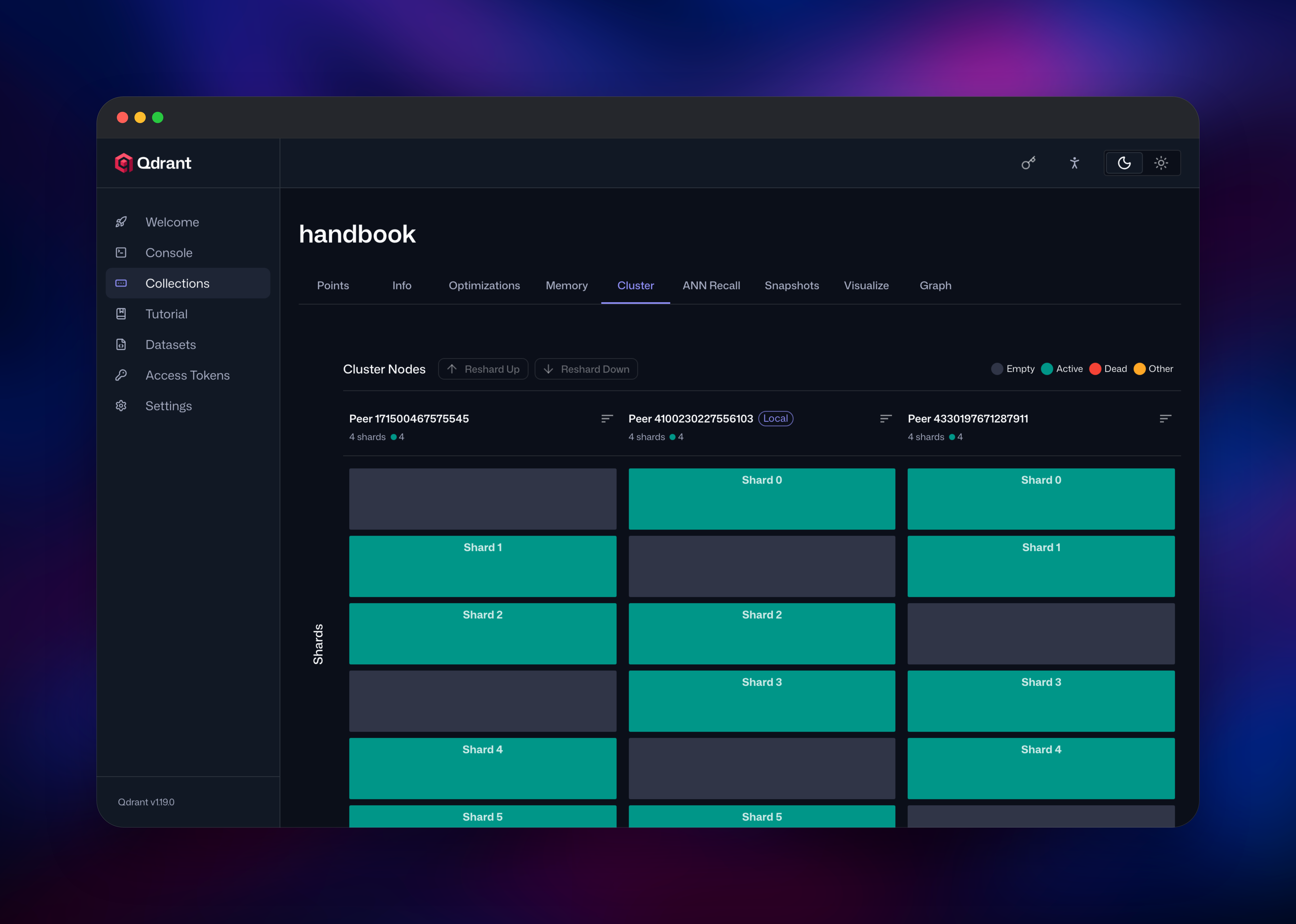
Self-host Qdrant on Railway and this template gives you the shape Qdrant documents for production, not a single container. Three nodes join one Raft cluster over the private network, each with its own volume. A Caddy gateway holds the only public domain and round-robins the REST API across all three, so losing a node does not take the endpoint down. New collections default to six shards at replication factor two, and a managed object storage bucket holds snapshots, so a backup taken on one node restores from any of them.
Getting Started with Qdrant on Railway
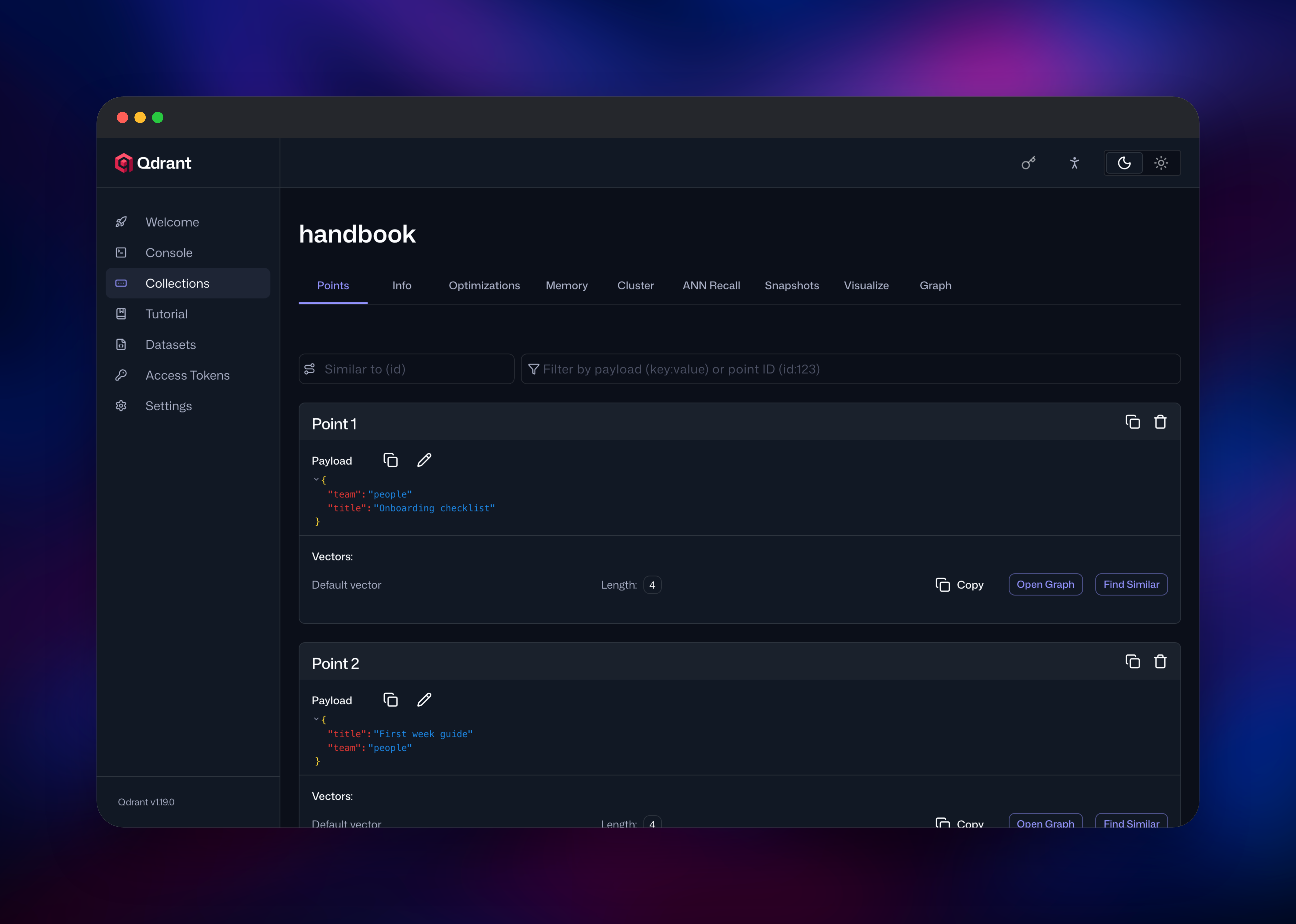
Deploying generates one public URL on the gateway. There are no default credentials to change: an API key is generated at deploy time and every data route rejects requests without it. Copy it from QDRANT__SERVICE__API_KEY on qdrant-1, then open /dashboard on your new domain, which prompts for the key on first load.
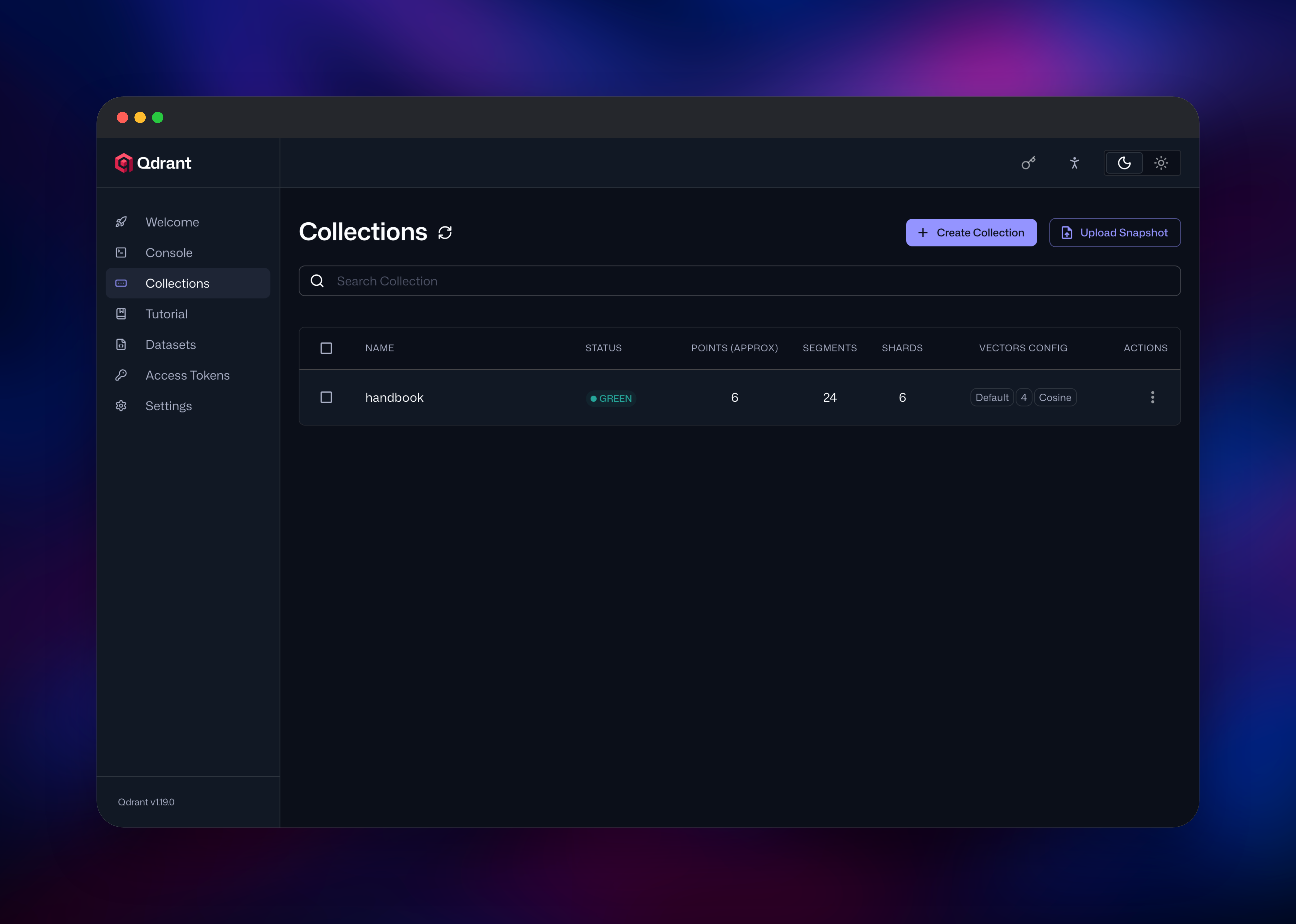
Confirm the cluster is healthy first: open the Console and run GET cluster, which should show three peers, one node with "role": "Leader", and an empty message_send_failures. Create your first collection from the Collections tab, matching the vector size to your embedding model (1536 for OpenAI text-embedding-3-small, 768 for most sentence-transformers). Upsert a few points, query them from the Console, then open the collection's Cluster tab to watch its shards spread across the peers. From your app, point any Qdrant client at the same URL with the key as the api-key header.
About Hosting Qdrant
Qdrant is a purpose-built vector search engine, not an extension bolted onto a general-purpose database. Teams self-host it when embeddings become core to the product and a managed service is too expensive, too slow, or ruled out by data residency. Being a single static Rust binary with no JVM and no external coordinator, it is unusually cheap to run at a given scale.
Key features:
- Filtered HNSW search — payload conditions applied during traversal, not after
- Hybrid and sparse vectors — dense, sparse and multi-vector search with server-side fusion
- Quantization — scalar, binary and 4-bit modes that cut memory dramatically
- JWT access control — scoped read-only or collection-limited tokens
The three qdrant-N services are peers, not primaries and replicas: any accepts any request and forwards it to whichever peer holds the shard, which is why a round-robin load balancer is safe in front of them. Raft consensus on private port 6335 keeps topology and collection definitions consistent. The gateway health-checks each node and routes around unhealthy ones, holding no credential of its own. The bucket exists because a Railway volume attaches to one service — object storage is what makes a snapshot visible cluster-wide.
Why Deploy Qdrant on Railway
Railway removes the work that makes a self-hosted vector cluster unattractive:
- Three nodes, three volumes and a load balancer provisioned in one click
- Private networking between peers, with no ports exposed to the internet
- Managed S3-compatible object storage wired up for snapshots
- Usage-based pricing with no per-vector or per-query fees
Common Use Cases
- Retrieval-augmented generation — ground an LLM in your documents, filtered per tenant so one customer never retrieves another's data
- Semantic and hybrid search — meaning-based ranking combining dense and sparse vectors in one query
- Recommendations and deduplication — "more like this" feeds, near-duplicate detection, image and audio matching
- Long-term agent memory — a durable store AI agents write to and search across sessions
Dependencies for Qdrant
qdrant/qdrant:v1.19.0— three nodes, each with a 6333 REST API, a 6334 gRPC API and a 6335 Raft peer portgridalpha/qdrant-gateway-railway— Caddy 2 load balancer, from this source repository- One object storage bucket for snapshots, and three volumes mounted at
/qdrant/storage
Environment Variables Reference
| Variable | Purpose |
|---|---|
QDRANT__SERVICE__API_KEY | Full-access key sent as the api-key header |
QDRANT__SERVICE__READ_ONLY_API_KEY | Key permitting reads and search but no writes |
QDRANT__SERVICE__HOST | Listen address; must stay :: for peers to reach each other |
QDRANT__STORAGE__COLLECTION__REPLICATION_FACTOR | Copies of each shard for new collections |
QDRANT__STORAGE__SNAPSHOTS_CONFIG__SNAPSHOTS_STORAGE | s3 for the bucket, local for the volume |
Deployment Dependencies
- Qdrant on GitHub, the documentation and the distributed deployment guide
qdrant/qdranton Docker Hub- Official clients for Python, JavaScript, Rust, Go, Java and .NET
Hardware Requirements for Self-Hosting Qdrant
Memory is what matters. A rough HNSW estimate is vectors × dimensions × 4 bytes × 1.5, so a million 768-dimension vectors needs about 4.5 GB before quantization — binary quantization cuts that by up to 32×.
| Resource | Minimum per node | Recommended per node |
|---|---|---|
| CPU | 1 vCPU | 4+ vCPU |
| RAM | 1 GB | 4–8 GB, sized to your index |
| Storage | 5 GB volume | 20 GB+, roughly 2× raw vector size |
| Runtime | Linux container, x86-64 or ARM64 | Same |
Self-Hosting Qdrant
A single node runs from one container. The following is a docker run with an API key and a persistent volume:
docker run -p 6333:6333 -p 6334:6334 \
  -v $(pwd)/qdrant_storage:/qdrant/storage \
  -e QDRANT__SERVICE__API_KEY="your-secret-key" \
  qdrant/qdrant:v1.19.0
Clustering needs no custom image or start command — it is configured entirely through environment variables. The first peer advertises itself with QDRANT_URI; later peers also set QDRANT_BOOTSTRAP. The following is the environment for a second node joining a cluster:
QDRANT__CLUSTER__ENABLED=true
QDRANT__CLUSTER__P2P__PORT=6335
QDRANT__SERVICE__HOST=::
QDRANT_URI=http://qdrant-2.railway.internal:6335
QDRANT_BOOTSTRAP=http://qdrant-1.railway.internal:6335
Two details decide whether a self-hosted cluster works. QDRANT__SERVICE__HOST also controls the Raft peer listener, so the default 0.0.0.0 leaves peers unreachable on IPv6-only private networks. And with no startup ordering, a node whose bootstrap target is not up yet exits — give joining nodes an always-restart policy so they retry until the cluster forms.
How Much Does Qdrant Cost to Self-Host?
Qdrant is free and open source under Apache 2.0, with no feature gating, node limit or seat count in the self-hosted build. Clustering, replication, quantization and JWT access control are all in the open-source binary. Qdrant Cloud is the paid managed offering; self-hosting costs only infrastructure, so on Railway you pay for what the four services consume.
FAQ
What is Qdrant? An open-source vector database and similarity search engine. It stores high-dimensional embeddings with JSON payloads and returns the nearest matches to a query vector, optionally constrained by filters on those payloads.
What does this Railway template deploy? Three Qdrant nodes forming one Raft cluster, each on its own volume, a Caddy gateway holding the public domain and load-balancing across them, and a bucket for snapshots. New collections default to six shards at replication factor two.
Why does the template include a gateway instead of exposing Qdrant directly? A Railway domain points at one service, so exposing a node directly makes it a single point of failure. The gateway health-checks all three and routes around a failed one, and keeps the Raft peer port private — which Qdrant's docs require, since that port can perform writes.
How do I enable API key authentication in self-hosted Qdrant?
Set QDRANT__SERVICE__API_KEY and send it as the api-key header; this template does it for you. Note that /, /healthz, /livez, /readyz and the /dashboard static files stay anonymous by design — the dashboard behaves like a login screen, and every data call it makes still needs the key.
Which Qdrant version does this template run, and how do I upgrade it?
It pins v1.19.0. Qdrant migrates its on-disk format between consecutive minors only, so upgrade one minor at a time and snapshot first.
Template Content
qdrant-3
qdrant/qdrant:v1.19.0qdrant-1
qdrant/qdrant:v1.19.0qdrant-2
qdrant/qdrant:v1.19.0snapshots
Bucket