
Deploy Spacebot (Slim)
An AI agent for teams, communities, and multi-user environments.
Spacebot
Just deployed
/data
See the difference between Full and Slim versions here
An AI agent for teams, communities, and multi-user environments.
Thinks, executes, and responds — concurrently, not sequentially.
Never blocks. Never forgets.
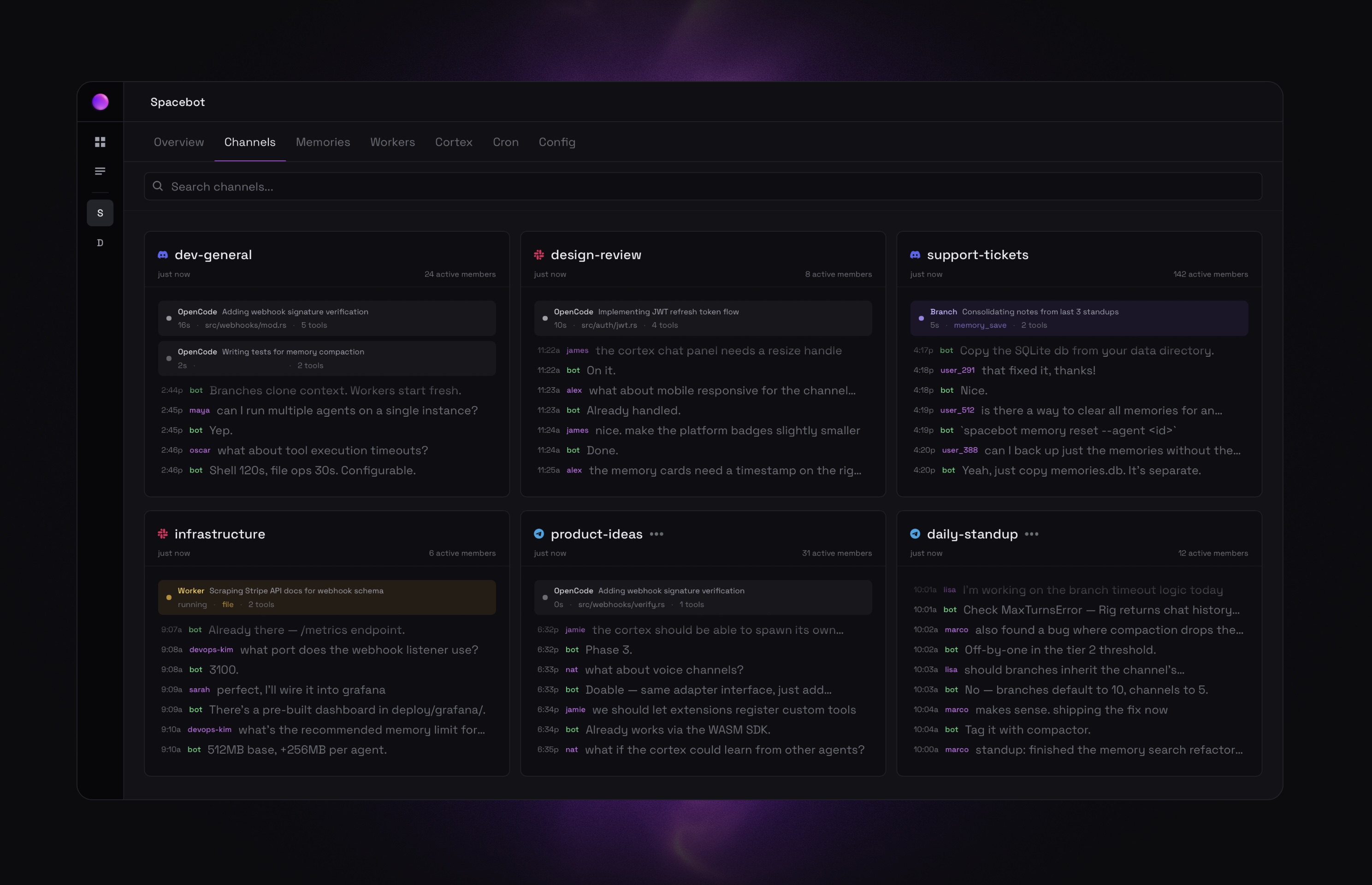
Spacebot is an AI agent built for teams, communities, and multi-user environments. Unlike single-threaded agents, it thinks, executes, and responds concurrently — handling dozens of simultaneous conversations across Discord, Slack, Telegram, and more without ever blocking.
About Hosting Spacebot
Hosting Spacebot involves running a Rust-based binary that coordinates multiple specialized processes: a session manager, memory system, worker pool, and messaging adapters. Connect your chosen platforms (Discord, Slack, Telegram, Twitch, Webchat, or webhook) and optionally set up persistent memory storage. A single deployment can run multiple agents with distinct identities and permission sets, making it well-suited for communities or engineering teams that need a reliable, always-on AI presence without managing complex infrastructure themselves.
Common Use Cases
- Community bots — Drop Spacebot into a Discord server and let fifty members interact with it simultaneously across channels and threads, with per-member memory and real background task execution
- Team assistants — Connect to Slack so engineers can run long coding sessions in one channel while teammates get quick answers in another, all without waiting on each other
- Scheduled automation — Use built-in cron job support to run recurring research, reporting, or file operations in the background across any connected platform
Dependencies for Spacebot Hosting
- API credentials for your chosen messaging platform(s) — Discord bot token, Slack app credentials, Telegram bot token, etc.
- (Optional) A persistent volume or external database for long-term memory storage
- (Optional) A headless Chrome instance if using the browser worker backend
Deployment Dependencies
Why Deploy Spacebot on Railway?
Railway is a singular platform to deploy your infrastructure stack. Railway will host your infrastructure so you don't have to deal with configuration, while allowing you to vertically and horizontally scale it.
By deploying Spacebot on Railway, you are one step closer to supporting a complete full-stack application with minimal burden. Host your servers, databases, AI agents, and more on Railway.
The Problem
Most AI agent frameworks run everything in a single session. One LLM thread handles conversation, thinking, tool execution, memory retrieval, and context compaction — all in one loop. When it's doing work, it can't talk to you. When it's compacting, it goes dark. When it retrieves memories, raw results pollute the context with noise.
OpenClaw does have subagents, but handles them poorly and there's no enforcement to their use. The session is the bottleneck for everything.
Spacebot splits the monolith into specialized processes that only do one thing, and delegate everything else.
Built for Teams and Communities
Most AI agents are built for one person in one conversation. Spacebot is built for many people working together — a Discord community with hundreds of active members, a Slack workspace with teams running parallel workstreams, a Telegram group coordinating across time zones.
This is why the architecture exists. A single-threaded agent breaks the moment two people talk at once. Spacebot's delegation model means it can think about User A's question, execute a task for User B, and respond to User C's small talk — all at the same time, without any of them waiting on each other.
For communities — drop Spacebot into a Discord server. It handles concurrent conversations across channels and threads, remembers context about every member, and does real work (code, research, file operations) without going dark. Fifty people can interact with it simultaneously.
For fast-moving channels — when messages are flying in, Spacebot doesn't try to respond to every single one. A message coalescing system detects rapid-fire bursts, batches them into a single turn, and lets the LLM read the room — it picks the most interesting thing to engage with, or stays quiet if there's nothing to add. Configurable debounce timing, automatic DM bypass, and the LLM always knows which messages arrived together.
For teams — connect it to Slack. Each channel gets a dedicated conversation with shared memory. Spacebot can run long coding sessions for one engineer while answering quick questions from another. Workers handle the heavy lifting in the background while the channel stays responsive.
For multi-agent setups — run multiple agents on one instance. A community bot with a friendly personality on Discord, a no-nonsense dev assistant on Slack, and a research agent handling background tasks. Each with its own identity, memory, and security permissions. One binary, one deploy.
Documentation
| Doc | Description |
|---|---|
| Quick Start | Setup, config, first run |
| Config Reference | Full config.toml reference |
| Agents | Multi-agent setup and isolation |
| Memory | Memory system design |
| Tools | All available LLM tools |
| Compaction | Context window management |
| Cortex | Memory bulletin and system observation |
| Cron Jobs | Scheduled recurring tasks |
| Routing | Model routing and fallback chains |
| Messaging | Adapter architecture (Discord, Slack, Telegram, Twitch, Webchat, webhook) |
| Discord Setup | Discord bot setup guide |
| Browser | Headless Chrome for workers |
| OpenCode | OpenCode as a worker backend |
| Philosophy | Why Rust |
License
FSL-1.1-ALv2 — Functional Source License, converting to Apache 2.0 after two years. See LICENSE for details.
Template Content