
Deploy SurrealDB
Multi-model database for documents, graphs and vectors in one engine
surrealdb
Just deployed
/data

Just deployed

console
Just deployed
backups
Bucket
Just deployed
Deploy and Host SurrealDB on Railway
Deploy SurrealDB to get one database that stores documents, graph edges, vectors, time-series and key-value data behind a single query language. Teams normally reach for Postgres for relational data, MongoDB for documents and Neo4j for relationships, then spend the project keeping them in sync. SurrealQL removes that split: a record can hold nested objects, be joined by graph edges written ->edge->, and be searched by full-text or vector index, in one statement. Written in Rust, it speaks HTTP and WebSocket on one port and enforces record-level permissions, which is why it is often used as an application's entire backend.
Self-host SurrealDB here as three services. surrealdb runs the database on the official surrealdb/surrealdb:v3.2 image, storing data with RocksDB on a persistent volume, on the private network with no public URL. console serves Surrealist, SurrealDB's official browser console, and reverse-proxies the database API from the same origin, so one HTTPS address gives you both a query workbench and the wss://.../rpc endpoint your application connects to. backup exports every namespace and database on a schedule to a Railway object storage bucket, so your data survives more than the disk it sits on.
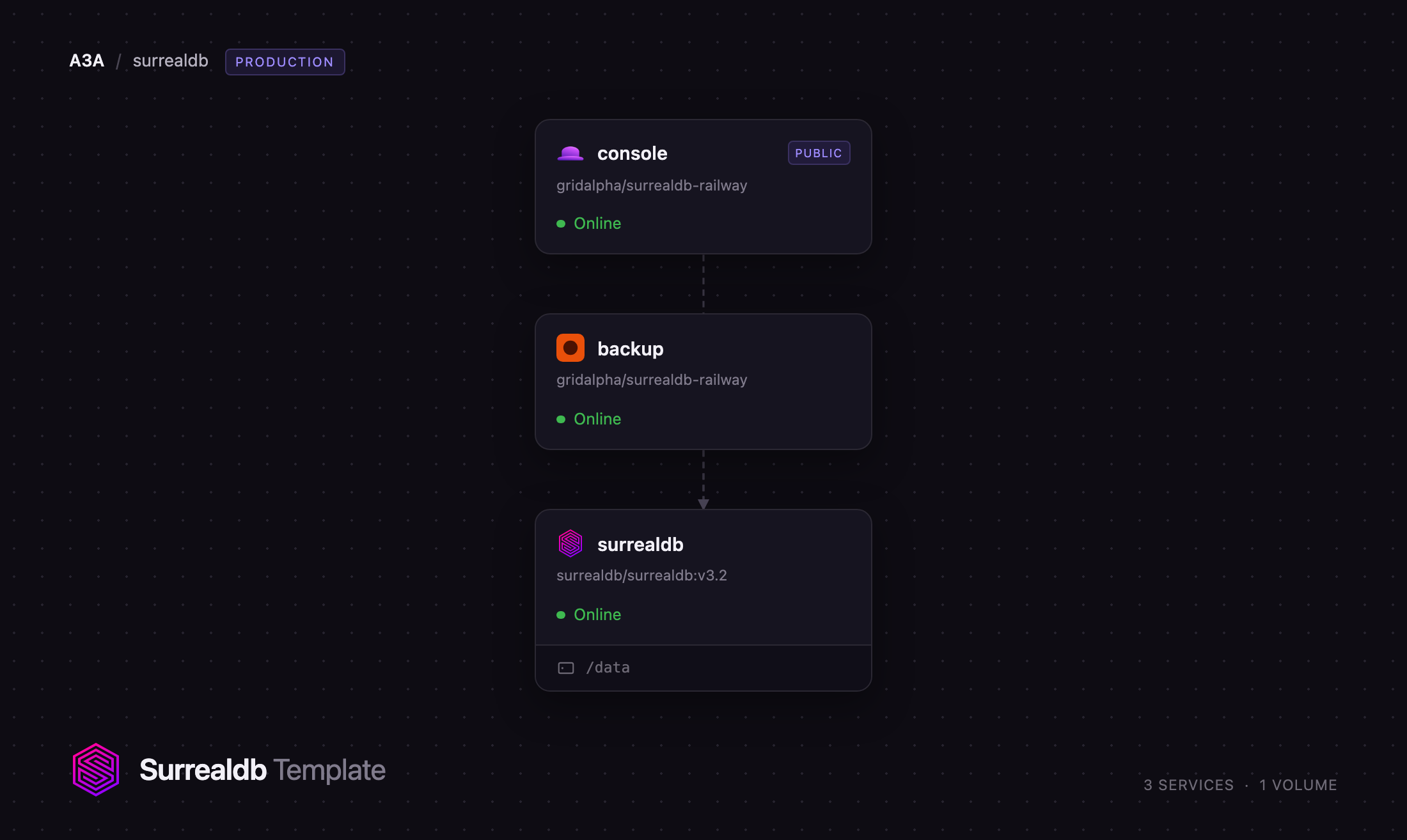
Getting Started with SurrealDB on Railway
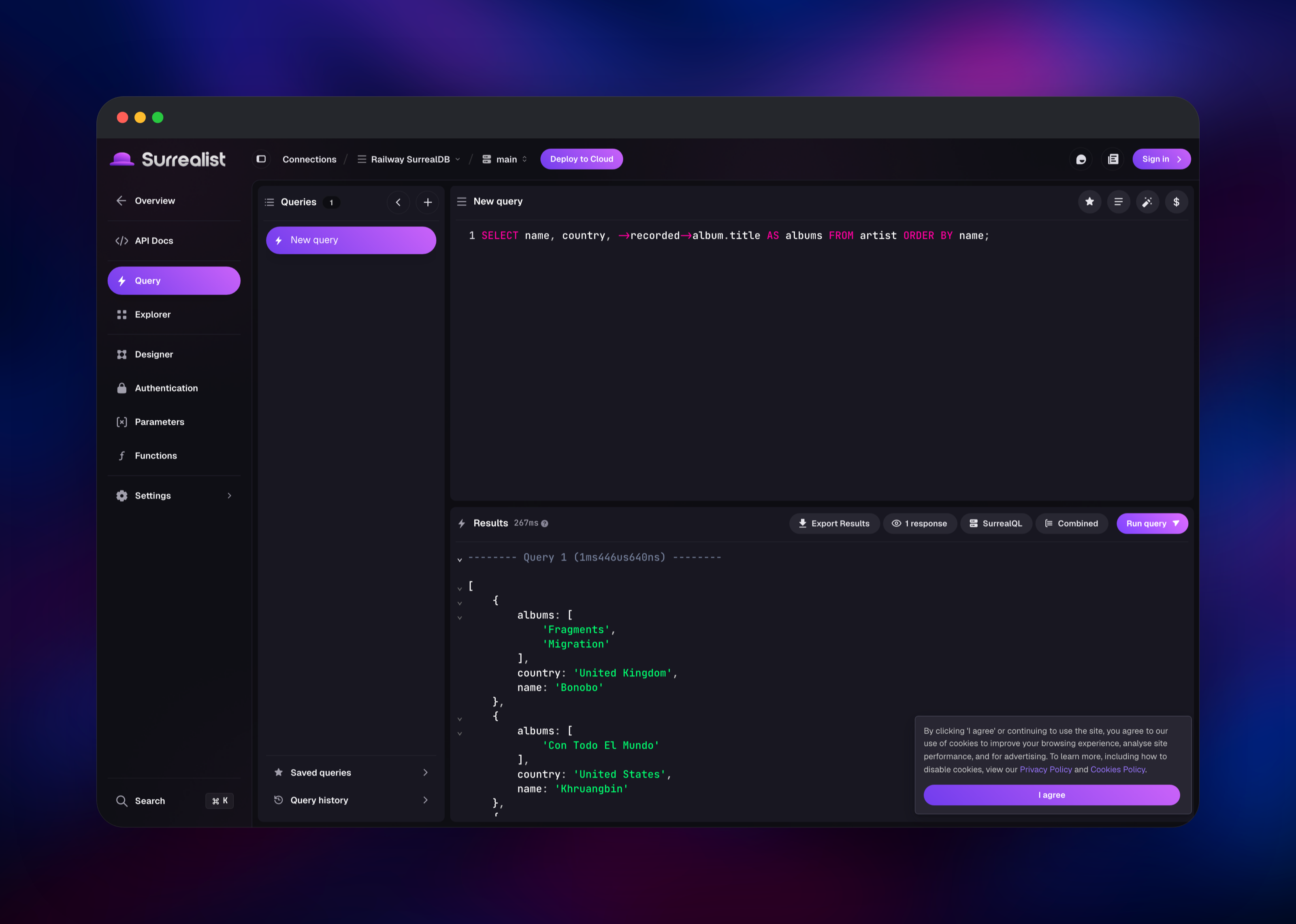
Open the public URL of the console service and Surrealist loads. There is no account to create — it is a client, and the database's root credentials are the only login. Click Create connection, leave the protocol on WSS, and enter your Railway domain as the remote address, with no https:// prefix and no port. Under Authentication, keep the Root tab and enter the SURREAL_USER and SURREAL_PASS values from the surrealdb service. Save it, and Surrealist opens on the main namespace and database the server creates on first boot.
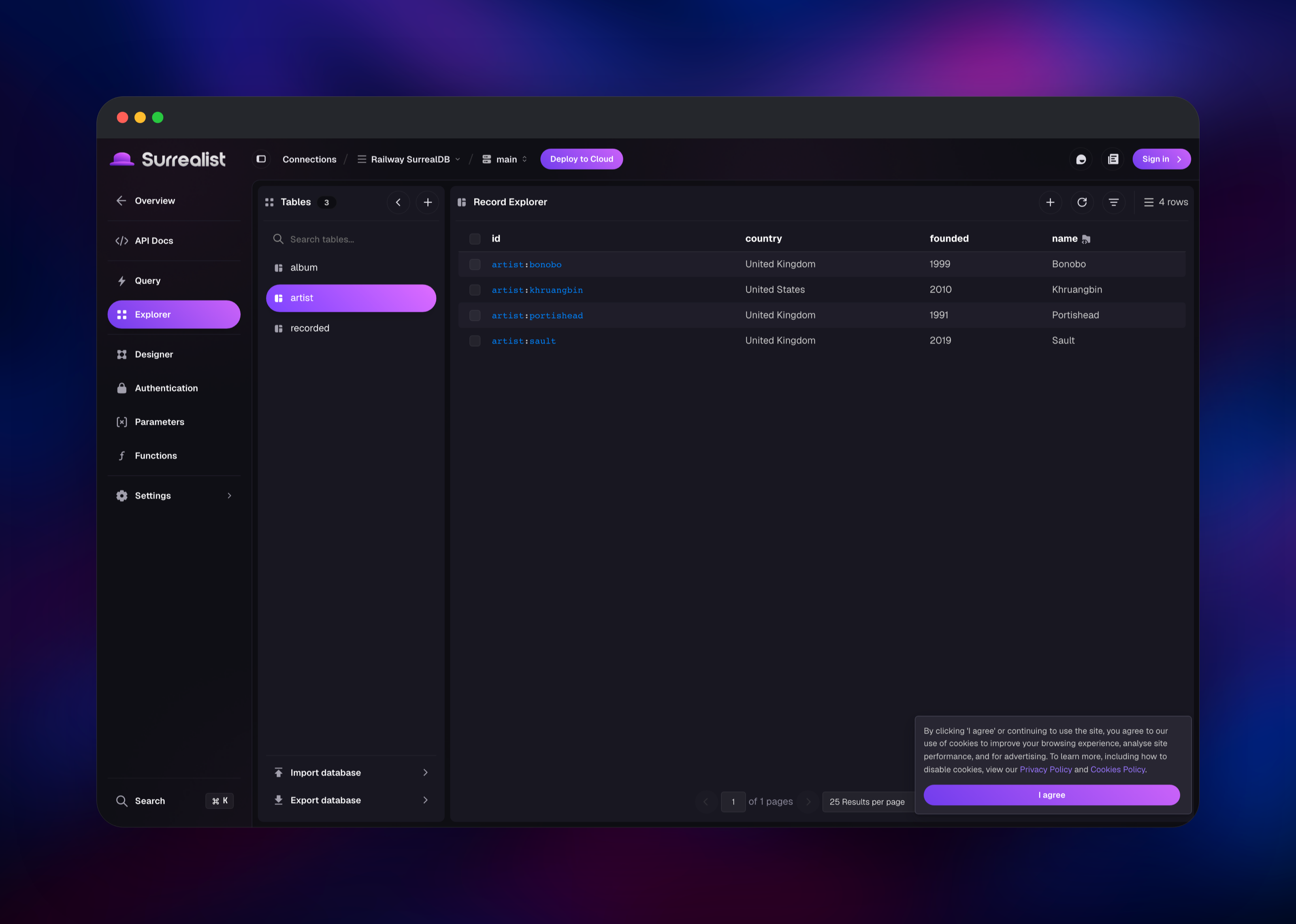
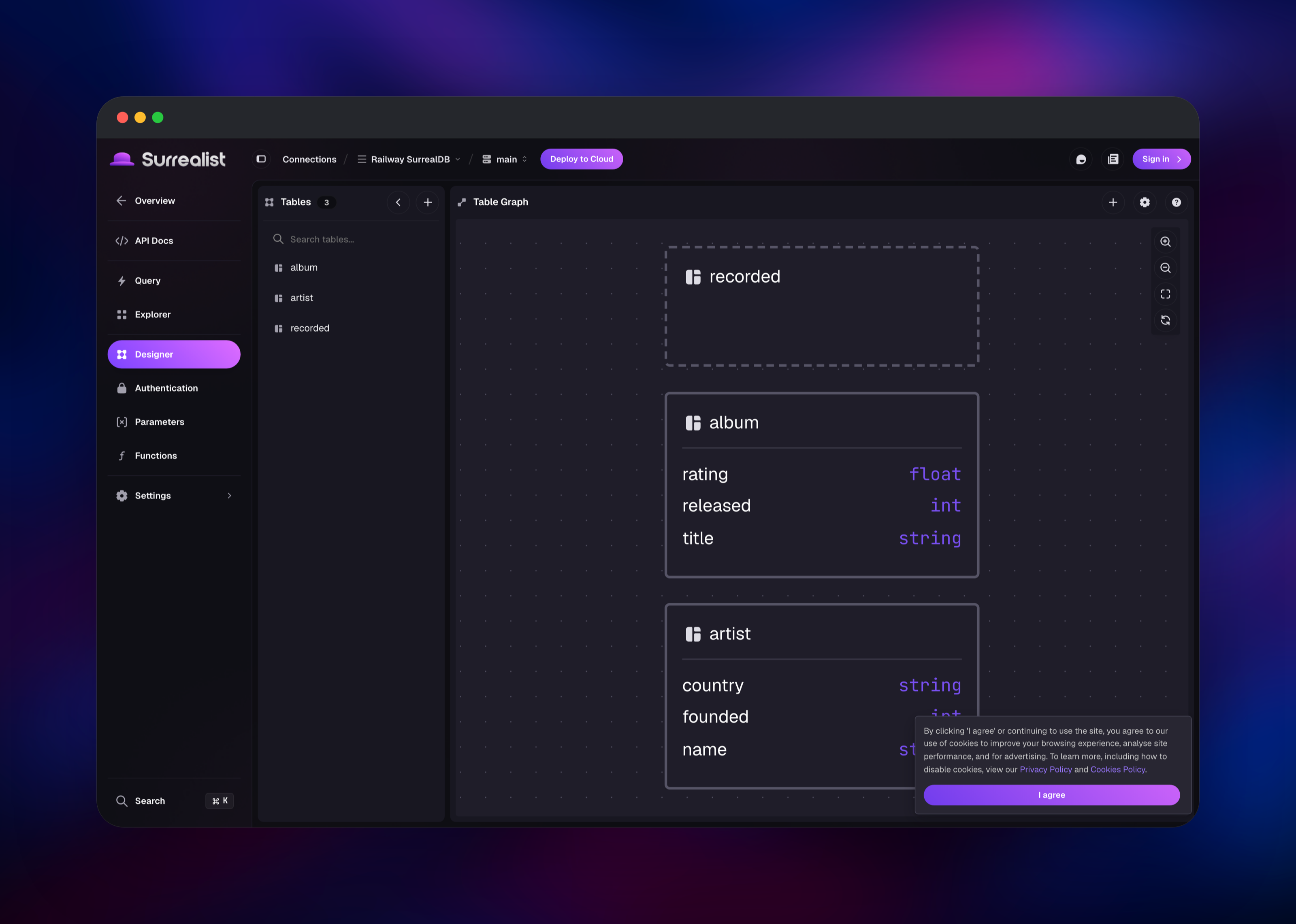
The Query view runs SurrealQL. A good first check is CREATE artist SET name = 'Bonobo'; then SELECT * FROM artist; — if the record comes back, the database, the volume and the proxy all work. Explorer browses records without a query, Designer draws the schema and its graph edges, and Authentication is where you define scoped users instead of giving applications root. Your application connects to the same host: wss:///rpc for the WebSocket SDKs, or https:///sql for plain HTTP. Services inside the project use http://surrealdb.railway.internal:8000.
About Hosting SurrealDB
SurrealDB is built to be the whole data layer of an application. It answers a problem most teams meet in a product's second year: the relational schema is fine, but half the interesting questions are about relationships, and answering them means joining across three systems. Self-host it when you want that consolidation under your own control, when queries are graph-shaped, or when permissions belong in the database rather than in every service that talks to it.
- SurrealQL: SQL-like, with graph traversal, nested records and computed fields
- Document, graph, vector, geospatial, full-text and time-series data in one engine
- Row-level permissions and record access rules defined in the schema itself
- Live queries that push changes to connected clients over WebSocket
- Official SDKs for Rust, JavaScript, Python, Go, Java and .NET
The architecture keeps the roles separate. The database is private, so nothing reaches it but the console and your own services. The console is the only public surface, and because it proxies the database's routes on its own origin, browser clients need no CORS configuration. The backup worker holds no state: it reads through the API and writes elsewhere, which is what makes it useful when a volume is lost.
Why Deploy SurrealDB on Railway
Railway removes the parts of running a database that are not the database.
- The volume, the private network and TLS are provisioned for you
- One public origin serves the console and your application's API endpoint
- Object storage for backups sits in the same project
- Vertical scaling is a slider, not a migration
- Deploys, logs and metrics live beside the rest of your stack
Common Use Cases
- Application backends where users, permissions and relationships live in one store rather than a database plus a separate auth service
- Recommendation and knowledge-graph features, where
->edge->traversals replace recursive CTEs or a second graph database - Real-time dashboards and collaborative tools driven by live queries over WebSocket
- Retrieval features keeping documents, embeddings and relationships together instead of in a vector store beside a database
Dependencies for SurrealDB
surrealdb/surrealdb:v3.2— the database server, official imagecaddy:2-alpinewithsurrealdb/surrealist— the console, built from gridalpha/surrealdb-railwayalpine:3.22— the backup worker, same repository- A volume mounted at
/dataand one object storage bucket
Environment Variables Reference
| Variable | Service | Purpose |
|---|---|---|
SURREAL_USER / SURREAL_PASS | surrealdb | Root credentials, created on first boot and kept in storage |
SURREAL_PATH | surrealdb | Storage backend and location, rocksdb:/data/surreal.db |
SURREAL_BIND | surrealdb | Listen address, [::]:8000 so private clients reach it |
SURREAL_UPSTREAM | console | Host and port of the database the console proxies |
BACKUP_INTERVAL_SECONDS | backup | Seconds between backup cycles, default one day |
BACKUP_RETENTION | backup | Dumps kept per database before the oldest is deleted |
Deployment Dependencies
- Source and docs: surrealdb/surrealdb, surrealdb.com/docs
- Console: surrealdb/surrealist
- Image: surrealdb/surrealdb on Docker Hub
Hardware Requirements for Self-Hosting SurrealDB
| Resource | Minimum | Recommended |
|---|---|---|
| CPU | 1 vCPU | 2–4 vCPU |
| RAM | 512 MB | 2–4 GB |
| Storage | 1 GB volume | 10 GB+, sized to your dataset |
| Runtime | Linux container | Linux container |
RocksDB sizes its block cache from the memory the container is allowed, so more RAM directly increases how much of the working set stays hot.
Self-Hosting SurrealDB
The server is a single binary with no configuration file: everything is an environment variable or an argument. This runs a persistent instance with Docker:
docker run --rm -p 8000:8000 -v surreal:/data \
  -e SURREAL_USER=root -e SURREAL_PASS=change-me \
  surrealdb/surrealdb:v3.2 start rocksdb:/data/surreal.db
Any HTTP client can then query it. This is a shell example using curl:
curl -u root:change-me \
  -H 'surreal-ns: main' -H 'surreal-db: main' \
  -H 'Accept: application/json' \
  --data 'CREATE artist SET name = "Bonobo";' \
  http://localhost:8000/sql
To restore a dump, pipe it into the /import route with the target namespace and database in the headers. Objects are keyed surrealdb///.surql.gz.
How Much Does SurrealDB Cost to Self-Host?
The server is free. SurrealDB ships under the Business Source License 1.1, which permits any use except offering it to third parties as a database service, and converts to Apache 2.0 on 1 January 2030 — building a product on it is inside the grant. A paid SurrealDB Cloud and an Enterprise edition for clusters exist, but neither is needed here. On Railway you pay only for the compute, volume and object storage these services use.
FAQ
What is SurrealDB? A multi-model database written in Rust that stores documents, graphs, vectors and time-series data behind one query language, SurrealQL, over HTTP and WebSocket.
What does this Railway template deploy? Three services: the SurrealDB server with a persistent volume, the Surrealist console on a public URL that also proxies the database API, and a worker backing up every database to object storage.
Why does the template include an object storage bucket? A volume attaches to one service and lives beside the data it holds, so it cannot protect you from losing that service. The backup worker exports through the API and writes the dumps elsewhere.
How do I connect my application to self-hosted SurrealDB?
Inside the project, point the SDK at http://surrealdb.railway.internal:8000. From outside, use wss:///rpc or https:///sql on the console's domain, with root or a scoped user.
Is the database reachable without a password? No. Guest access is denied, so unauthenticated queries are rejected with HTTP 403 and a wrong password with 401. Define scoped users under Authentication and keep root for administration.
Can I run SurrealDB as a multi-node cluster on Railway? Not in this shape. SurrealDB documents self-hosted clustering as an Enterprise feature running on Kubernetes; the single-node RocksDB deployment here is what its own docs recommend for self-hosted production.
Template Content